ALLPCB


Overview
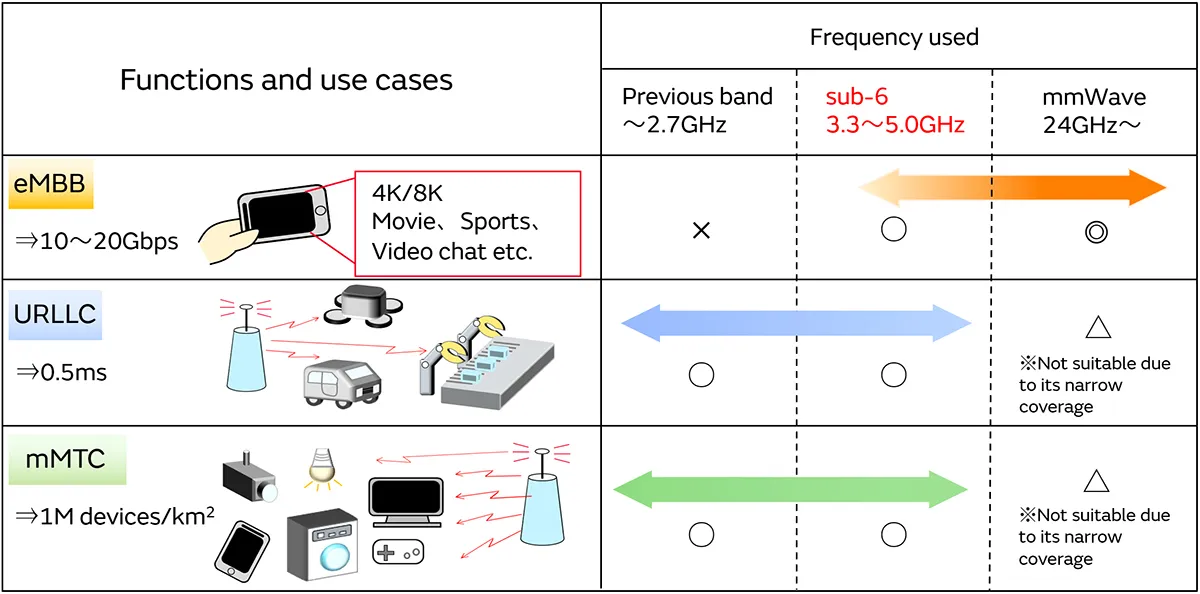
In 5G communication, beyond current use cases of high speed and large capacity, functions such as low latency, high reliability, and massive connectivity are expected to expand applications. The Sub-6 bands n77 to n79 (3.3 to 5.0 GHz) are important for delivering these functions, but under certain conditions transmission performance degradation has been observed. This article describes the observed issues and practical countermeasures.
Sub-6 Usage and the Issue
Sub-6 3.3 to 5.0 GHz (bands n77 to n79) are important frequency ranges for 5G functionality.
When devices such as mobile routers and CPE communicate with a base station on 5G band n79 while simultaneously operating Wi-Fi in the 5 GHz band with a user equipment, 5G communication speed can degrade and block error rate increases have been observed.
Noise Interference Paths
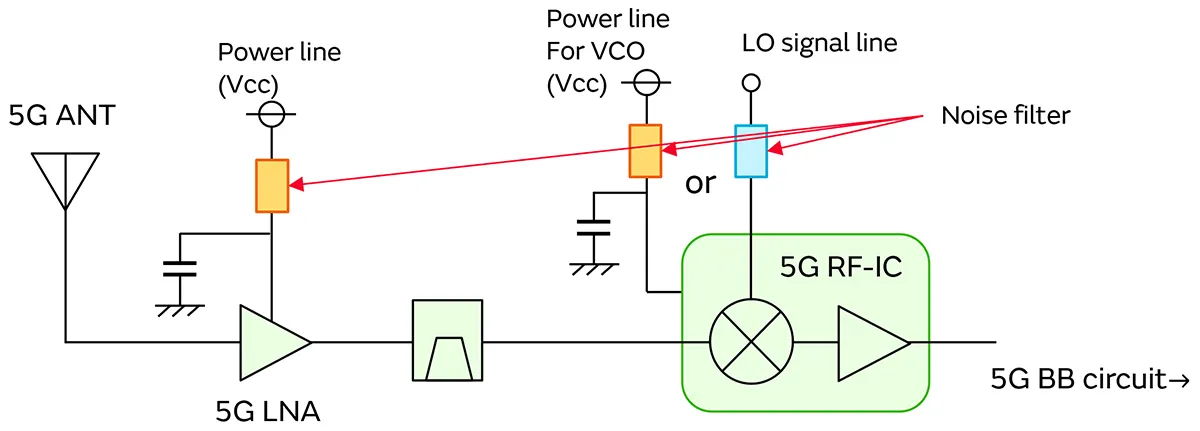
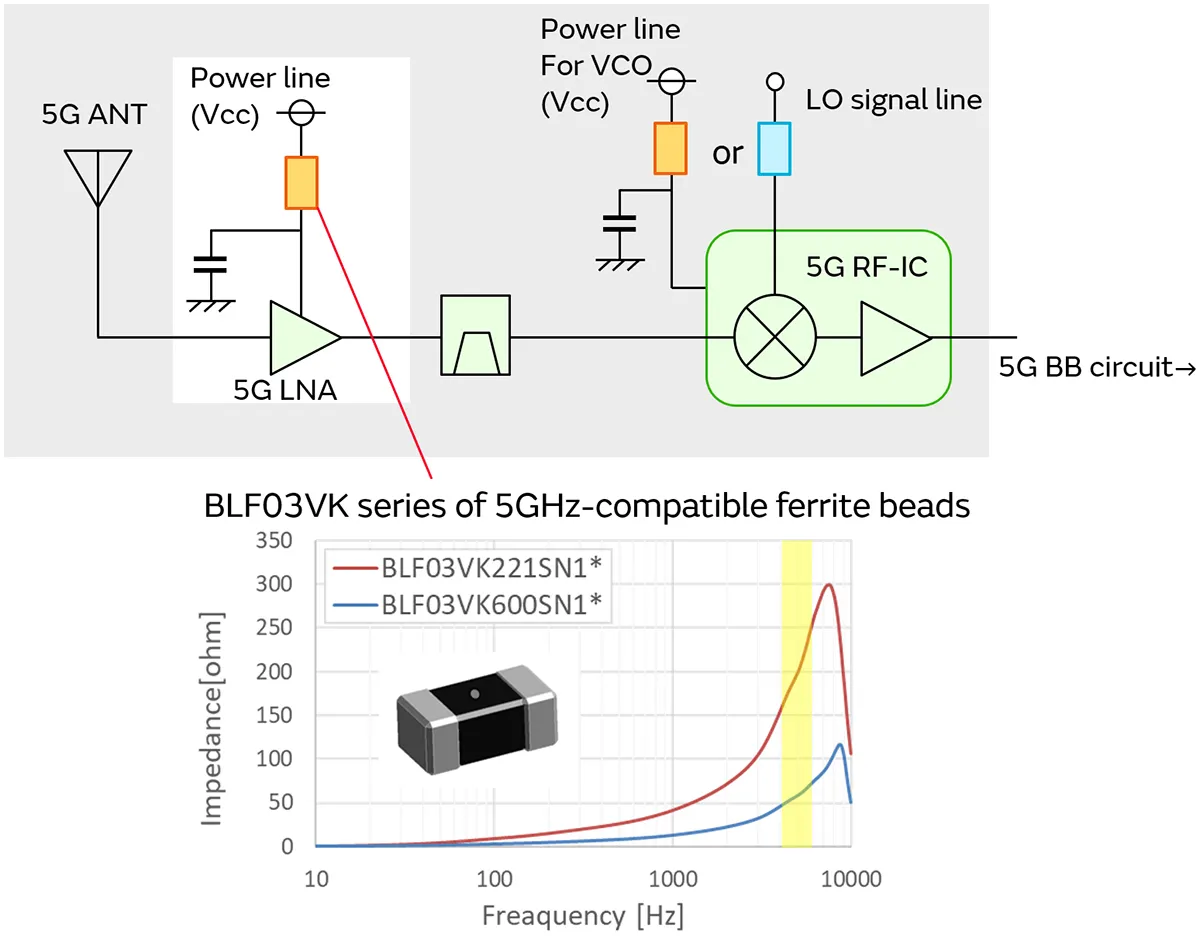
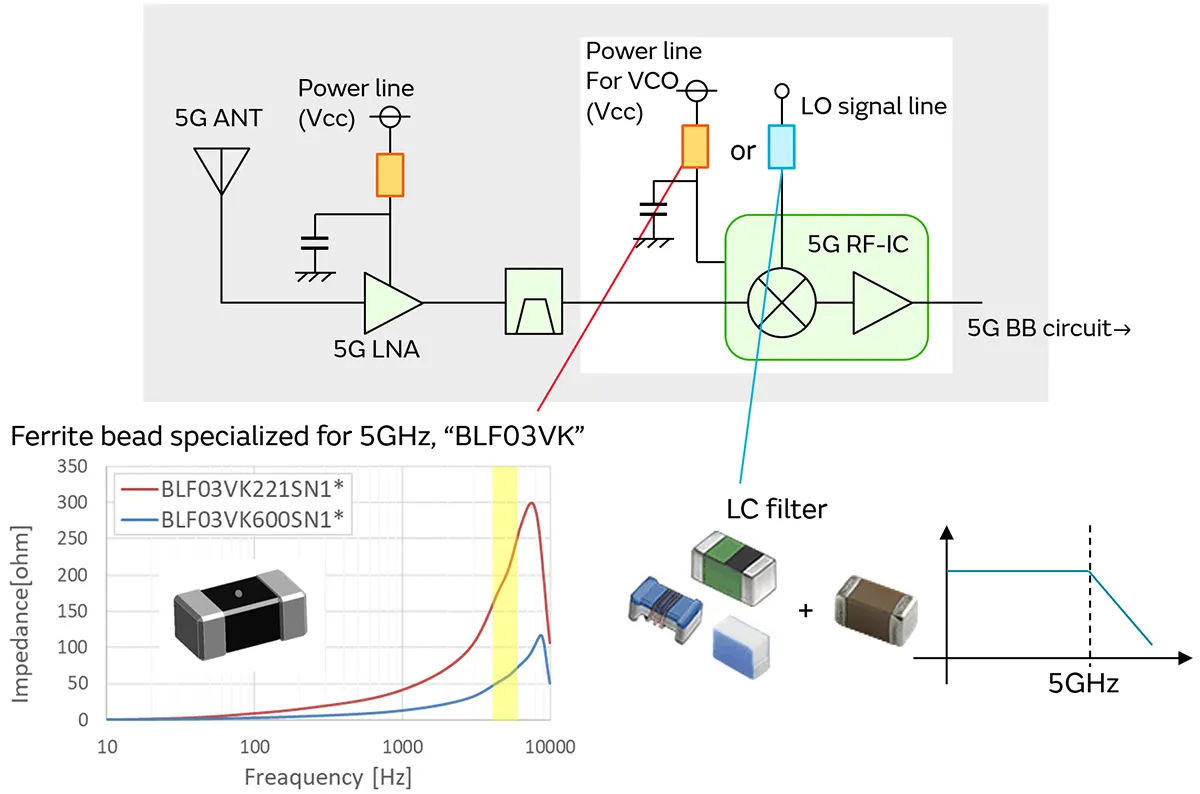
Interference occurs when the Wi-Fi 5 GHz signal couples into the device internal 5G RF circuitry. Entry paths include LNA power lines and RF-IC LO signal lines or the power lines that supply LO generation circuits.
Key Countermeasure
Inserting filters at the LNA or RF-IC inputs to suppress noise ingress is an effective countermeasure.
LNA Power-Line Countermeasures
Insert ferrite beads on the LNA supply line (Vcc). To suppress Wi-Fi 5 GHz band signals effectively, use ferrite beads designed to attenuate noise in the 5 GHz range, for example the BLF03VK series optimized for that band.
RF-IC Countermeasures
When the LO is supplied externally to the RF-IC, the LO input must be free of superposed Wi-Fi 5 GHz components. An LC low-pass filter that attenuates signals above 5 GHz is required. If the LO is generated inside the RF-IC, the power supply is a potential ingress path; similarly, inserting a ferrite bead on the LO power supply tuned for the 5 GHz range is effective.
Summary of Interference Countermeasures
Increased error rates in 5G communication were caused by simultaneous operation of Wi-Fi in the 5 GHz band. Within the device, Wi-Fi 5 GHz signals couple into the 5G RF paths via the LNA supply and RF-IC signal or supply lines. Inserting noise filters at the LNA and RF-IC input paths is effective at mitigating this interference.
Measurement Setup to Identify Noise
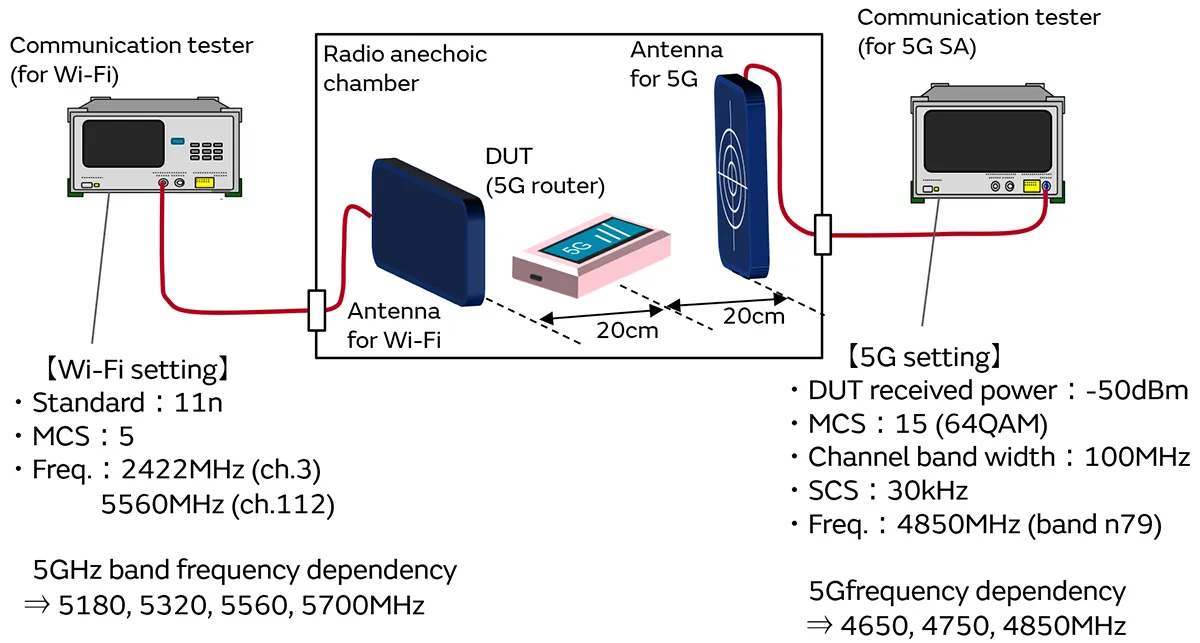
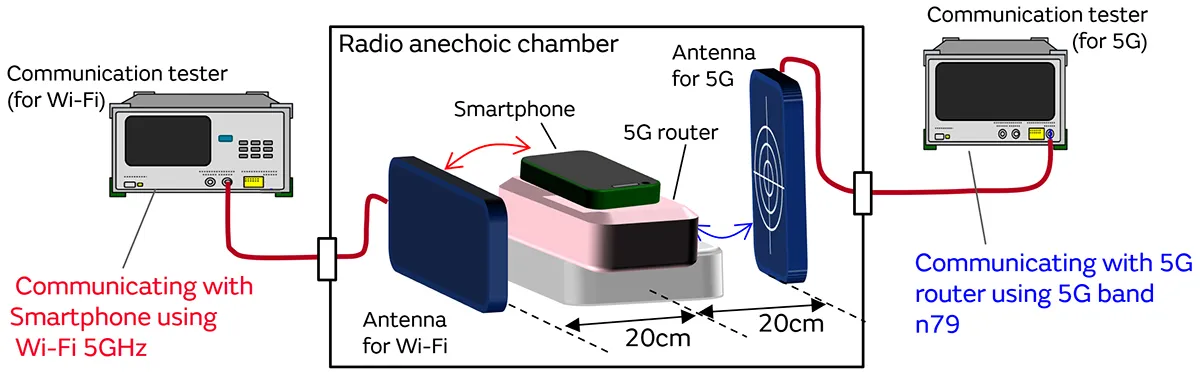
The block error rate for 5G was measured with a communication tester acting as the 5G base station and a Wi-Fi client operating on the 5 GHz band. This created a DUT scenario where 5G and Wi-Fi 5 GHz were active simultaneously.
Measurement Results
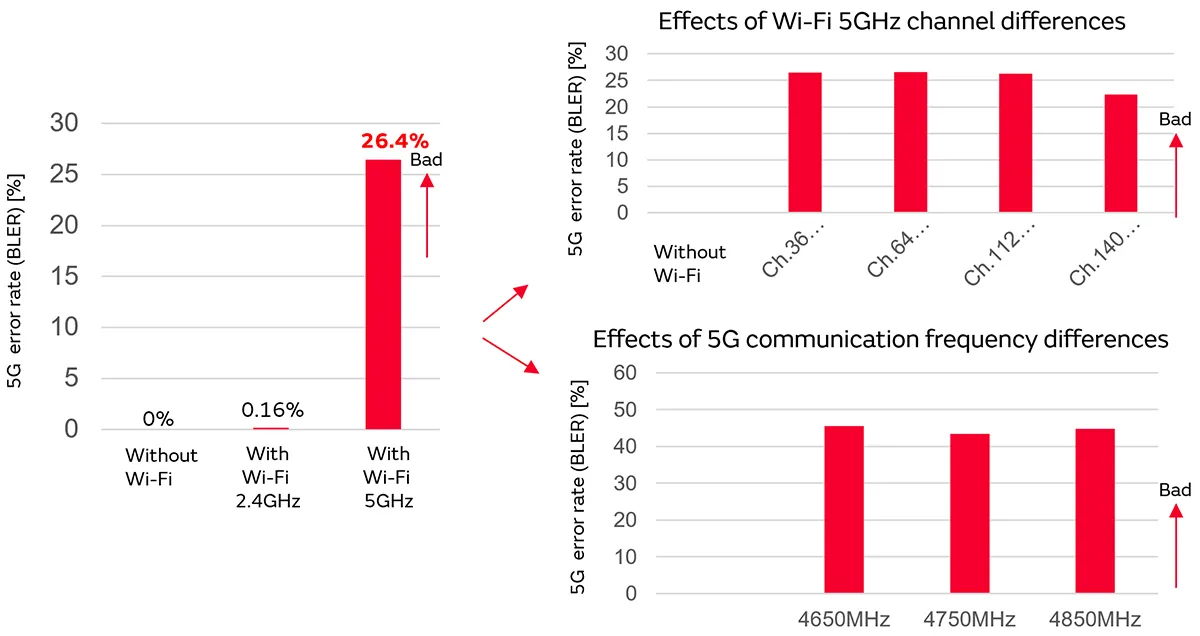
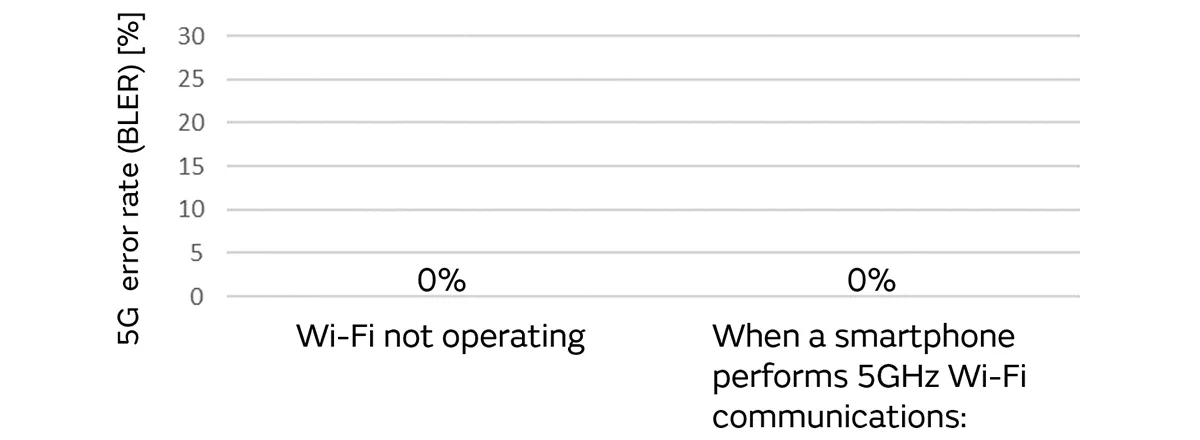
When Wi-Fi in the 5 GHz band was active, BLER on 5G band n79 worsened. The issue occurred irrespective of the specific Wi-Fi or 5G channel used.
Noise Observation During Wi-Fi Activity
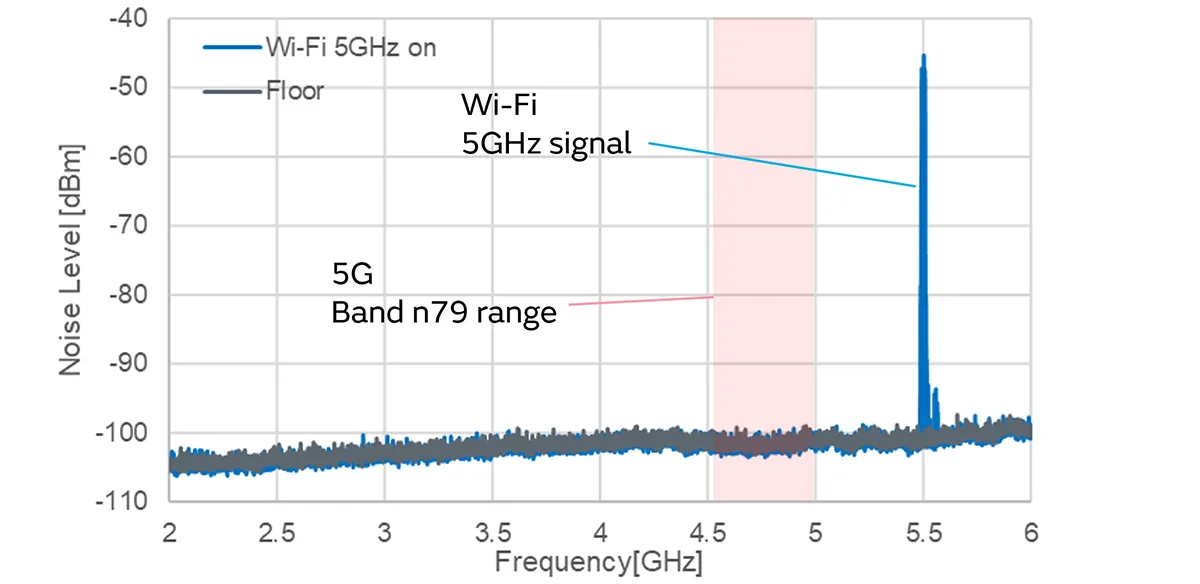
Noise generated when the Wi-Fi 5 GHz band was active was observed. When noise from the Wi-Fi module or antenna combined with the 5G RF circuitry inside the terminal, the spectrum at the RF path showed the interfering components.
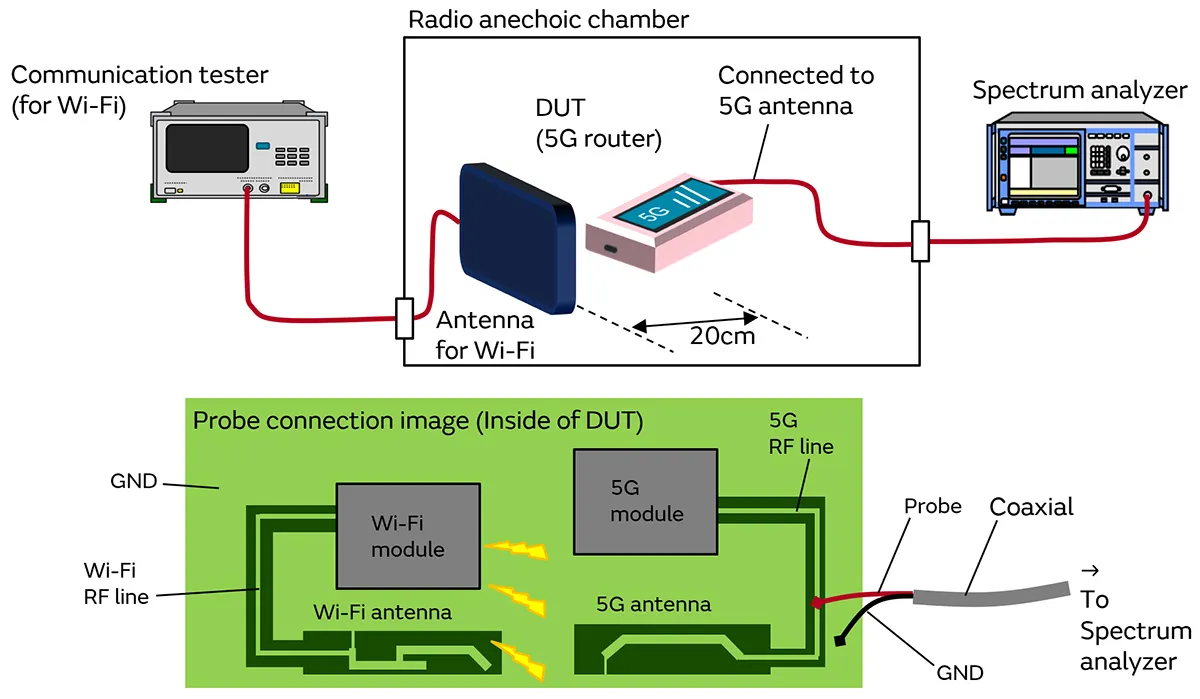
Measurement indicated no noise outside the Wi-Fi 5 GHz band, implying that the noise did not couple through the antenna. In other words, the Wi-Fi 5 GHz signal leaked internally via supply or signal lines.
Confirming the Noise Source
To verify whether external Wi-Fi signals were causing the BLER increase, measurements were taken with a Wi-Fi device placed near the DUT. No BLER increase was observed when the Wi-Fi device was placed nearby, which confirms the interference was not due to external radiation but internal leakage from the device Wi-Fi circuitry.
Conclusions
- Observed issue: BLER of 5G band n79 increases when Wi-Fi operates in the 5 GHz band.
- This issue was not observed with Wi-Fi operating in the 2.4 GHz band.
- Measurements showed no noise outside the Wi-Fi 5 GHz band and no BLER increase from external 5 GHz signals, indicating internal coupling as the cause.
- Mitigation: Use filters and ferrite beads tuned for 5 GHz on LNA and RF-IC supply and LO paths. Components such as the BLF03VK series ferrite beads can address the specific 5 GHz noise problem.