ALLPCB


Overview
Gesture detection and recognition is a growing market driven by technology advances and expanding applications, particularly in the IoT sector. Notable markets for gesture recognition include gaming, healthcare, automation, automotive infotainment, and portable consumer electronics such as wearables.
Non-contact gesture control has entered automotive infotainment systems and the same sensing techniques are increasingly used in wearable designs. The simplest gesture-sensing circuits can include an IR LED, an IR photodiode, an ambient light sensor, and a proximity sensor. To shorten development time, higher-integration devices, subsystems, and modules that combine multiple optical sensors and control circuitry are becoming more common.
ams TMG4903 Optical Sensing Module
This article examines a recently introduced solution: the ams TMG4903 optical sensing module. The related evaluation board TMG4903 EVM-ND helps designers integrate gesture recognition efficiently into next-generation products, reducing development effort and BOM cost compared with discrete implementations.
For designers and hobbyists who want a lower-cost starting point for exploring gesture recognition, the SparkFun SEN12787 breakout based on the Avago APDS9960 offers a simple option.
Market Outlook
Market research projected that the global gesture recognition market would grow substantially through 2020. Demand is driven by the need for simple, intuitive interfaces to control the expanding functionality of handheld and wearable devices such as smartphones, health monitors, and fitness gadgets. Improvements in sensor technology and control circuitry have enabled exploration of new human-machine interfaces. Further growth is expected from innovations in 3D vision, eye tracking, and machine control.
Interpreting gesture data with mathematical algorithms allows devices to communicate in more natural ways. In wearables, gesture sensing can reduce or replace physical buttons, using body movements, hand motions, or facial expressions to convey commands.
Design Challenges
Wearable devices require compact, robust, and extremely low-power sensors and control electronics to preserve battery life. Recent improvements in accuracy, speed, and design simplicity have expanded the viability of wearables for medical and broader consumer applications. Gesture recognition is increasingly viewed as a differentiating feature for next-generation products.
Design can be challenging. Wearables operate in environments with strong ambient light, including sunlight, which can include IR content. Sensor apertures can be contaminated by sweat, dust, or dirt. Highly sensitive photodiodes are needed to reliably distinguish background IR from IR reflected by an LED, so advanced analog semiconductor techniques are required.
Gesture systems typically wake periodically to scan for gestures. To minimize battery drain, devices need effective power-down and sleep modes as well as low-power wake-up mechanisms, ideally without operating the IR LED continuously.
Once suitable hardware is available, application software must interpret raw IR measurements. Software must compute hand movement speed and direction, estimate hand-to-device distance, separate ambient light from LED reflections, and translate motion into distinct gestures. System performance depends heavily on both the application software and the sensor hardware.
Wearable manufacturers increasingly prefer off-the-shelf integrated sensor systems rather than discrete sensors and processing components. An integrated approach can save design effort and provide predictable optical crosstalk, more reliable calibration of power variability, optimized combinations of IR LED, photodiodes, and drivers, and tighter physical tolerances for the module.
Module vs Discrete Implementation
The ams TMG4903 is a highly integrated optical sensing module that includes an IR LED with an advanced LED driver, an ambient light sensor, and a color diode array. A UV/IR blocking filter and parallel ADCs produce 16-bit results, while an IR beam pattern generator includes RAM and dedicated control logic. At its core is a gesture and proximity engine that enables true 3D gesture recognition in addition to simple 2D directional gestures. The module supports features such as remote control, barcode simulation, RGB color sensing, proximity detection, and 3D gesture detection.
To meet small size and low-power requirements, the module is packaged in a multi-module package measuring 2 x 5 x 1 mm. Supply voltage ranges from 1.7 to 2.0 V. Typical active current is 150 μA (max 200 μA), idle is 30 μA (max 60 μA), and sleep is 0.4 μA (max 5 μA).
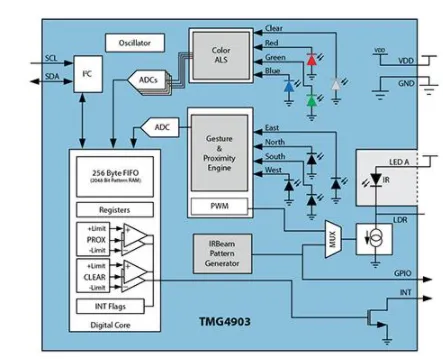
The module automatically adjusts IR LED timing and output power for 3D gesture recognition and proximity sensing to minimize noise and power while optimizing sensitivity and dynamic range. It suppresses ambient light noise and uses automatic calibration to remove electrical noise and optical crosstalk. The integrated LED driver offloads gesture processing from the host and reduces host processing requirements.
Getting Started: Evaluation Board
The TMG4903 EVM evaluation module includes a main controller board hosting the gesture device and a PIC microcontroller with a USB 2.0 interface and cable. The evaluation software lets designers configure and log key features such as ambient light sensing, proximity sensing, and gesture recognition. A user guide covers parameters such as pulse length, number of pulses per cycle, and gesture cycle frequency.
In operation, raw gesture data is captured by four directional photodiodes and displayed on a 3D grid along with Z data from the proximity sensor. Detection can identify directional gestures as well as longer gestures, such as simulated button presses.
Low-Cost Entry Option
For low-cost experimentation, the SparkFun SEN12787 RGB and gesture sensor breakout provides an environment for ambient light and color measurement, proximity detection, and non-contact gesture sensing. It is based on the Avago APDS9960, an integrated module with filters, diodes, and an I2C interface.
The APDS9960 device measures 3.94 x 2.36 x 1.35 mm and includes an IR LED with a factory-calibrated LED driver. Gesture and proximity detection use four directional photodiodes and ambient light sensor data. Engine features include automatic activation, ambient light subtraction, and crosstalk cancellation. Adjustable IR LED timing minimizes power and noise. Recommended supply voltage is 2.4 to 3.6 V. At 3 V, current ranges are approximately 1 μA (sleep), 38 μA (standby), 200 μA (active), and up to 790 μA during gesture and proximity pulses.
The breakout exposes pins for VL (optional IR LED supply), GND, VCC, SDA (I2C data), SCL (I2C clock), and INT (interrupt). The module can be used to demonstrate gesture recognition for microcontroller-based devices, computers, or robots.
Conclusion
Non-contact gesture sensing and recognition is a growing market with rapidly evolving solutions. Gesture sensing is likely to become a common HMI feature in small battery-powered portable and wearable devices, enabling smaller form factors and lower power operation while providing intuitive control.
Design remains challenging due to ambient light, contamination, and power constraints. This article reviewed two approaches that help engineers: the highly integrated, high-performance ams TMG4903 module and a lower-cost SparkFun APDS9960-based breakout for initial experimentation.