ALLPCB


Overall approach for enabling 5G on 900 MHz
Following competitors' 700 MHz deployment pace, enable 5G on 900 MHz outside areas shared with 700 MHz, ensuring 5G network breadth and shallow indoor coverage comparable to industry levels.
Activation areas
Except for regions shared with 700 MHz, upgrade sites wherever feasible.
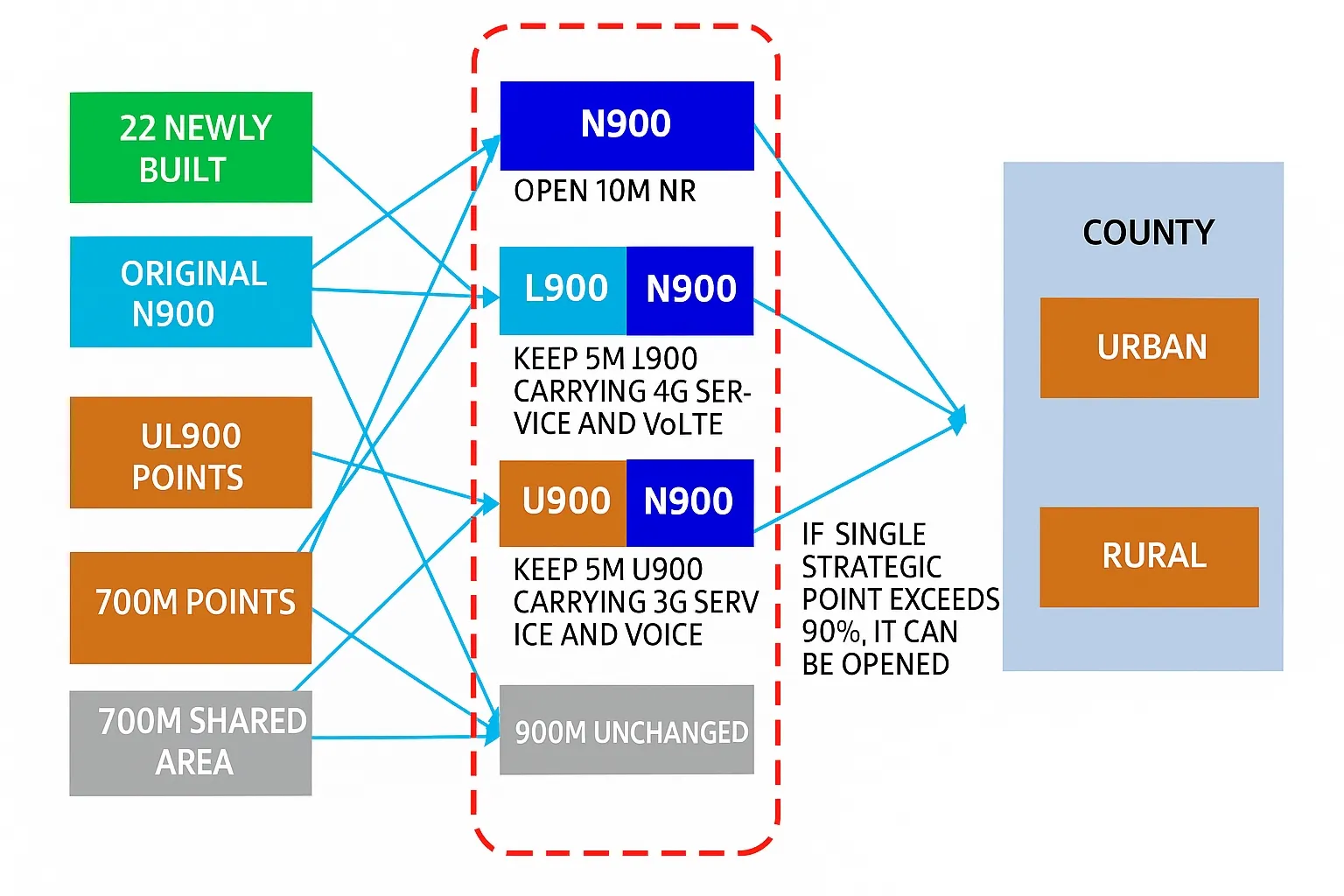
Contiguous areas
Generally organized by district or county. Where the environment is independent and interference is controllable, 5G may be activated in local zones. Considering 4G and 3G service conditions and differentiating urban and rural scenarios, proceed with activation when at least 90% of cells meet the activation criteria. The following describes the planning scheme for the 900 MHz target network.
Frequency strategy
Within each activation area maintain a unified frequency policy. Considering combined traffic load and voice protection, initially adopt L5+N5 or U5+N5 modes, and progressively evolve to 10 MHz NR. For future frequency evolution, use the 900 MHz band in the order: NB (if needed) + LTE/UMTS + NR, with uplink 904-915 MHz and downlink 949-960 MHz.
Service assurance
Prioritize user experience. Ensure data services are carryable and voice services are protected. Choose activation strategies based on site frequency resources and traffic load. Prefer to offload data traffic to mid bands; for areas where offload is not possible or voice protection is required, retain at least a 5 MHz L900 or U900 baseline.
900 MHz base station hardware upgrade plan
- New sites built in 2022 (170,000 sites): 900 MHz base station hardware already supports 5G; upgrading to NR only requires adding a 5G carrier software package.
- Existing network 2T4R/2T2R sites that can be upgraded to NR: require adding a 5G BBU and a 5G carrier software package.
- Huawei, Ericsson, Nokia BBU hardware solution: reuse existing 4G BBU chassis, add 4/5G dual-mode controller board and baseband board.
- ZTE BBU hardware solution: replace with the new V9200 platform; add BBU chassis, 4/5G dual-mode controller board and baseband board.
Transmission
The transport solution is consistent between 2022-built 4T4R sites and existing 2T4R/2T2R 900 MHz sites.
Metropolitan area network
The smart metropolitan area network solution follows the same design as newly built 2.1 GHz NR deployments.
IPRAN
The IPRAN solution is consistent with the previously issued scheme.
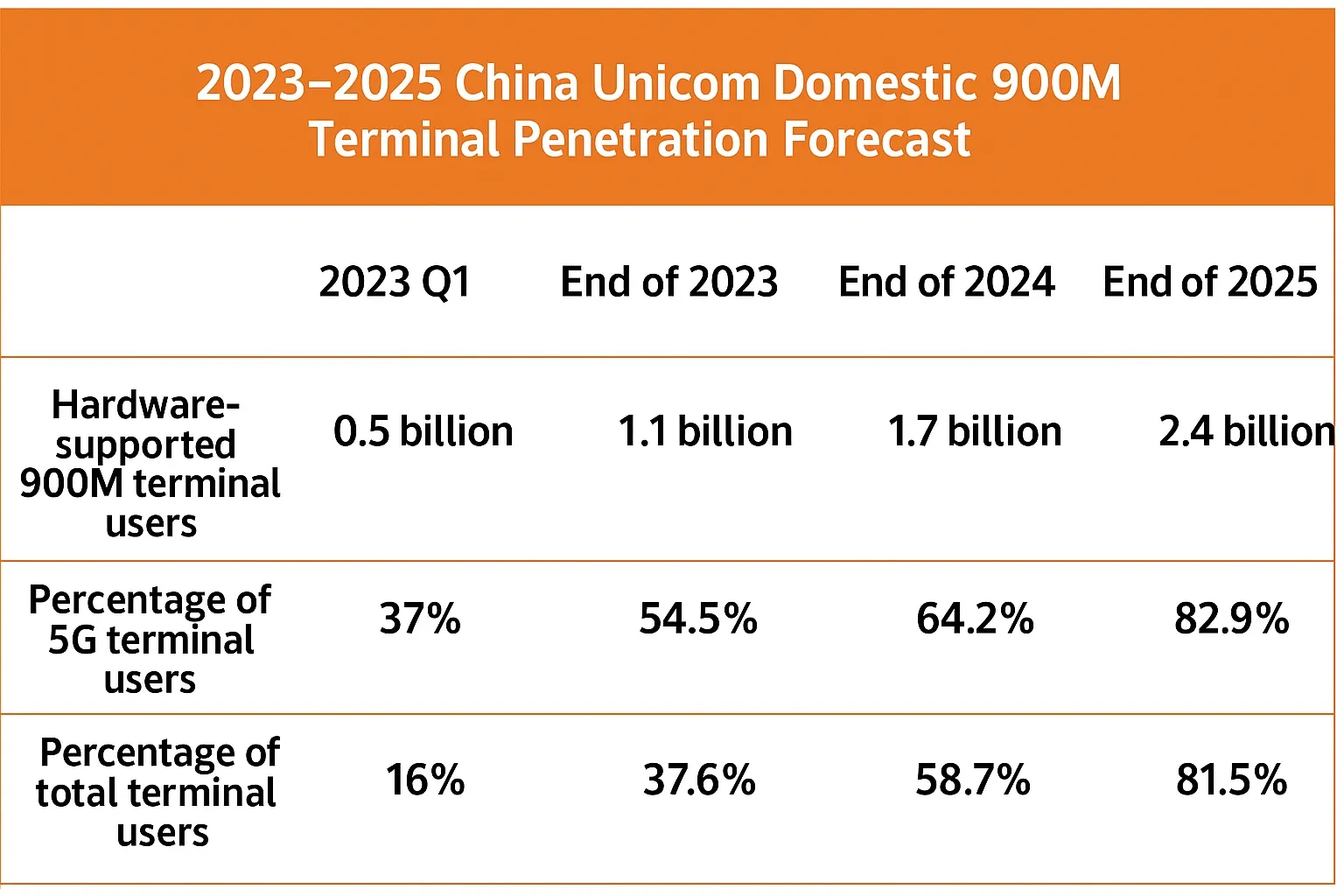
900 MHz terminal industry progress - penetration forecast
Based on the official licensing timing for 900 MHz, and assuming terminal-network compatibility testing, large-scale field testing, and vendor software pushes proceed as planned, group headquarters estimated the penetration pace of 900 MHz-capable terminals in the existing network.