ALLPCB


Overview
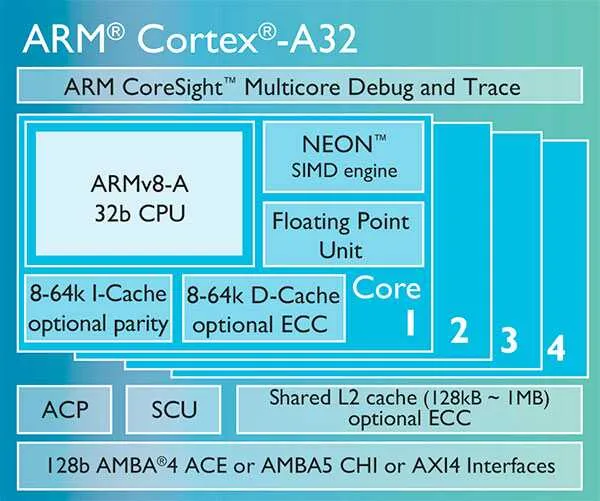
At first glance, resource-rich MCUs and small battery-powered wearable applications seem at odds. ARM's Cortex-A32 aims to resolve that tension by combining processor architecture and process technology to deliver a 32-bit core with about 25% efficiency improvement in silicon as small as 0.25 mm2. The Cortex-A32 is based on the ARMv8-A architecture and represents an evolutionary path from architectures commonly used in 32-bit application processors such as the A5 and A7. Compared with the A7, the A32 can deliver lower power and adds more resources for 32-bit applications. The A32 architecture includes more than 100 additional 32-bit instructions, with enhancements for media performance, software cryptography, and floating-point computation.
Scalability and Power
The A32 is designed for scalability to meet a range of application needs. At the high end, quad-core devices can run at GHz clock speeds with power per core below 75 mW. In a minimal configuration, a 100 MHz single-core A32 with an AMBA interface and 8 KB instruction and data caches per core consumes less than 4 mW.
Fit for Industrial and Wearable IoT
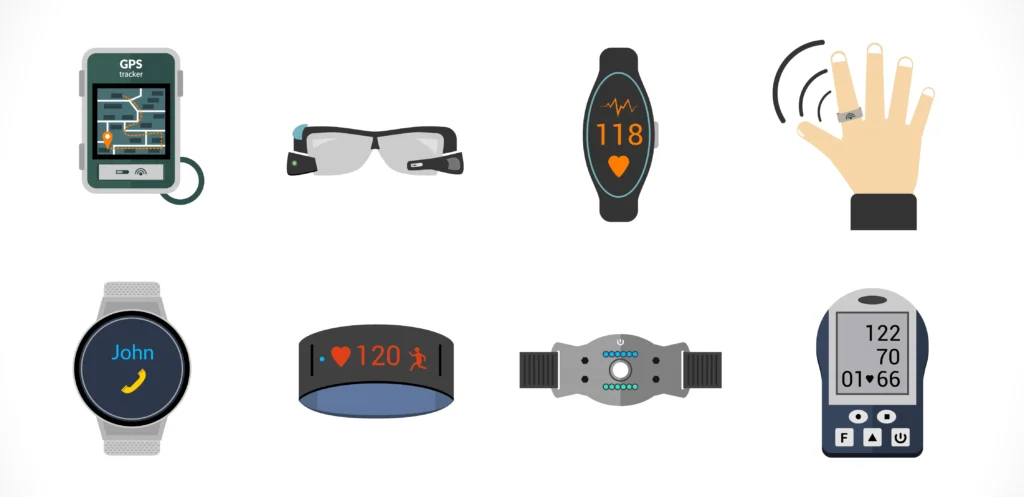
The A32 can provide the performance required by industrial applications such as gateways, robots, and edge devices that perform local data analysis and control. The combination of richer resources and low power also makes the A32 suitable for constrained wearable IoT designs. Smartwatches, health monitors, and similar devices must be highly energy efficient to minimize user frustration from frequent charging or battery replacement. They also require complex graphics interfaces, robust operating systems, and significant sensor-processing capabilities to deliver the expected features and user experience. The A32 is intended to meet these seemingly conflicting requirements.
Software and Availability
Zac Shelby, ARM's vice president for IoT marketing, says the new generation of processors enabled by the A32 core aligns with trends seen in IoT and other embedded designs. "The embedded space is changing," Shelby said in an interview. "Other industries expect systems to include an advanced, complete software stack so developers do not spend time assembling those parts and can focus on writing application code." Such a platform-level foundation requires an operating system and hardware abstractions that support languages like Java or Python. The performance of the A32 core helps support building this kind of foundation in wearable IoT designs so subsequent developers can start from a platform.
So far, only the core has been announced. ARM does not manufacture chips, and no licensees have yet released products based on the A32 core. Developers will need to wait before the A32 becomes an available design option, although historically silicon products tend to follow ARM core announcements within a reasonable timeframe.