ALLPCB


Overview
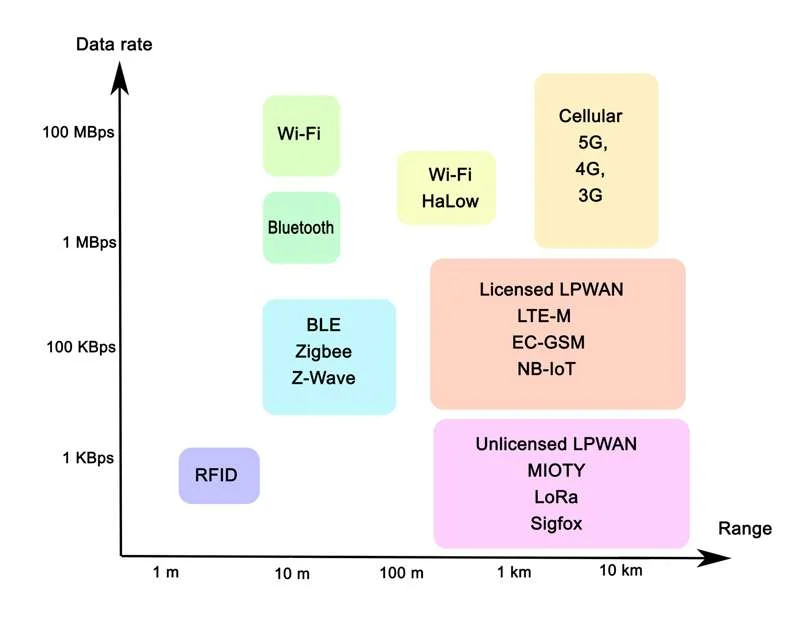
This article describes three cellular IoT technologies, including NB-IoT, LTE-Cat.1, and LTE-M, and summarizes their characteristics and typical application scenarios.
What is NB-IoT?
NB-IoT (Narrow Band Internet of Things), also called a low-power wide-area network (LPWAN), is a cellular technology for IoT devices that supports low-power devices with wide-area connectivity. NB-IoT enables long standby times and efficient connections for devices with modest data requirements. Devices using NB-IoT can achieve multi-year battery life while providing reliable indoor cellular coverage.
Typical NB-IoT network components include NB-IoT endpoints, base stations, the packet core, an IoT connection management platform, and application servers.
Case 1 - Power fault indicators (remote areas)
Requirement: Remote detection of fault indicators on transmission and distribution networks.
Solution: In remote areas where fiber or dedicated channels are unavailable, using NB-IoT as the transport protocol can extend coverage. A star network topology allows data to connect directly to the grid control center. Installation, communications, and protocol development are relatively simple.
Case 2 - Remote water meter reading
Requirement: Remote reading of water meters.
Solution: Water level sensing combined with NB-IoT. The transmission range and carrier support for NB-IoT facilitate rapid citywide deployment of smart water meters.
What is LTE-Cat.1?
LTE (Long-Term Evolution) is a 4G wireless technology that provides higher data rates and lower latency. LTE supports multiple user equipment categories to meet different application needs, including Cat.1, Cat.2, Cat.3, and Cat.4. LTE-Cat.1 is a category targeted at IoT applications, with peak uplink rates around 5 Mbps and peak downlink rates around 10 Mbps.
LTE-Cat.1 balances throughput, power consumption, and cost while taking advantage of LTE network coverage. It is widely used in 4G modules for low-to-moderate data-rate IoT applications.
What is LTE-M?
LTE-M (LTE-Machine-to-Machine) is a cellular IoT technology evolved from LTE. It uses existing cellular networks and supports peak rates up to about 1 Mbps. LTE-M devices use 1.4 MHz RF and baseband bandwidth and can directly access existing LTE networks. Key capabilities include mobility support and positioning. Reported device cost is roughly 25% of Cat.1 chip costs, and compared with GPRS the data rate is about four times higher.
Application Scenarios Comparison
LTE-Cat.1 is suited for applications that require moderate data rates, such as industrial gateways, retail kiosks, payment terminals, telematics, shared power banks, charging stations, and video surveillance.
LTE-M supports cellular handover and voice services and is suitable for wearable devices such as smart bands and smart watches, as well as asset tracking, health monitors, and alarm systems.
NB-IoT is designed for connecting large numbers of low-power devices that operate in low-power modes for long periods, enabling multi-year battery life for devices such as sensors, smart water meters, and smart electricity meters.