ALLPCB


Introduction
A fingertip sliding across a small screen can make complex information immediately accessible. Mobile phones with touchscreens have changed everyday life. Once, users typed on T9 or full keyboards; then a wave of devices removed physical keys and replaced them with virtual buttons that appear only when needed. How were touchscreens invented, and how have they influenced our lives?
First touchscreen
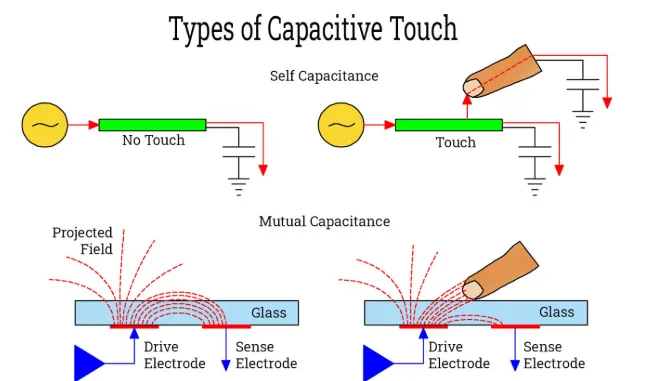
A touchscreen is essentially a sensor, an assembly of touch-detection elements and a touch controller. When a finger contacts a graphical button on the display, the system can drive connected devices according to preprogrammed logic and present information on an LCD.
In 1965, Johnson proposed the concept of a touchscreen in a paper titled "Touch Panels: A New Input Device for Computers." Two years later, he built the world's first capacitive touch screen.
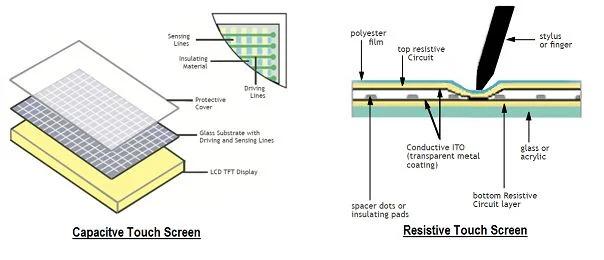
The first device used a laminated glass substrate with an inner surface coated with ITO (indium tin oxide) and four electrodes at the corners. It was bulky but novel: the screen lit up at the touched position, regardless of where a finger touched.
Its limitations were clear: it could track only a single finger position and could not sense touch pressure.
Accidental discovery of the resistive touchscreen
Because of the limitations of early capacitive designs, the invention did not attract wide attention until 1970, when Samuel Hurst developed a more sensitive and practical resistive touchscreen.
The resistive touchscreen was largely an accidental outcome. In 1971, Dr. Hurst and his team used a scintillation detector to record particle impacts and created a teaching tool that could digitize the positions of bright spots on a display. That teaching tool inspired further work that led to the resistive touchscreen.
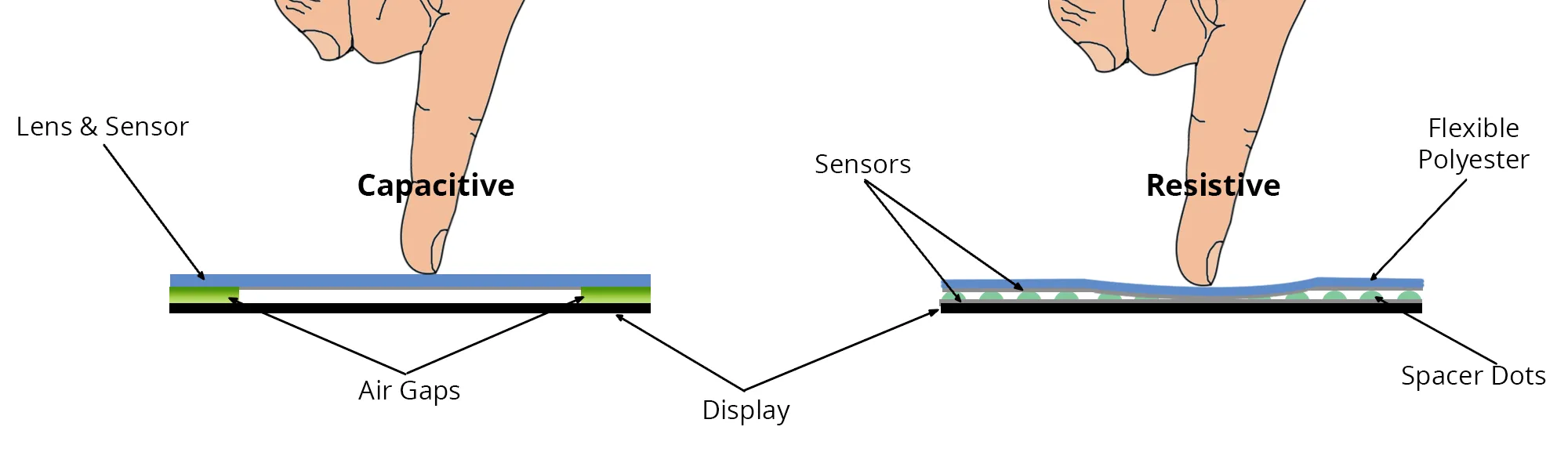
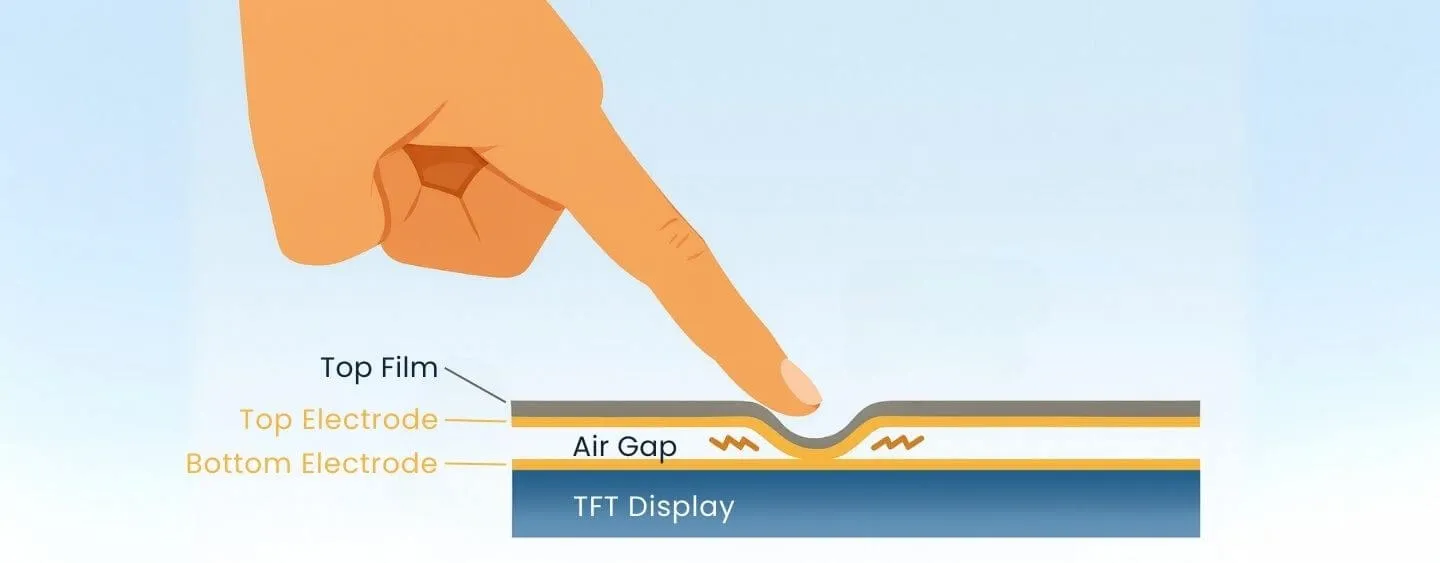
Like capacitive designs, the resistive approach used an ITO conductive coating. The difference was that the coating was applied to a flexible, pressable film. When a finger or other object pressed the film, the coated layer made contact with a conductive backing, allowing current to flow at that point.
Its advantage is that the touch object does not need to be conductive: a wooden stylus or plastic pointer can operate it. The current level at the contact point correlates with pressure, enabling detection of variable press force.
Adoption and commercialization
Early touchscreens were used mainly in military applications and did not see broad adoption initially. In 1993, resistive touchscreens were used in the Apple Newton handheld computer. Later, the iPad redefined tablet computing, and the launch of the iPhone drove the commercialization of consumer devices that integrate touch technology with applications.
Compared with traditional input devices, touchscreens combine input and output in one device, replacing the complexity of keyboard-and-mouse setups and offering a direct, intuitive user experience. Touch interaction—tapping, dragging, pinch-to-zoom—made screens compelling new multimedia interfaces.
Today, touchscreens are used in mobile phones, tablets, retail terminals, public information kiosks, multimedia systems, medical instruments, industrial control, entertainment and hospitality, ticketing systems, and education, among other fields.
Future trends
Touchscreen technology has moved from the periphery into everyday life and continues to evolve. Ongoing innovation and changing user behavior will drive further development.
Higher flexibility and resolution: Displays have moved from low to high resolution and from poor to high transmittance. Electronic paper technologies are being applied to e-newspapers, e-readers, and smartwatches, improving portability and readability.
Advances in screen materials: ITO has been widely used in both resistive and capacitive screens, but alternative materials such as metal mesh, silver nanowires, carbon nanotubes, conductive polymers, and graphene are emerging. Metal mesh and silver nanowires can outperform ITO in conductivity, yielding stronger, more responsive, and more durable displays.
Multi-touch: Multi-touch enables multiple contact points or multi-user interaction on the same display, such as pinch-to-zoom using two points. Users can interact with gestures like single tap, double tap, pan, press, scroll, and rotate.
With the growth of the Internet of Things, more appliances will adopt touchscreen interfaces, making devices easier to control and more user-friendly.
In summary, information technology development depends on continual technological updates. Future touchscreens will trend toward multifunctionality, variety, and larger screens, providing more intuitive and visual ways for users to interact with devices. Touchscreens will continue to change how people work, live, and perceive the world.