ALLPCB


Market context
According to IDC data, global wearable device shipments reached 138.4 million units in Q3 2021, a year-on-year increase of 9.9%. Shipments in the Chinese market reached 35.28 million units, up 5.0% year on year. Global smart wearable device shipments are forecast to reach 632 million units by 2024.
Power management in compact wearables
Power management is a key focus for compact wearable devices and directly affects user experience. As wearable functions become richer, system power consumption rises. Efficient PMICs improve power conversion efficiency and reduce system power draw, maximizing performance per watt and extending battery life.
Qorvo and the ACT81460 PMIC
Qorvo entered the PMIC field after acquiring Active-Semi in 2019. Active-Semi had accumulated experience in PMIC design, with previous PMICs recognized by several manufacturers and a strong position in action camera applications. Building on that experience, Qorvo introduced the ACT81460, a PMIC targeted at compact, battery-powered wearable systems.
The ACT81460 integrates linear charging with a quiescent current of 6 μA. The very low standby current helps extend battery life, especially for devices that remain idle or operate in low-power modes for extended periods. The chip includes a low-power operating mode in which the number of active regulators can be configured to match actual requirements, maximizing battery efficiency.
The ACT81460 supports 4 V to 5 V input and integrates three low-dropout regulators, three load switches, four configurable GPIOs, and four configurable high-efficiency DC/DC converters. Two of the DC/DC converters are buck converters, one is a bidirectional buck-boost, and one is a boost converter that supports up to 20 V. Each DC/DC output can be configured over I2C to meet application needs. Thanks to the DC/DC converters' efficiency, the PMIC can use battery voltage down to 2.7 V. The device is offered in a WLCSP package measuring 3.3 x 3.3 mm, meeting the size constraints of wearable designs.
Maxim's compact, multi-output PMIC
Maxim has released several PMICs for wearable applications. The MAX20310 is a prior example featuring ultra-low quiescent current. It uses an innovative single-inductor multiple-output (SIMO) architecture composed of a single inductor, two programmable output channels, two low-dropout regulators, and other power-management elements.
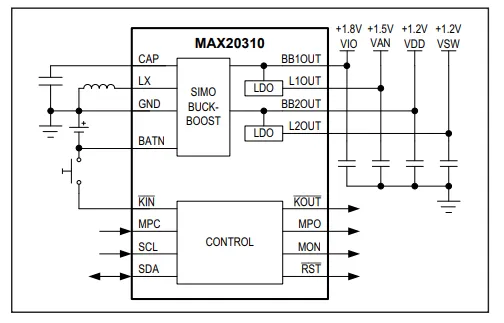
Circuit topology. Source: Maxim
The SIMO architecture provides two programmable voltage outputs using a single inductor, reducing overall package size and increasing design flexibility. This approach also lowers per-channel quiescent current; compared with discrete designs, standby current is reduced by more than 40%.
The MAX20310 can operate with battery input as low as 0.7 V, maximizing battery utilization and supporting output voltages both above and below the battery voltage. The device integrates two programmable LDOs that can function as power switches to disconnect peripheral circuits and reduce unnecessary power loss. It also includes a multiplexer for monitoring power input/output for each function.
Key specifications: battery input range 0.7 V to 2.0 V; output voltages 0.9 V to 4.05 V, configurable as needed. Maximum total input power is 250 mW, with peak efficiency around 84% at 1.8 V/10 mA output. The MAX20310 is available in a WLP package measuring 1.63 x 1.63 mm, nearly 50% smaller than comparable devices. The combination of low power and small size makes it suitable for wearable applications.
Conclusion
Small, low-power PMICs support miniaturized wearable designs by freeing board area and enabling more flexible component placement. Very low quiescent current helps extend device runtime and improves user experience. As the wearable market grows, more PMICs with lower power consumption and smaller footprints are likely to become available for device manufacturers to choose from.