ALLPCB


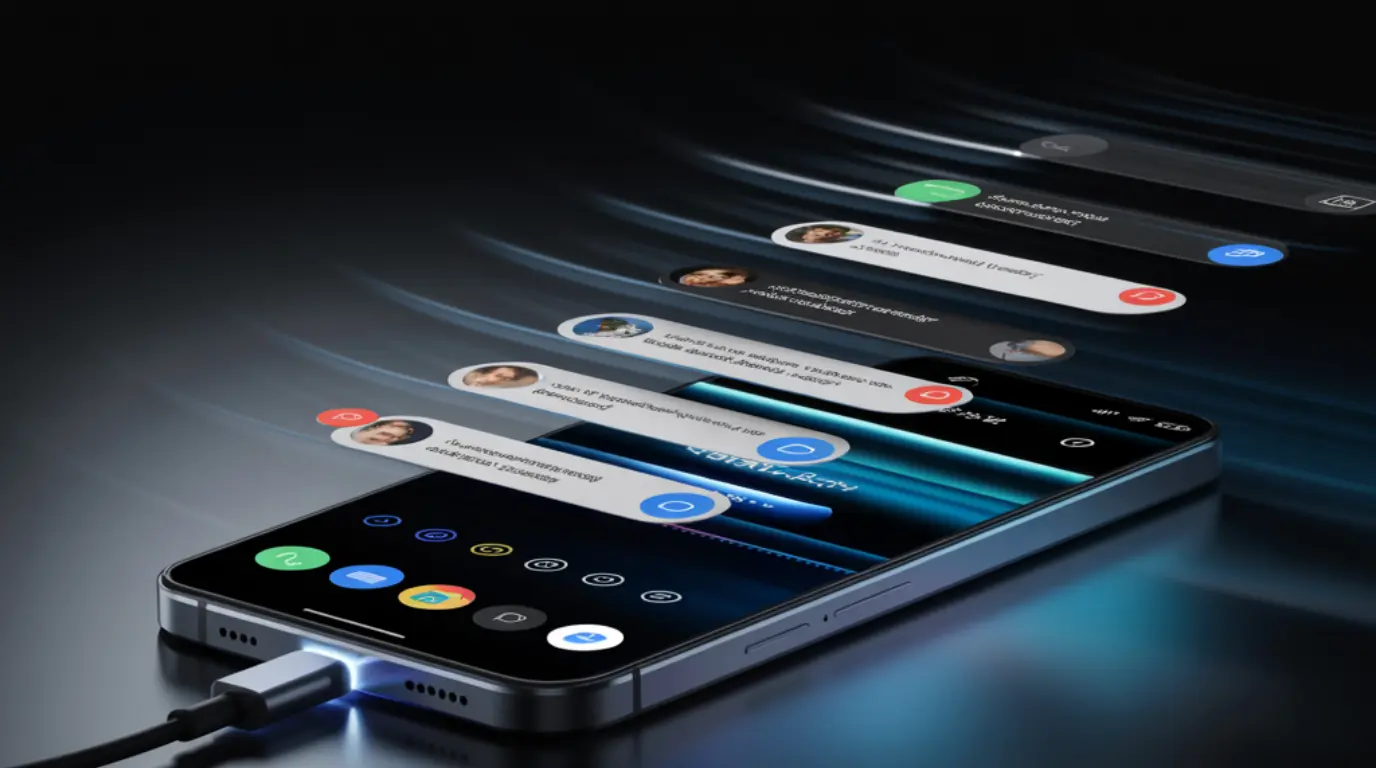
Many people use mobile games, social media, short videos, or tablets for entertainment. Even the author habitually checks a phone before bed. Sliding a finger across a small display now provides an easy way to access information. The touchscreen's intuitive interfaces and portability have made it widely adopted. How did touchscreens, developed over just a few decades, come to affect and change daily life?
The first touchscreen
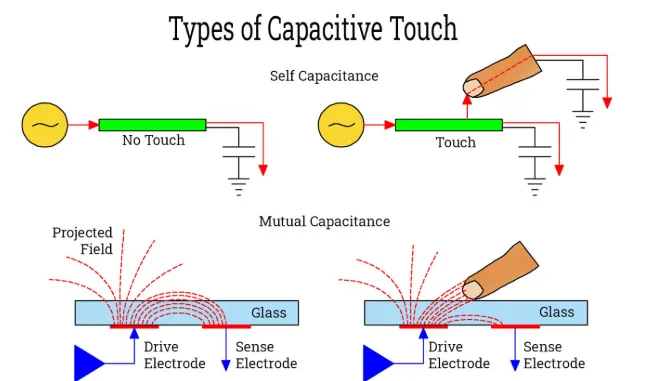
The touchscreen is essentially a sensor composed of a touch-detection layer and a touchscreen controller. When a graphical button on the display is touched, the haptic feedback or programmed response can drive connected devices, replacing mechanical button panels and producing vivid visual output on an LCD.
The concept of the touchscreen was first proposed by Johnson in his 1965 paper "Touch Panels: A New Computer Input Device." Two years later he turned the idea into a working device and produced the first capacitive touchscreen.
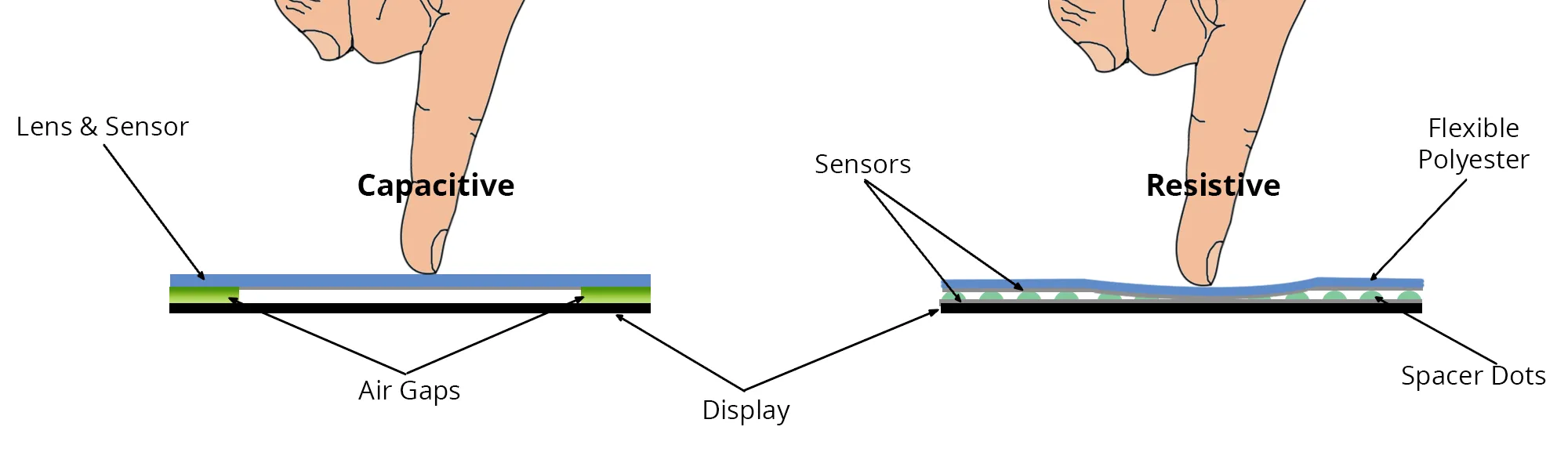
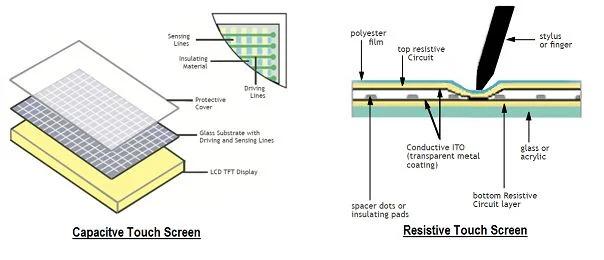
The original screen used a composite glass substrate with an inner surface coated in a metal oxide called ITO (indium tin oxide) and four electrodes at the corners. It was bulky but novel: wherever a finger touched, the screen would light at that position. Its limitations were that it could detect only a single touch point and could not sense touch pressure.
An accidental discovery
The limitations of early capacitive screens meant the invention attracted little attention at first, until Samuel Hurst developed a more sensitive and practical resistive touchscreen around 1970.
Hurst and his team were working with a particle accelerator and sought an efficient way to record the locations where particles struck a screen. They created an educational device that could digitize image data onto a sensing plate. That device inspired further development and eventually led to the resistive touchscreen.
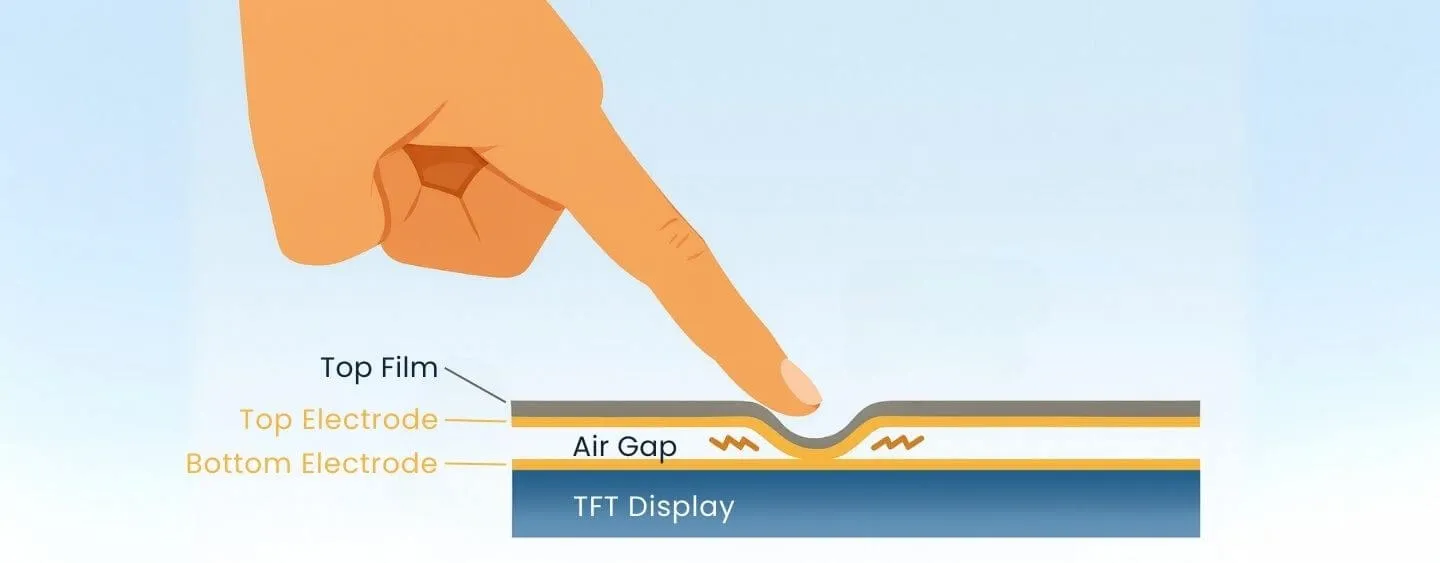
Like capacitive designs, resistive touchscreens used an ITO conductive coating. The difference was that the coating was applied to a flexible, pressure-sensitive membrane. When a finger or other object pressed the membrane, the coated membrane contacted a conductive layer beneath it, allowing current to flow at the contact point. A key advantage is that the input does not need to be electrically conductive—materials such as wood or plastic can register a touch. The magnitude of current at the contact also relates to applied pressure, enabling pressure-sensitive input.
Commercial adoption
Initially, touchscreens saw limited use and were applied mainly in military contexts. In 1993, resistive touchscreens appeared in consumer devices such as the Apple Newton. Later, devices like the iPad and the iPhone helped redefine tablets and smartphones, driving the commercialization of touch-enabled smart products and their associated applications.
Compared with traditional input devices, touchscreens integrate input and output into a single surface and provide a direct, tactile interaction model. In situations where keyboards and mice are inconvenient or difficult to maintain, touchscreens are commonly used in public terminals, portable electronics, and many other applications.
Touch interfaces made direct human-computer interaction simple: users can operate a system by touching icons or text onscreen. As a result, touchscreens rapidly became a compelling new multimedia interaction device. Today, touchscreens are used in phones, tablets, retail systems, public information kiosks, multimedia systems, medical equipment, industrial control, entertainment and hospitality, ticketing machines, and education, among other fields.
Future trends
Touchscreen technology moved from the periphery into everyday life, but development continues. Ongoing technological iteration and changes in how people live will keep driving touchscreen innovation.
Greater flexibility and clarity
User expectations for touchscreens have risen: higher resolution and better optical transparency are now standard demands. Electronic paper has emerged as a candidate touchscreen material because of its flexibility and very low power consumption. Companies including Kodak, Toshiba, Motorola, Canon, Epson, and Guangzhou Aos have pursued research and production in this area. E-paper has seen applications in electronic newspapers, e-readers, and smartwatches, emphasizing portability and low power use.
Advances in screen materials
Both resistive and capacitive touchscreens historically used ITO. That material is increasingly being replaced by alternatives such as metal mesh, silver nanowires, carbon nanotubes, conductive polymers, and graphene. Metal mesh and silver nanowires can offer higher conductivity than ITO, leading to more durable screens with faster response and improved usability.
Multi-touch interaction
Multi-touch is another major development direction. Multi-point and multi-user interactions on the same display provide greater functionality; common gestures such as pinch-to-zoom use two-point touch. Users can operate devices with gestures including taps, double-taps, pan, press, scroll, and rotate.
Although multi-touch production has advanced, wider commercial adoption continues to evolve. With the development of the Internet of Things, more household appliances and consumer products will incorporate touch interfaces, yielding more controllable and user-friendly electronic products.
In summary, the information society depends on continuous technological updates. Future touchscreens will trend toward multi-functionality, diversity, and larger displays, delivering more intuitive and visual user experiences.
Touchscreens will continue to change how people work, live, and even perceive the world.