ALLPCB


Introduction
In modern electronic devices, image sensors are critical to the success of many applications. The ON Semiconductor AR0132AT is a 1/3-inch CMOS digital image sensor with a range of features and application flexibility. This article analyzes the sensor's characteristics, working principles, and practical considerations for system integration.
Product Overview
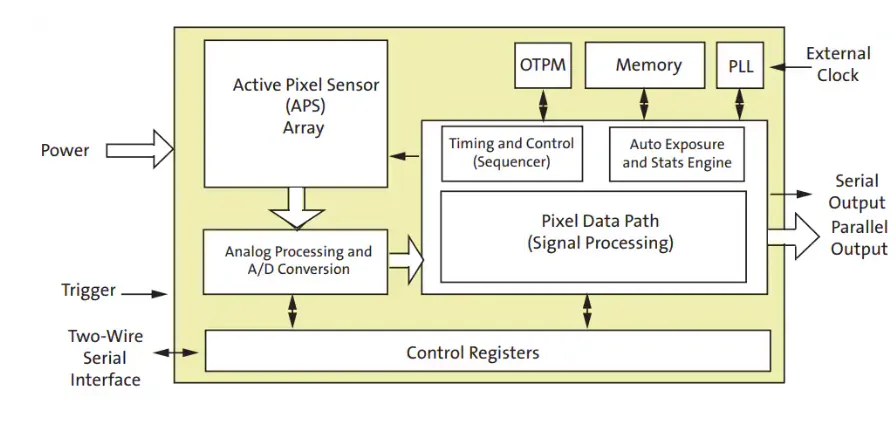
The AR0132AT has a 1280H x 960V active pixel array and captures images using a rolling shutter in either linear or high dynamic range modes. It integrates camera functions such as automatic exposure control, windowing, and video/single-frame modes, making it suitable for low-light and high dynamic range scenes. Programming is done through a simple two-wire serial interface, and the sensor produces sharp digital images suitable for surveillance and high-definition video applications.
Key Feature Analysis
Low-Light Performance and Dynamic Range
The sensor delivers strong low-light performance and supports linear and high dynamic range capture modes. In HDR mode, it can handle up to 120 dB of dynamic range, preserving detail in scenes with both bright and dark regions.
Output Modes and Frame Rates
Parallel and serial (HiSPi) output ports are provided to match system requirements. The sensor supports up to 45 fps at full resolution and up to 60 fps at 720p, meeting various application frame rate needs.
Integrated Smart Functions
- Automatic exposure and statistics engine: The automatic exposure control (AEC) computes and updates optimal exposure and gain settings every two frames to maintain appropriate image brightness.
- Automatic black level calibration: The sensor measures the average value of a set of optical black pixels and applies digital low-pass filtering to remove temporal noise and random variations, ensuring stable black level.
- Real-time context switching: Users can switch between two complete register contexts by writing the context switch bit in R0x30B0[13]. New settings take effect on the next exposure and readout.
Temperature Sensor
An on-chip PTAT-based temperature sensor provides junction temperature readings accessible via registers. ADC values from the sensor can be converted to degrees Celsius using a simple linear function.
Operation and Data Output
Functional Overview
The AR0132AT is a progressive-scan sensor that uses an on-chip phase-locked loop (PLL) to generate internal clocks from a single master input clock in the 6–50 MHz range. The maximum output pixel rate is 74.25 Mp/s. Users interact with the sensor via a two-wire serial bus to control the array, the analog signal chain, and the digital signal chain.
Pixel Array and Readout
The pixel array is configured as 1412 columns by 1028 rows, including dark pixels for black level monitoring and row noise correction. By default, the sensor begins reading from physical pixel address (112, 44). The optical center is located at x_addr_end (R0x3008)=643 and y_addr_end (R0x3006)=485.
Output Data Format
Image data are read out line by line, with valid image data surrounded by horizontal and vertical blanking. Horizontal line time and vertical frame time are programmable via registers. In parallel output mode, FRAME_VALID (FV) and LINE_VALID (LV) indicate frame and line boundaries, and PIXCLK can be used to latch data.
High Dynamic Range Mode
By default the sensor powers up in linear mode, but it can be configured for high dynamic range (HDR) operation. HDR uses multi-exposure capture, sequentially acquiring three exposures and combining them on-chip to produce a 20-bit linearized pixel value. The result can be optionally compressed to 12 or 14 bits. Compression is lossless in 14-bit mode and has minimal loss in 12-bit mode.
Exposure Setting Limits
Due to line buffer limitations, the maximum coarse integration time in HDR mode is 42 × T1/T2 lines. The maximum coarse integration time is also constrained by the frame_length_lines register, i.e. maximum coarse_integration_time = minimum(42 × T1/T2, frame_length_lines - 45). There are also minimum exposure line count requirements.
Motion Compensation
To reduce artifacts caused by object motion in multi-exposure HDR, the AR0132AT includes a 2D motion compensation circuit. Default HDR motion compensation can be enabled via R0x318C[14], or DLO-based HDR combination can be enabled via R0x3190[13].
Electrical Characteristics and Power Management
Electrical Specifications
Under specified conditions (for example VDD = 1.8 V ± 0.15 V, VDD_IO = VDD_PLL = VAA = VAA_PIX = 2.8 V ± 0.3 V), the sensor has defined electrical characteristics. The two-wire serial register interface meets the relevant electrical standards, and I/O timing can be adjusted via register R0x3028.
Power Management
The device supports both hard standby and soft standby modes, and in each mode the external clock can be disabled to reduce power consumption. Specific sequences are required for entering and exiting standby to ensure normal operation.
Applications and Integration Considerations
Applications
- Automotive imaging: Suitable for rear-view cameras, surround-view systems, and other automotive imaging applications requiring clear imagery to support driver assistance.
- Video surveillance: Capable of capturing scene details in low-light and high dynamic range conditions for security monitoring.
- 720p60 video: Meets the requirements for HD video recording and transmission, applicable to video conferencing and live streaming.
Integration Considerations
- Power sequencing: Follow the recommended power-up and power-down sequences. Ensure required separation times between supplies to avoid functional issues and excessive current draw.
- Column correction: The column-parallel readout architecture can introduce offset between column signal paths. Perform column correction and follow specific trigger sequences at startup and when changing modes to ensure correct calculation of column correction coefficients.
- Test modes: When enabling test modes, disable black level calibration (BLC) to avoid affecting test results.
Conclusion
The ON Semiconductor AR0132AT image sensor provides a comprehensive feature set and performance suitable for a range of imaging applications. Proper understanding of its capabilities and adherence to recommended operating procedures are necessary to achieve reliable, high-quality image acquisition and processing.