ALLPCB


Understanding the role of fiducial marks in PCB manufacturing is critical for ensuring high-quality outcomes in surface mount technology (SMT) assembly. One often overlooked factor is the fiducial mark material, which can significantly influence SMT assembly reliability and component placement accuracy. In this blog post, we’ll explore how the choice of fiducial material impacts PCB manufacturing quality and why it matters to engineers and manufacturers aiming for precision and durability in their designs.
At its core, the material used for fiducial marks affects how well automated assembly machines detect and align with the PCB during SMT processes. Poor material choices can lead to misalignment, reduced accuracy, and even assembly failures. In the sections below, we’ll dive deep into the science behind fiducial mark materials, their impact on reliability, and best practices for optimizing PCB manufacturing quality through material selection.
What Are Fiducial Marks and Why Do They Matter in SMT Assembly?
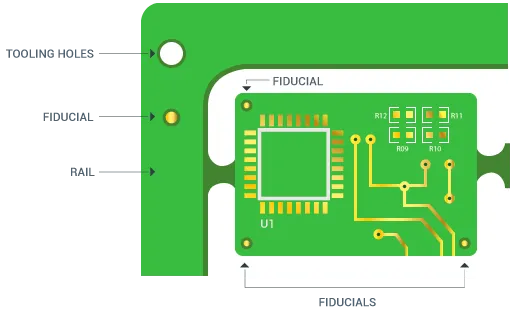
Fiducial marks are small, precise reference points on a PCB panel used by automated SMT machines to determine the board’s orientation and position. These marks act as visual guides for pick-and-place machines and other equipment during component placement. Without accurate fiducial marks, machines may misplace components, leading to defective products and costly rework.
In SMT assembly, reliability hinges on precision. Fiducial marks ensure that components are placed within tight tolerances, often as small as 0.1 mm for modern high-density designs. Their importance becomes even more pronounced in high-volume production, where even a slight error can result in thousands of defective units. The material used for these marks plays a subtle but crucial role in their visibility and durability, directly impacting component placement accuracy and overall PCB manufacturing quality.
The Role of Fiducial Mark Material in SMT Assembly Reliability
The material used for fiducial marks isn’t just a minor detail—it directly affects how well machines can detect and interpret these reference points. Most fiducial marks are made from exposed copper, often with a protective coating or solder mask clearance to enhance contrast against the PCB substrate. However, variations in material properties like reflectivity, durability, and resistance to environmental factors can influence SMT assembly reliability.
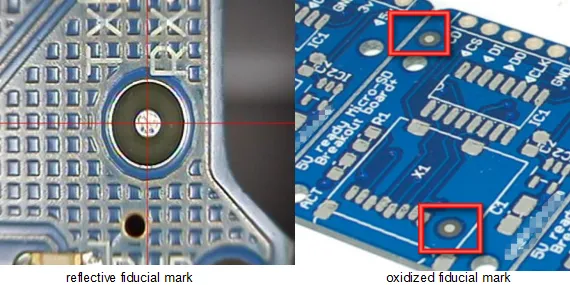
For instance, copper fiducial marks are widely used due to their high conductivity and compatibility with standard PCB fabrication processes. However, if the copper oxidizes over time due to poor storage conditions, its reflectivity decreases, making it harder for machine vision systems to detect the marks. This can lead to alignment errors during component placement, reducing SMT assembly reliability. Studies suggest that misalignment caused by poor fiducial detection can result in placement errors of up to 0.05 mm, which is significant for fine-pitch components like 0201 resistors or QFN packages.
Alternatively, some manufacturers use gold-plated fiducial marks for enhanced durability and reflectivity. While gold resists oxidation better than copper, it adds to production costs and may not always be necessary for standard applications. The key is to balance material performance with cost-effectiveness while ensuring consistent detection by SMT equipment.
How Fiducial Mark Material Impacts Component Placement Accuracy
Component placement accuracy is a cornerstone of PCB manufacturing quality, especially in SMT assembly where components are often placed at high speeds. Fiducial mark material influences accuracy by affecting how clearly and consistently machines can recognize reference points. Let’s break down the material science behind this.
Machine vision systems in SMT equipment rely on contrast and reflectivity to identify fiducial marks. A material with low reflectivity, such as oxidized copper or a poorly contrasted surface, can cause the system to misread the mark’s position. This might result in a rotational error of just 0.2 degrees, but for a large PCB with components at the edges, this tiny error can translate to a positional shift of 0.3 mm or more—enough to cause soldering defects or connection failures.
Moreover, the durability of the fiducial mark material under manufacturing conditions matters. During processes like reflow soldering, fiducial marks are exposed to high temperatures (up to 260°C for lead-free solder profiles). If the material degrades or warps under heat, its shape may distort, further reducing detection accuracy. For example, using a low-quality coating over copper might lead to peeling or discoloration, impacting the mark’s visibility post-reflow.
Fiducial Mark Material and PCB Manufacturing Quality
PCB manufacturing quality isn’t just about the final assembly—it encompasses every step from design to fabrication. The choice of fiducial mark material can influence quality at multiple stages. During the initial imaging and etching processes, the material must withstand chemical exposure without degrading. For instance, copper fiducial marks must be protected from over-etching, which could alter their precise circular or cross-shaped geometry, critical for accurate detection.
In high-reliability applications, such as automotive or aerospace electronics, fiducial mark materials must also endure environmental stressors like humidity and thermal cycling. A study on PCB reliability found that fiducial marks with improper material coatings failed to maintain visibility after 500 thermal cycles between -40°C and 85°C, leading to a 15% increase in assembly errors during testing. This highlights how material science plays a role in long-term PCB manufacturing quality.
Additionally, the interaction between fiducial mark material and the surrounding solder mask or substrate can affect manufacturing outcomes. If the solder mask encroaches on the fiducial mark due to poor material compatibility or fabrication errors, it reduces contrast, making detection harder. Ensuring that the fiducial material contrasts sharply with the PCB background—often achieved by leaving a clear zone of 1-2 mm around the mark—is essential for maintaining quality.
Best Practices for Choosing Fiducial Mark Materials
Selecting the right fiducial mark material is a balance of performance, cost, and compatibility with your manufacturing process. Below are some actionable tips to optimize SMT assembly reliability and PCB manufacturing quality through material choice:
- Use Exposed Copper with Protective Measures: Copper is the most common and cost-effective choice for fiducial marks. Ensure it’s protected from oxidation by applying a thin layer of OSP (Organic Solderability Preservative) or storing panels in controlled environments to maintain reflectivity.
- Consider Gold for High-Reliability Needs: For applications requiring extreme durability, such as military or medical devices, gold-plated fiducial marks offer superior resistance to oxidation and environmental stress, though at a higher cost.
- Ensure High Contrast: Regardless of material, ensure the fiducial mark stands out against the PCB substrate. A clearance of at least 1 mm around the mark, free of solder mask or silkscreen, helps maintain visibility for machine vision systems.
- Test Material Under Process Conditions: Before mass production, test the fiducial mark material under real-world manufacturing conditions, including reflow temperatures and chemical exposures, to confirm it won’t degrade or lose visibility.
- Standardize Fiducial Design: Use industry-standard shapes (like circles or crosses) and sizes (typically 1-3 mm in diameter) for fiducial marks, and pair them with materials that align with your SMT equipment’s vision system requirements.
Material Science Behind Fiducial Mark Performance
Diving deeper into material science, the properties of fiducial mark materials—such as reflectivity, thermal stability, and chemical resistance—directly correlate with their performance in SMT assembly. Reflectivity, for instance, is quantified by the material’s ability to bounce back light in the visible or infrared spectrum, which machine vision systems use for detection. Polished copper has a reflectivity of around 60-70% in the visible range, but this drops to below 30% if oxidized, making detection unreliable.
Thermal stability is another critical factor. During reflow soldering, materials must withstand temperatures without deforming. Copper, with a melting point of 1085°C, is inherently stable at soldering temperatures, but coatings or nearby materials might not be. For example, some low-cost protective layers break down above 200°C, exposing the copper to oxidation mid-process.
Chemical resistance also matters during PCB fabrication. Etching solutions, cleaning agents, and fluxes can corrode or dull fiducial mark surfaces if the material isn’t chosen carefully. This is why material science research continues to explore alternatives like nickel or specialized alloys for fiducial marks, though these are less common due to cost and integration challenges.
Common Challenges with Fiducial Mark Materials and How to Overcome Them
Even with the best material choices, challenges can arise in maintaining fiducial mark performance. Below are some common issues and solutions:
- Oxidation and Reflectivity Loss: Store PCB panels in low-humidity environments and apply protective coatings like OSP to prevent copper oxidation. Regular inspection before assembly can catch early degradation.
- Thermal Degradation: Choose materials and coatings rated for your specific reflow profile. If using lead-free solder, ensure the fiducial material can handle peak temperatures of 260°C without warping or discoloring.
- Poor Contrast with Substrate: Design fiducial marks with a clear zone around them, free of solder mask or other layers. If contrast remains an issue, consider adjusting the PCB substrate color or material to enhance visibility.
- Inconsistent Detection by Machines: Calibrate SMT equipment regularly to account for variations in fiducial mark materials. Provide detailed documentation of material properties to assembly teams to ensure machine settings match the panel’s characteristics.
Future Trends in Fiducial Mark Materials for SMT Assembly
As PCB designs become more complex with smaller components and tighter tolerances, the demand for advanced fiducial mark materials is growing. Innovations in material science are paving the way for marks with enhanced reflectivity and durability, even in harsh manufacturing environments. For instance, research into nano-coated fiducial marks aims to improve visibility for next-generation vision systems operating at higher resolutions.
Additionally, the rise of flexible and hybrid PCBs introduces new challenges for fiducial mark materials. Traditional copper marks may not adhere well to flexible substrates or withstand repeated bending. This has spurred interest in alternative materials like conductive polymers or silver-based coatings, which offer flexibility without sacrificing detection accuracy.
Automation and AI in SMT assembly are also influencing fiducial mark design. Future materials might be optimized for infrared or UV detection, expanding beyond visible light to improve accuracy in low-light or high-speed production settings. Staying ahead of these trends can give manufacturers a competitive edge in achieving superior SMT assembly reliability.
Conclusion: Optimizing Fiducial Mark Material for Superior SMT Results
The impact of panel fiducial mark material on SMT assembly reliability cannot be overstated. From influencing component placement accuracy to ensuring overall PCB manufacturing quality, the right material choice is a small but mighty factor in achieving flawless production outcomes. By understanding the material science behind fiducial marks and following best practices for selection and design, manufacturers can minimize errors, reduce rework, and deliver high-quality electronic products.
Whether you’re working on consumer electronics or mission-critical aerospace systems, paying attention to fiducial mark materials is a step toward excellence in SMT assembly. With ongoing advancements in materials and manufacturing technology, staying informed about the latest options can help you maintain a competitive edge in PCB production.