ALLPCB


Overview
As VR and AR gain attention, a variety of augmented reality applications are turning fictional concepts into real experiences. In some AR approaches no physical screen is required; virtual objects can be rendered by recording and reproducing light fields. This raises two questions: as AR technology matures, will it push the display industry toward a screenless era? And could it disrupt the flat-panel display market?
What is AR
Augmented reality overlays virtual information onto the real world by combining computer-generated objects, scenes, or system prompts with real-world views, thereby enhancing perception. From Google's perspective, AR represents a future direction because it offers more interactive experiences rather than isolating users from reality.
Three technical categories of AR displays
From a technical perspective, AR display technology can be grouped into three main categories:
- Video-based AR. Examples include handheld-device AR games such as Pokémon Go. Because no additional hardware is required, this is currently the most common AR display approach. The device screen functions as a window or amplifier to present the world with virtual overlays.
- Optical-based AR. This category includes head-mounted optical-imaging systems such as Meta and HoloLens. Based on working principle, these systems can be divided into optical see-through and video see-through types. Optical-based AR can provide a better experience and free the user's hands, which is a major research focus for many AR hardware vendors in China and abroad.
- Projection-based AR. An example is MIT's SixSense project. Projection-based AR directly projects generated virtual content onto the real scene so no headset or glasses are required. Because it needs additional projection equipment, it has not been widely adopted by consumers.
Industry activity
In recent years, major technology companies have been active in AR, including Google Glass, Microsoft HoloLens, Meta AR glasses, Oculus, and Magic Leap, which has received investments from companies such as Google and Alibaba. Apple has also been reported to be considering AR-capable eyewear. However, these companies are pursuing different technical approaches.
Technical challenges and light-field displays
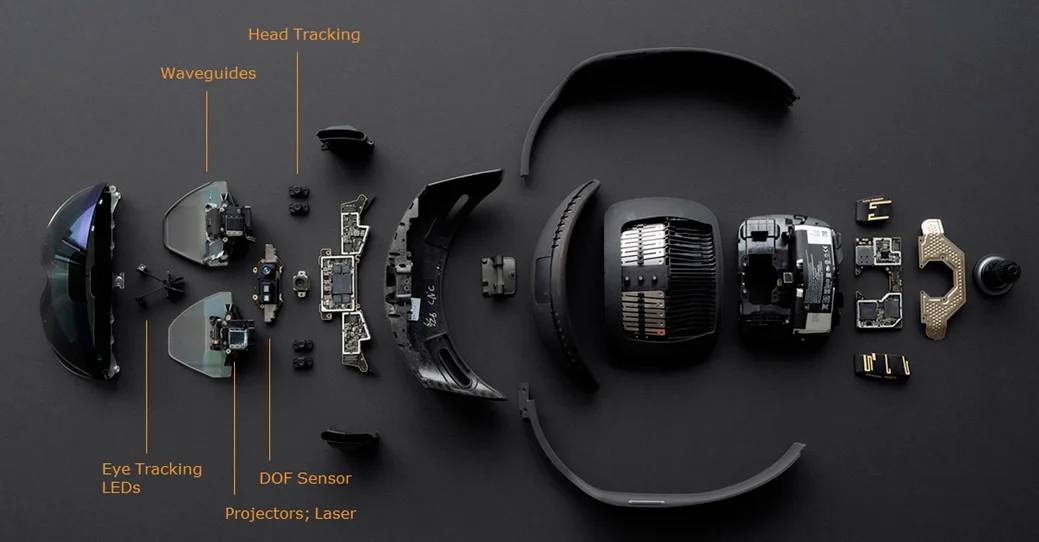
Dr. Xuan Cao of the Institute of Automation, Chinese Academy of Sciences said in an interview with China Electronics News that true aerial floating imaging without any medium is technically very challenging and unlikely to be commercialized within five years. Current AR glasses require display components. For example, Meta and Google Glass create images using microprojectors, while Microsoft HoloLens uses waveguides and related display components to project "holographic" images. Magic Leap uses light-field display technology. Light-field displays can be understood as a form of digital holography: they produce more realistic visuals but require larger data volumes and greater computational power, placing higher demands on display hardware and processing performance. Google and Oculus are also developing light-field related technologies.
Among the different technical paths, Dr. Cao is more optimistic about the future of light-field displays. Light-field display technology records and reproduces the light rays in space to more accurately render real scenes. By presenting images at different depths, users can actively focus on near or far objects, allowing the ciliary muscles to accommodate naturally and substantially reducing eye strain and dizziness. Traditional LCD and OLED displays can only render 2D images and cannot display light fields.