ALLPCB


HUD product evolution
Head-up display (HUD) is an optical device that works similarly to a projector, projecting information onto a transparent medium in front of the driver.
HUDs were first used in military aircraft and later migrated into the automotive industry as the technology matured.
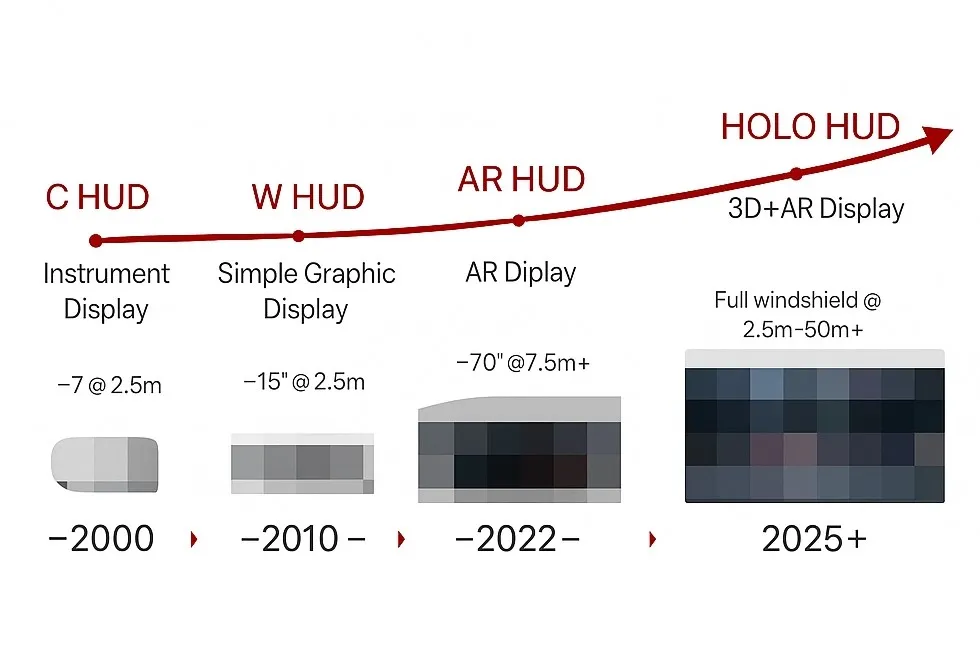
Automotive HUDs have gone through four generations: C-HUD, W-HUD, AR-HUD, and HOLO HUD.
C-HUD provides simple graphic and text display of vehicle instrument information, while W-HUD offers basic graphic display.
AR-HUD uses augmented reality techniques and deep integration with connected vehicle data to overlay virtual images on the real world, enabling features such as arrow navigation and person guidance on the windshield.
Future HOLO HUDs combine 3D techniques and AR display to enable richer content and more immersive, full-field displays.
Technical and cost challenges of AR-HUD
Continuous software updates are an important part of AR-HUD development. Compared with traditional W-HUD, AR-HUD must integrate information from cameras, radar, high-precision maps, and other vehicle sensors, then render overlays such as directional arrows or person markers on the windshield.
This requires AR-HUD systems to generate images within millisecond-level latency after image acquisition, placing high demands on both algorithms and hardware.
AR-HUD also needs to ensure stable real-time rendering, which imposes strict requirements on software algorithms and optical imaging quality.
Although several OEMs have introduced AR-HUD-equipped models, adoption remains limited. The wide field of view required by AR-HUD increases cost, physical size, and introduces optical challenges such as sunlight leakage.
PGU is the core component of HUD
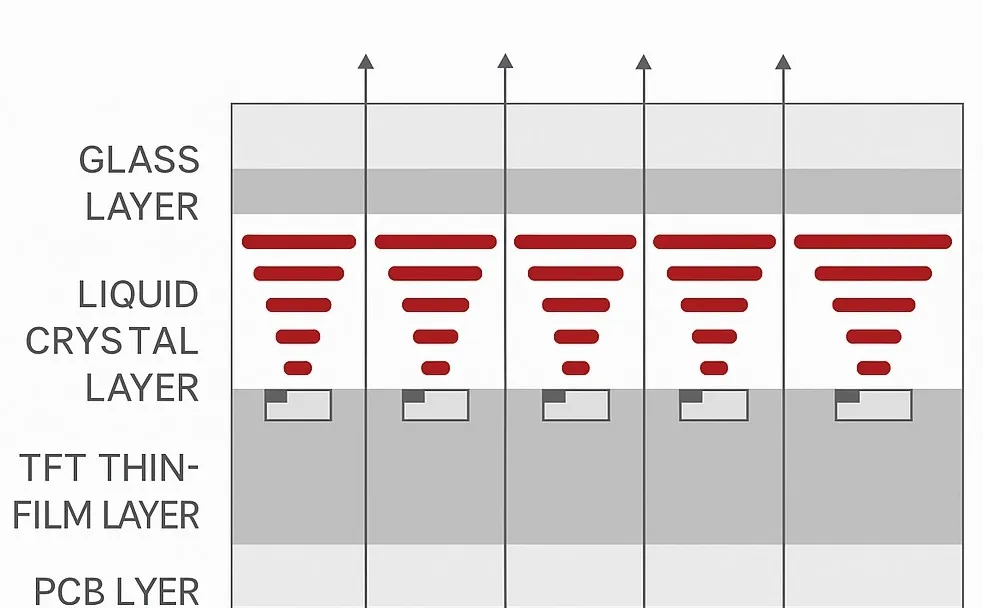
The projection generating unit (PGU) accounts for 30% to 50% of the AR-HUD system BOM. Current mainstream imaging approaches for PGUs include TFT-LCD, DLP, LCoS, and LBS; these different imaging technologies produce very different HUD performance and cost profiles.
Among them, the optical engine for TFT routes represents about 30% of total cost, LCoS routes about 40%, and DLP routes more than 50%.
From a chip perspective, DLP’s DMD chips are exclusively supplied by Texas Instruments and are relatively expensive, while TFT and LCoS solutions, including MEMS chips, can be localized.
TFT has the lowest cost. As LCoS production scales, its cost may fall to around 70% of DLP. MEMS-based laser engines are currently in experimental stages and could become a low-cost optical engine option in the future.
Current HUD market pricing
In early April, a HUD manufacturer said that in cooperation with an OEM in the Chinese market they had implemented AR-HUD as standard across a model line using a TFT solution, with pricing within 2,000 CNY, while many other vendors were pricing in the 2,000–3,000 CNY range at that time.
In early June, Jiangcheng Technology released a next-generation TFT AR-HUD that achieved large imaging size without sacrificing image quality while controlling volume; the company claimed a price of about 1,000 CNY.
More recently, a HUD technical lead stated that Huayang achieved an AR-HUD priced at about 950 CNY in a specified OEM program, and other HUD suppliers are following suit.
Industry trends
HUD development may follow two technology tracks: low-cost routes and next-generation technologies.
The low-cost approach, exemplified by TFT, aims to refine and standardize TFT optical engines as cost-effective, reliable products. Although this may reduce margin, stable quality and volume production can still yield profitability.
Currently multiple technologies are competing. Mainstream options include DLP led by TI and LCoS solutions pursued by companies such as Huawei, Ruiweishi, Jiangcheng Technology, and Yishu Technology.
Other choices include LBS adopted by Desay SV, Jinglong Ruixin, and Ruisi Huachuang, as well as research into autostereoscopic 3D. These approaches promise significant improvements in user experience.
Multiple local suppliers have achieved AR-HUD vehicle integration
According to Zosi Automotive Research, in the first quarter of 2023, the Chinese passenger vehicle market (excluding imports and exports) saw 10 suppliers deploy about 25,000 AR-HUD units across 14 car brands and more than 20 models.
Huayang Group has about 10 years of HUD R&D experience and has released mature W-HUD and AR-HUD products and solutions, securing OEM positions with manufacturers including Great Wall, Changan, SAIC, Geely, GAC, Chery, NIO, and Dongfeng Honda.
Huayang shipped more than 400,000 HUD units in 2022, ranking first among HUD suppliers in the Chinese market. According to Gaogong Intelligent Automotive Information, Huayang's cumulative HUD shipments exceeded 1,000,000 units by July 2023.
Crystal-Optech established a HUD R&D team in 2013, entered the aftermarket HUD field in 2016/2017, and began OEM AR-HUD supply in 2020 to the Hongqi EHS9. In 2022 Crystal-Optech supplied AR-HUD to Changan Deep Blue SL03, shipping nearly 40,000 HUD units that year. In 2023 the Deep Blue S7 equipped with Crystal-Optech AR-HUD began deliveries. The company has multiple HUD OEM projects in reserve and its PGU products have entered BYD’s supply chain.
Future Black Technology’s 2022 HUD product was matched to Li Auto L9/L8 models; with strong sales of those models, the company reported 68,000 HUD units shipped in 2022 and cumulative deliveries of 122,000 units by the end of April 2023. The company expected to reach about 350,000 HUD shipments in 2023.
Conclusion
As autonomous driving advances toward L3–L4, HUDs can provide predictive display cues that increase driver confidence and improve driving safety and travel efficiency.
However, given the trend toward separation of hardware and software responsibilities, the market should consider who will ultimately implement these functions.