ALLPCB


Key supporting technology
Active distribution network control technology requires coordinated changes across all links of a new power system, with emphasis on the composition of power sources, grid topology, load characteristics, technical foundations, and operational characteristics. This includes grid digital transformation.
1. Path to building new power systems
Building new power systems is a core part of constructing a new energy framework and acts as an important carrier. New power systems enable efficient integration of renewable energy, transforming grids from a unidirectional, hierarchical transmission network into a multi-directional, mixed, hierarchical structure.
By developing renewable energy at scale and ensuring its safe and reliable replacement of traditional fossil fuels, the share of fossil generation will gradually decline. Constructing new power systems can accelerate power decarbonization and the clean energy transition, which is necessary to meet carbon peak and carbon neutrality goals.
New power systems are founded on ensuring energy and power security. They rely on digital technologies to coordinate generation, transmission, load, and storage resources; improve dispatch and operation mechanisms; and enhance system flexibility, security, and overall operational efficiency to meet targets for secure supply, clean consumption, and economic efficiency.
2. Grid digital transformation
New power systems are open, complex systems involving multiple societal sectors. Their development requires balancing growth and security to ensure continuous, reliable power supply, maintain grid stability, and promote efficient renewable integration.
Deep integration of low-carbon generation technologies with advanced information and communication and control technologies is needed to enable high-penetration renewable connection on the generation side and secure, flexible allocation of grid-side resources. Continual improvements are required in system flexibility, security capacity, and emergency supply assurance. The innovation chain linking new technology R&D, technology transfer, and equipment manufacturing should be strengthened to support new business models and application scenarios. Accelerating development of first-of-a-kind equipment for new power systems is also important.
Distribution networks will transition from passive load-serving networks to active networks. Electricity users will evolve from simple buyers to integrated prosumers. Distribution will shift from purely AC to hybrid AC/DC distribution, with broader application of flexible DC technologies. Control will evolve from centralized, coarse switching control to multi-layered, zonal, fine-grained power control.
The distribution network is the link between the bulk grid and end users. The energy structure transition drives evolution in distribution network topology and technology.
Integration of distributed generation changes distribution flows from fixed, unidirectional patterns to stochastic, bidirectional flows. Voltage distribution will no longer just step down stage by stage but will follow fluctuating flow patterns, increasing volatility. This diversification of power regulation methods enables more refined operational control.
3. Concept of the active distribution network (ADN)
An active distribution network is defined as a distribution system capable of active control and management of distributed energy resources (DER). It manages network flows through flexible topology adjustments, and under appropriate regulatory frameworks and interconnection protocols, distributed resources can provide system-level support.
Typical characteristics of an active distribution network are activity and proactiveness.
Activity means the network contains distributed resources such as wind turbines, photovoltaics, and energy storage.
1. Handling uncertainty
The intermittent output of distributed generators makes flow directions and voltage distributions within an ADN uncertain.
2. Islanding resilience
During faults, an active distribution network with local generation can island and continue supplying non-fault areas to some extent, reducing customer outages. Proactiveness refers to the network's capability to actively manage abundant controllable resources, coordinating control to improve renewable utilization and optimize network operation.
3. Active integration
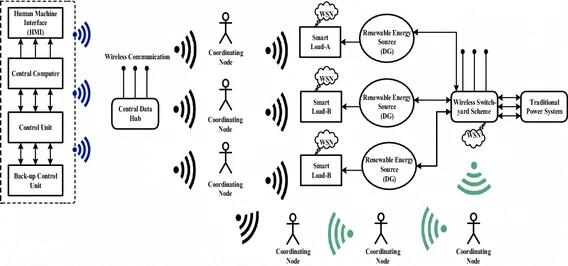
The ADN concept addresses integration and accommodation of diverse distributed generation. It mainly connects various distributed generators (DG), energy storage systems (ESS), and controllable loads (CL) to the existing distribution network. Leveraging advanced information and communication technologies and power electronics, it coordinates and actively manages controllable resources to achieve high compatibility and efficient use of distributed renewable generation, optimize network operating conditions, improve asset utilization, defer upgrade investments, and enhance supply quality and reliability.
4. From centralized control to multi-layer zonal control
Grid control shifts from a single centralized control center to flexible, multi-layered zonal and multi-unit control. Under normal operation, various control methods are used proactively to optimize operations, promote renewable energy accommodation, relieve congestion, balance loads, reduce losses, stabilize voltages, narrow peak-valley differences, and improve the economic, safety, and environmental performance of distribution networks.