ALLPCB


Overview
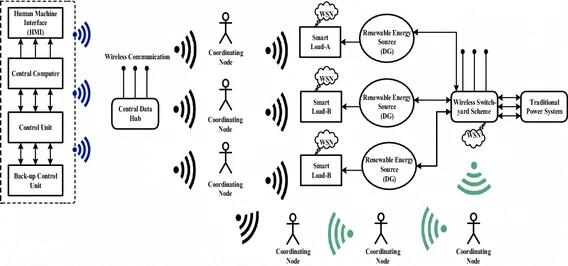
A distributed smart grid is an important form of smart grid. It uses next-generation information technologies, distributed control techniques, and advanced sensing technologies to transform the traditional centralized control architecture into a distributed collaborative control system. The core significance of distributed smart grids can be described from the following aspects.
Core Benefits
1. Enable clean generation and efficient energy use: Distributed smart grids facilitate efficient use and local generation of green energy. Through geographic optimization, they promote the flow and utilization of clean energy and support sustainable development of energy resources.
2. Improve grid reliability and security: Distributed smart grids adopt redundancy strategies that substantially improve system security and reliability, reducing the occurrence and impact of grid incidents.
3. Optimize supply and demand: Distributed smart grids enable efficient scheduling and supply of energy, promote precise allocation and use of resources, enhance supply-demand coordination, and support centralized and distributed demand-side control.
4. Improve power system efficiency and quality: By applying next-generation information technologies for precise monitoring and control, distributed smart grids optimize operational data, raise system efficiency, and improve power quality and stability.
5. Drive innovation and transformation in the power sector: With new technologies and forward-looking approaches, distributed smart grids promote the application of renewable and new energy, and advance the intelligence and sustainability of power systems.
Three Interpretations of Distributed Smart Grids
Level 1: Smart grids with high penetration of distributed generation. These grids can take the form of intelligent microgrids or active distribution networks. Their defining characteristic is a high share of distributed generation, especially renewable distributed energy. Some distributed smart grids can achieve 100% renewable penetration at any time, forming fully autonomous microgrids.
Level 2: Spatially dispersed smart grids. Within a larger area, such as a metropolitan region, many of the distributed smart grids described above coexist. These grids collaborate horizontally at the same voltage level and vertically across different voltage levels, forming a larger-scale distributed smart grid.
Level 3: Logically aggregated, geographically distributed resources. This concept approaches an advanced virtual power plant (VPP 3.0), aggregating various distribution networks or microgrids across different management and ownership boundaries. By integrating information flow, current, and control flow, it aggregates dispatchable distributed resources to form a logical distributed smart grid.
Distributed Resources and System Challenges
Distributed resources are well suited to local consumption, i.e., generation located close to loads minimizes constraints caused by marginal transmission and most marginal distribution costs, while benefiting from higher retail prices, which improves returns.
However, distributed clean resources dominated by distributed PV have intermittent, fluctuating, and stochastic characteristics. High penetration of distributed PV can also affect the safe and stable operation of the public distribution network. Therefore, at the distribution level, a more self-consistent, intelligent, and interactive distribution system integrating source, network, load, storage, and charging is required. This type of system is understood here as a distributed smart grid.
Implications for a New Energy System
Achieving carbon neutrality requires a new energy system centered on a new type of power system. In this architecture, centralized and distributed clean energy will both play important roles.
Centralized clean generation, as the supply-side resource, must be coupled into centralized, long-distance, large-scale power networks to form a large centralized system. This form of system is constrained by the safety and stability boundaries of transmission and distribution networks. The more centralized and larger the generation capacity, the stronger these constraints become, which raises the overall system cost.
By contrast, distributed smart grids, with their "small, fast, and flexible" characteristics, avoid imposing the same constraints on large power grids and can even support the safe and stable operation of the bulk grid. Although their past development has been hindered, under future power market conditions they are likely to gain more opportunities and merit increased attention, potentially becoming as important as centralized clean energy bases.