ALLPCB


Overview
The metaverse describes a fused coexistence of physical and virtual worlds and is expected to have significant societal impact. This article examines the metaverse concept and its significance, key supporting technologies, development challenges, and future directions.
Concept and Significance of the Metaverse
The idea of the metaverse has deep cultural roots. Historical narratives imagined abilities that resemble modern communication and transport technologies: long-range sight, remote hearing, rapid travel, and transformative ability. Contemporary technologies such as television, telephony, and aviation realized some of these expectations. Science fiction works like Neal Stephenson's 1992 novel Snow Crash described an Internet-enabled virtual world larger than Earth. In 2021, Facebook renamed itself Meta, signaling a strategic focus on integrating virtual and physical realities.
Early Internet communities provided social interaction and entertainment and represented early prototypes of metaverse-like experiences. The mobile Internet and rapid iteration of networking and information technologies laid the technical foundations for metaverse development. In the current digital era, 5G adds broad access and reliable low-latency connections compared with 4G. Together with the Internet of Things, artificial intelligence, blockchain, cloud computing, big data, and edge computing, these technologies enable richer digital-physical integration and make the metaverse more feasible.
The metaverse can be described as the interplay of physical entities, digital twins, and purely virtual entities, allowing switching, role-playing, and replacement among these three roles. A physical entity exists in the real world. A digital twin is a digitized counterpart of a real object or person. A virtual entity is created without a real-world template. Interactions and transitions among these three states produce commercial value and form a virtual socio-economic system.
Why the Metaverse Matters
The metaverse may reshape human civilization by enabling persistent, novel forms of connectivity and integration between virtual and real environments. These changes have implications for national security, economic development, and social systems.
From a security perspective, the metaverse could change patterns of international cooperation and competition and may introduce new ideological dimensions. Ensuring secure and controllable metaverse infrastructures and standards is therefore a strategic concern. From an economic perspective, the metaverse is a network-based socio-economic system that integrates new interaction models, digital twins, artificial intelligence, digital content creation, and blockchain-based payments. Unlike past models where physical manufacturing and intellectual property were separate, the metaverse era may see digital capital and virtual co-creation deeply fused with physical industry, driving deeper integration of the digital and physical economies.
International Metaverse Technology Trends
An industry ecosystem for the metaverse has emerged abroad, comprising digitized infrastructure, technology stacks for diverse applications, dollar-pegged trusted virtual payment systems, and a growing set of applications. Information formats are evolving from one-dimensional web content and two-dimensional images and audio/video to three-dimensional, immersive sensory spaces supported by technologies such as Web 3.0, brain-computer interfaces, autonomous agents, compute networks, privacy-preserving computing, and cross-chain computation. The ideal metaverse operating state features large numbers of continuously online users, high immersion and realism, efficient content production, and decentralized information storage and authentication. These technologies together form the metaverse's technical foundation.
Web 3.0 is widely discussed as an underlying network architecture for the metaverse. Gavin Wood proposed the Web 3.0 concept in 2014, defining it as a more decentralized, trustworthy, and secure Internet enabled by blockchain and related technologies. Web 3.0 aims to give users control over identity and data resources, enabling new economic models that break platform monopolies and foster grassroots innovation. While commercial models for Web 3.0 are still evolving, its decentralizing characteristics align closely with metaverse ecosystem needs. The metaverse can be viewed as an application ecosystem built on Web 3.0 that credibly carries social identities, assets, and economic interactions in virtual societies.
From an ecosystem perspective, Web 3.0 and the metaverse overlap substantially: Web 3.0's decentralized network primitives fit metaverse requirements. As Web 3.0 technologies erode the boundary between virtual and real and enable cross-platform user identities, they can catalyze new, creative metaverse systems.
Challenges for Metaverse Development in China
The metaverse represents a major new Internet experience and an emerging industry ecosystem, but it touches core political, economic, social, cultural, legal, ideological, and cyber-sovereignty interests. Current Web 3.0 implementations based on pure software protocols present trust, governance, and control risks due to their decentralized core ideas; they also raise concerns about payment systems anchored to the dollar creating new economic dependencies.
The metaverse in the Chinese market remains at an early stage and requires holistic planning at the top level: whether to rely on external platforms or to build indigenous core technologies is a strategic choice. From an infrastructure standpoint, network controllability is a strategic objective. At a major academic meeting, Vice Premier Liu He emphasized strengthening research in network information technologies to ensure control over network technology systems and highlighted the importance of AI, blockchain, and digital currency innovation. China must proactively pursue core infrastructure and technology development to avoid becoming predominantly a producer of metaverse data while external actors lead standards and rules. Key research areas include the following.
Build data-driven digital economic safeguards
Concepts such as data ownership and data sovereignty are being challenged. Rather than simply owning data, it is critical to have rights to access, control, and use data.
Establish distributed and flattened metaverse economic models
A distributed economy is built by many peer entities that co-create a social network, using incentive mechanisms and governance rules to enable self-organized division of labor and data-sharing collaboration. The challenge is enabling diverse self-organization, flattening economic hierarchies, breaking natural resource monopolies, while ensuring governance and controllability. Web 3.0 can bridge virtual and real worlds, and blockchain's decentralized value transfer features can provide seamless payment and settlement systems for virtual spaces.
Develop a metaverse digital payment system
Current central bank digital currency systems typically do not circulate on blockchains or activate automatically via smart contracts. Putting a central bank digital currency on-chain could address these limitations, but it requires customized blockchain solutions and poses implementation challenges.
Support a dual-circulation digital economy
Strengthening data and compute as production factors and ensuring smooth domestic and international digital economic flows require avoiding wholesale adoption of foreign platform-led metaverse content and resisting hidden foreign-controlled metaverse platforms. Only a technology standards system that is autonomous and controllable can enable secure, data-centric value sharing.
Constructing a secure and controllable Web 3.0 metaverse infrastructure requires consideration across four layers. Politically, guard against infiltration and protect national values. Economically, remove bottlenecks and develop digital metaverse industries to upgrade manufacturing. Technologically, plan ahead to break foreign technical monopolies and secure core technologies and standard-setting influence. For cybersecurity, ensure independent control to safeguard cyberspace and national security. China should lead in metaverse technology development and build an autonomous and controllable infrastructure and ecosystem.
Directions for Metaverse Development in China
Compared with the U.S. metaverse ecosystem, the critical factors for the Chinese market are building permissioned technology foundations and secure, controllable permissioned payment systems. China should accelerate development of an autonomous Web 3.0 technology stack. Rather than a purely trustless Web 3.0, a permissioned Web 3.0 architecture is needed. The Chinese metaverse architecture includes infrastructure, technology foundations, permissioned payments, and representative applications.
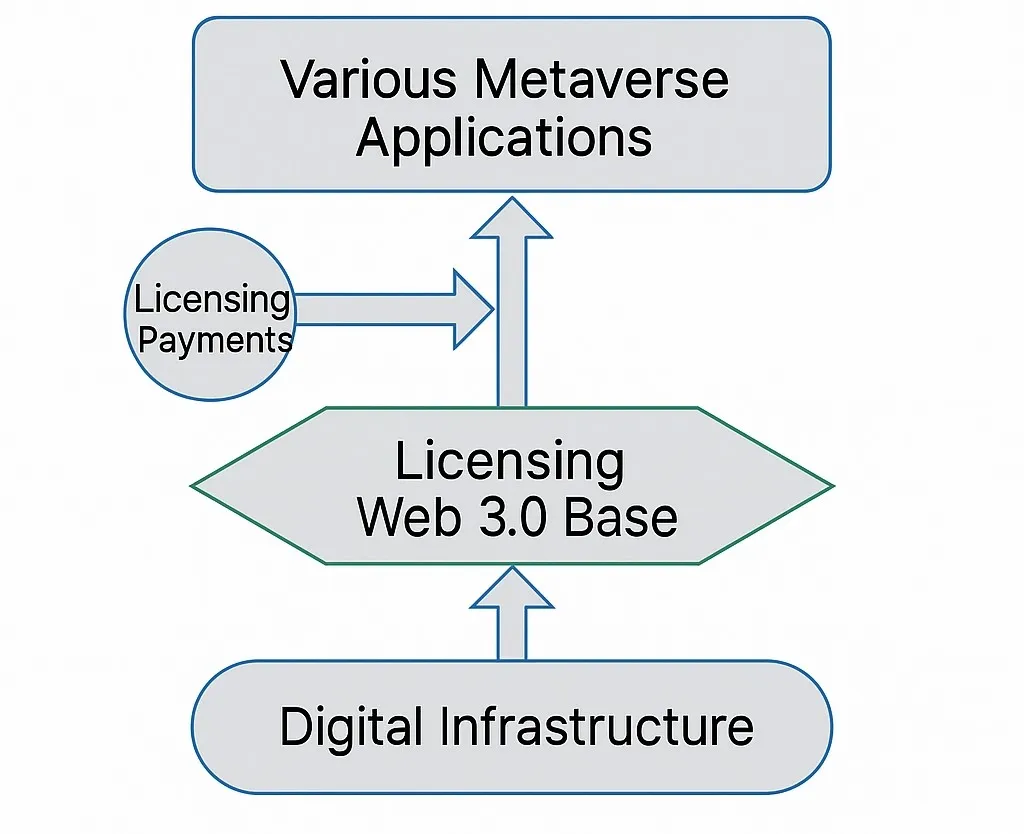
In communications, China established a leading global position in 5G and has forward-looking 6G research involving industry, academia, and research institutions. For compute and algorithms, domestic compute networks can support pervasive real-time computing needs, enabling close coordination among communications, networks, and computing to balance decentralization and system controllability and support domestic and international economic strategies. In interaction media and terminals, progress has been made in AR/VR devices, and China has competitive capabilities in brain-computer interface technologies, which can inform future metaverse access solutions.
In the 1990s, strategist Qian Xuesen proposed the concept of "Lingjing," a Chinese term that can be translated as "genie-environment," anticipating deep human-machine integration. "Ling" refers to intelligent agents, including human avatars and human-machine integrated intelligences that can adapt, modify, or create environments and understand human intent. "Jing" refers to the physical world represented by digital or cognitive twins, where data sensing, transmission, and storage occur. Together, these form future living, working, and learning spaces. Based on this concept, a China-specific metaverse technology foundation integrates sensing, communication, computing, and control.
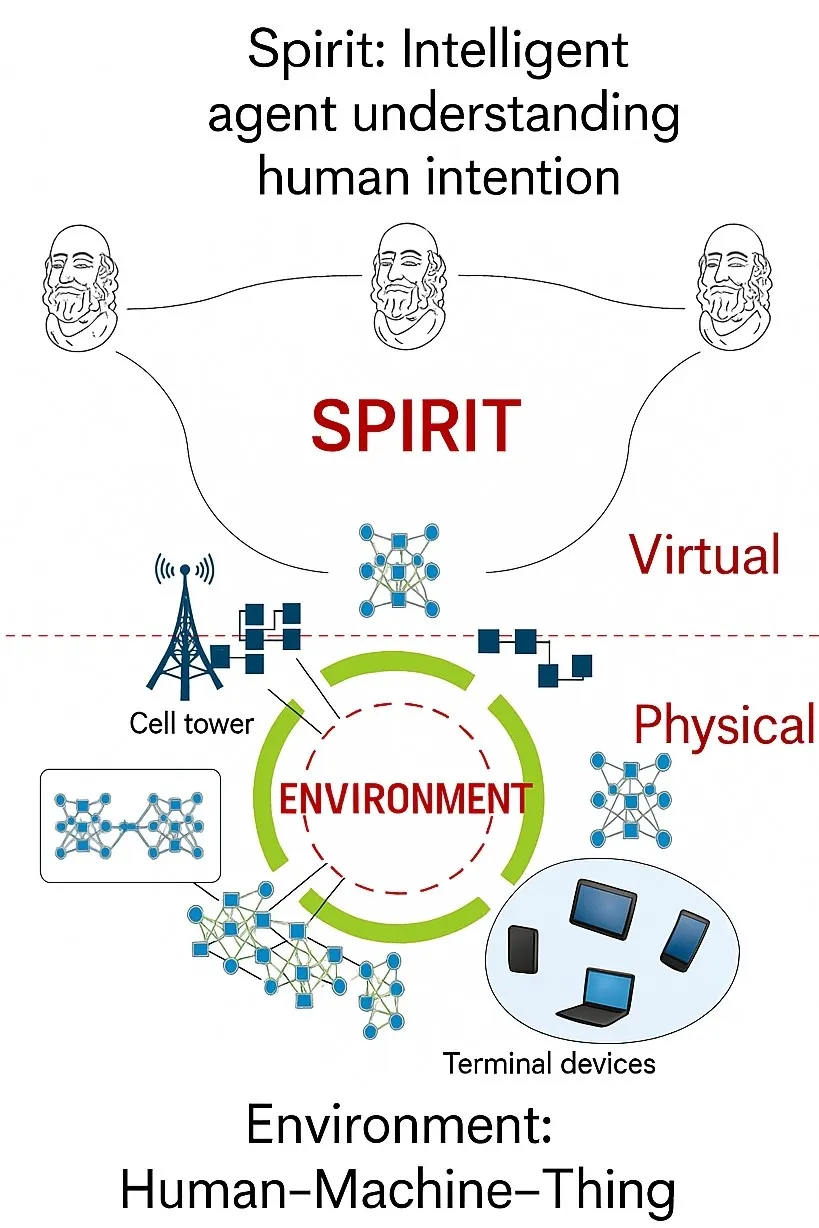
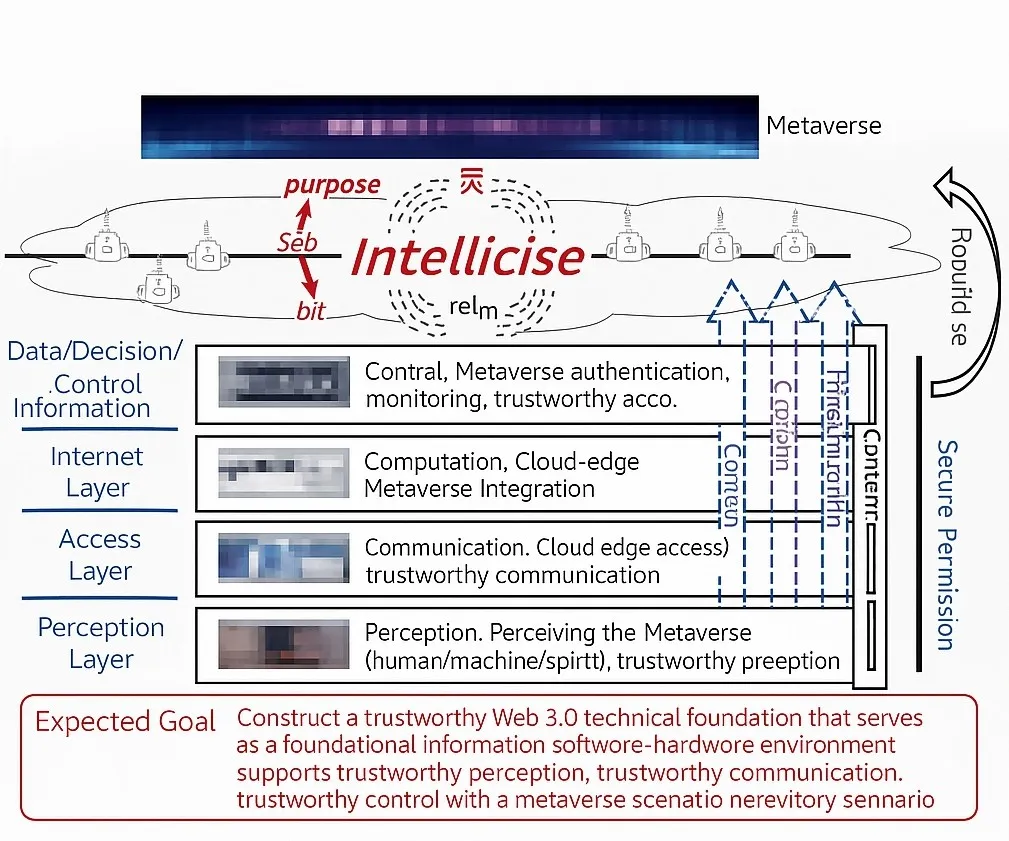
Trusted perception should enable ubiquitous sensing of environments, people, machines, and intelligent agents, covering human senses, brain-computer interfaces, machine vision, and natural language processing in a trustworthy, real-time manner. Trusted transmission requires reliable identity authentication and authenticated transmission schemes. For computing and control, research is needed on privacy-preserving metaverse learning and management, distributed access devices, federated learning in airborne computing, intelligent edge computing, blockchain transport, cloud clusters, and decentralized networks. Previous work on 6G has suggested adding a fourth dimension—intelligence—to the traditional triad of human society, information space, and physical world to enable real-time virtual service scenarios mediated by intelligent agents.
Recommendations and Conclusion
Developing an evolved metaverse centered on pervasive intelligent connectivity requires three core areas: foundational theory research, core technology breakthroughs, and major applications. Foundational research must tackle frontier questions such as how to represent and preprocess intelligence ("Ling") and how to decompose consciousness-related constructs. Core technology efforts must bridge virtual and real domains and support interaction between intelligent virtual agents and human-machine-physical environments. Demonstration applications should lead the formation of international and industry standards, create industry alliances, and prioritize urban governance, smart manufacturing, healthcare, and other sectors. Combining digital twins, artificial intelligence, and related technologies can drive industrial adoption and support national digital economy strategies.
The metaverse is a component of China-style modernization and emerging development strategies with implications for national security, economic prosperity, and social progress. Building an autonomous, controllable metaverse infrastructure and ecosystem is a strategic imperative and the timing to act is mature.