ALLPCB


Overview
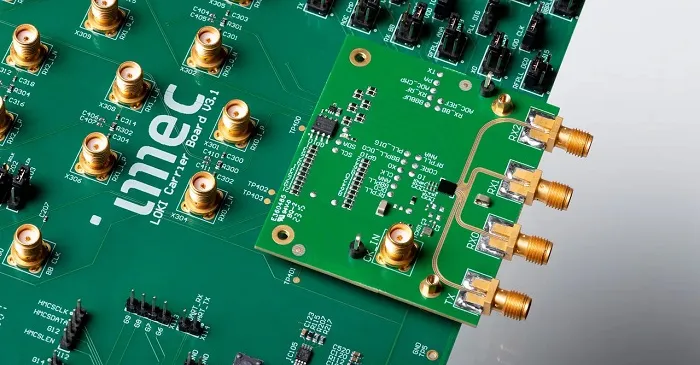
At symposium, research center imec presented an IEEE 802.15.4z-compliant impulse-radio ultra-wideband (IR-UWB) transceiver designed for high-precision ranging. The silicon-based transceiver achieves 1.4 mm ranging accuracy while maintaining very low power consumption, which could enable new automotive use cases such as in-cabin child presence detection and driver monitoring using on-chip UWB radar.
IR-UWB Advantages and Challenges
IR-UWB is being adopted for many applications across automotive, smart industrial, smart home, and IoT domains because of its precise ranging and localization capabilities. It can locate assets in warehouses, hospitals, and factories with centimeter-level accuracy and assist navigation in large public spaces. IR-UWB offers substantially better ranging precision than narrowband technologies such as Bluetooth, but it typically requires more complex circuitry and had higher power consumption.
imec Transceiver: Key Specs
imec's 6–9 GHz IEEE 802.15.4z-compatible IR-UWB 3Rx-1Tx transceiver is fabricated in 28 nm CMOS. The transceiver occupies 1.33 mm2 of silicon area and achieves ranging precision down to 1.4 mm. Despite the accuracy, the chip maintains a small power budget, consuming 8.7 mW in continuous transmit and 21 mW in continuous receive modes. The design also meets UWB international spectrum emission regulations with margin.
Architectural Highlights
The transceiver's low power is attributed to a highly optimized, low-power, interference-resistant receiver architecture and an innovative digital polar transmitter architecture. A distributed two-stage all-digital phase-locked loop further reduces power and helps shorten positioning measurement time. To improve ranging performance while complying with spectrum regulations, the system uses an analog finite impulse response (FIR)-based transmit pre-emphasis method for advanced, flexible pulse shaping.
Context and Collaboration
imec has previously demonstrated a sub-5 mW UWB transmitter chip for the IEEE 802.15.4z standard in 2021 and a UWB radio capable of supporting data rates up to 1.66 Gb/s for high-data-rate, low-power applications in 2022. imec describes the new transceiver as a step toward supporting multiple use cases that combine UWB ranging, communication, and radar functions, including automotive in-cabin presence detection and driver monitoring, where measurement accuracy and energy efficiency are critical.
To support commercialization, imec is collaborating with industry partners. One partner in the UWB ecosystem is CEVA. CEVA states that combining its UWB 802.15.4z modem and CCC/FiRa MAC with imec's transceiver aims to provide a low-power, low-latency, high-precision ranging architecture that complements the transceiver's capabilities.