ALLPCB


Overview
Although the recent Huawei Mate 60 Pro has generated considerable attention in the high-end smartphone market, the iPhone 15 series remains a high-profile topic. This article is a translation of a comprehensive teardown by the US teardown site iFixit, focusing mainly on the 15 Pro Max with references to other models.
Design and Architecture
For years, smartphones tended to open either from the front (making battery replacement difficult) or from the back (making screen replacement difficult). Apple addressed this trade-off on the standard iPhone 14 by enabling access from both the front and the back, which improved repairability scores. The iPhone 15 and 15 Plus inherit that advance. The internal components are mounted on a central frame.
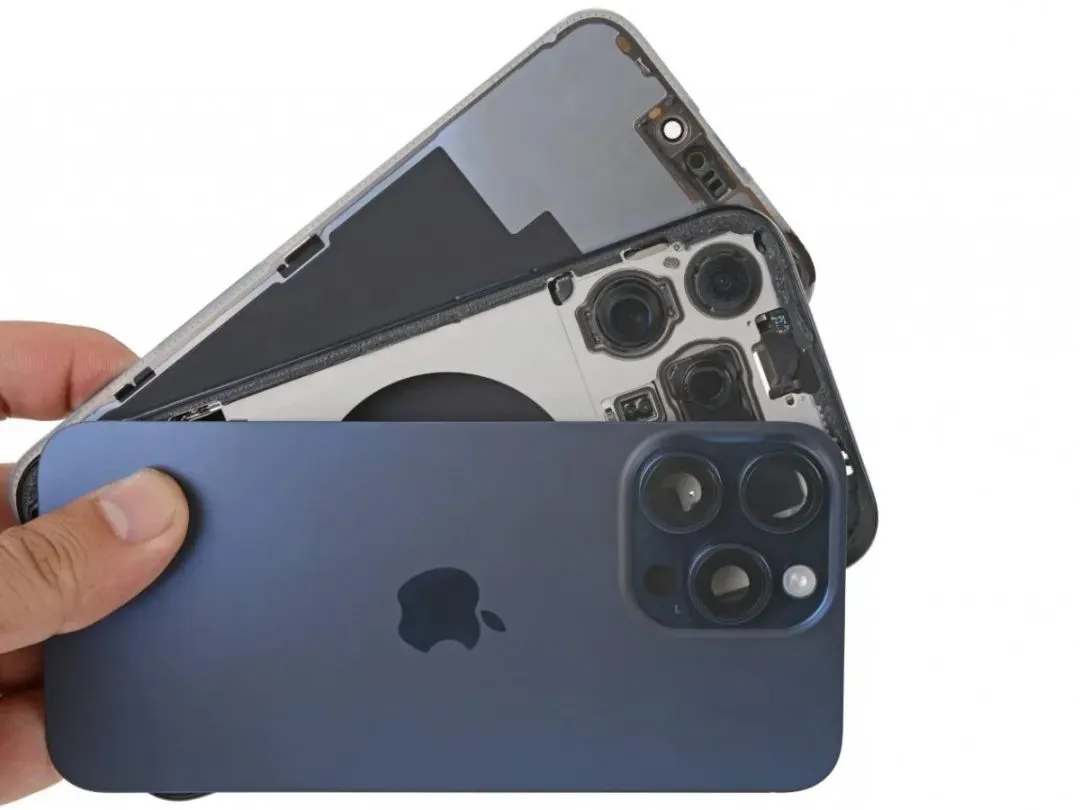
The iPhone 15 Pro and Pro Max can also be opened from both directions, but in an unexpected way: most internal structures are still accessed from behind the display rather than through the rear glass, although the rear glass itself is removable like on the iPhone 14. Apple highlighted this internal architecture in its keynote, noting a new structural frame that makes rear glass replacement easier.
Source: iFixit
This inverted layout increases the risk for certain repairs such as battery replacement compared with the iPhone 14, because technicians must remove the expensive and fragile display rather than the rear glass. To access the battery and other components, the display must be heated and pried open, which raises the chance of damaging display cables. In some cases, if a cable is torn, it is preferable to tear the rear glass cable rather than damage the display.
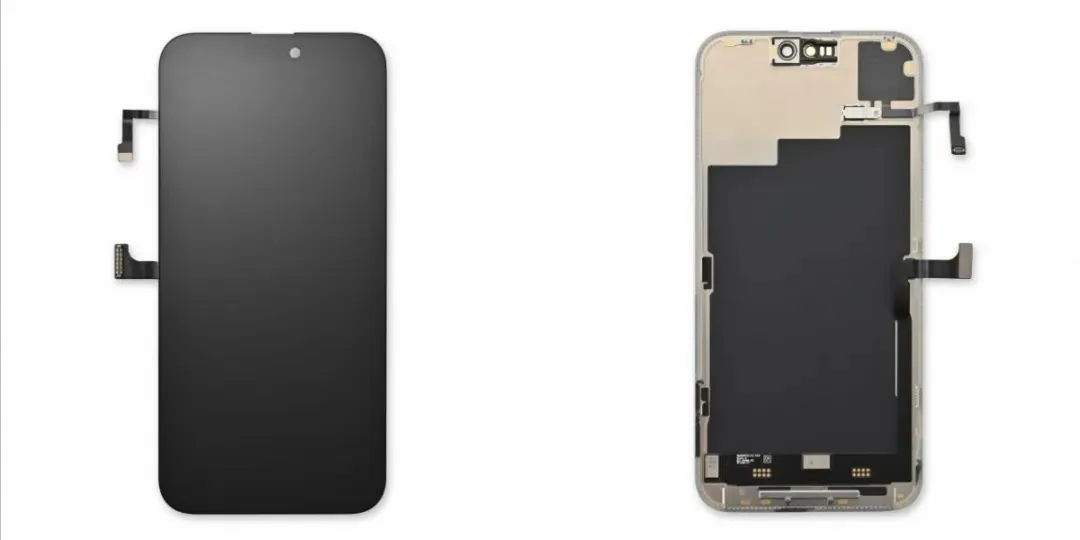
iPhone 15 Pro Max front and back view. Source: iFixit
Apple continues work on narrow display bezels. Some reported that the white gasket around the display is new; in fact it is the same gasket that was previously black, only the color has changed. The design differs slightly from earlier phones and some report it is a bit harder to remove.
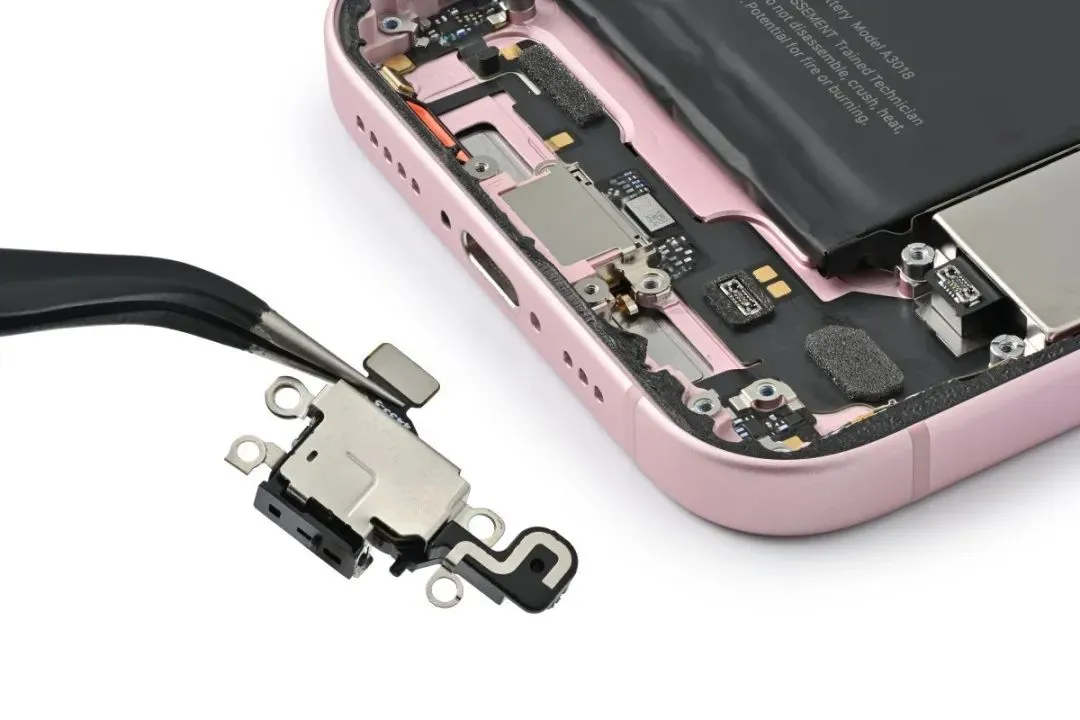
Source: iFixit. Many components in the iPhone 15 series are modular; for example, the microphone is now a distinct module.
USB-C
Apple resisted industry standardization for years, but the move to USB-C was ultimately driven by regulation in Europe requiring a common connector. The change offers compatibility advantages and increases the port's power delivery to external devices to 4.5 W, compared with about 0.3 W for the previous Lightning port.
Two earlier rumors about the charging port proved unfounded. First, the port is not serialized or locked to a motherboard pair; swapping two ports preserves full functionality. Second, Apple did not limit USB-C transfer rates for non-technical reasons. The A17 SoC adds a USB 3 controller supporting USB 3.2 Gen 2 (10 Gbps). Non-Pro iPhone 15 models retain the A16 Bionic and therefore are limited to USB 2 speeds comparable to prior Lightning devices.
Battery
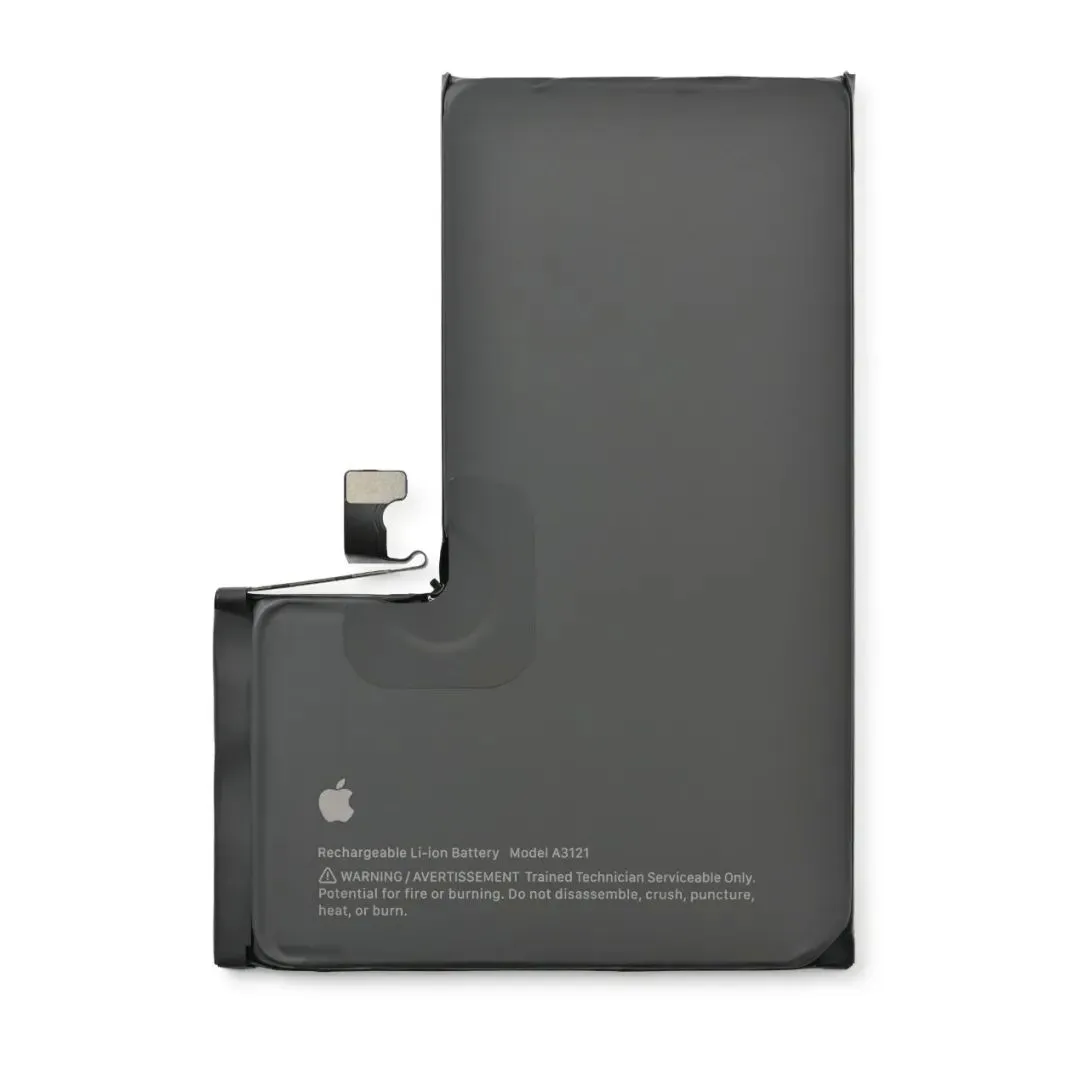
The iPhone 15 Pro Max battery is 4422 mAh, up 2.3% from the 4323 mAh in the 14 Pro Max. The iPhone 15 Pro battery is 3274 mAh, up 2.3% from the 3200 mAh in the 14 Pro. Overall battery capacity increases are modest, which may be concerning given the higher power consumption of the A17 Pro. Reports have noted increased heat and reduced battery life in some usage scenarios.
Source: iFixit
Titanium Frame
The new iPhone Pro Max weighs 221 g, 19 g lighter than the iPhone 14 Pro Max. Apple reduced mass at the perimeter by switching from stainless steel to titanium, which lowers the moment of inertia and makes the phone feel more maneuverable in the hand, beyond the actual percentage weight reduction.
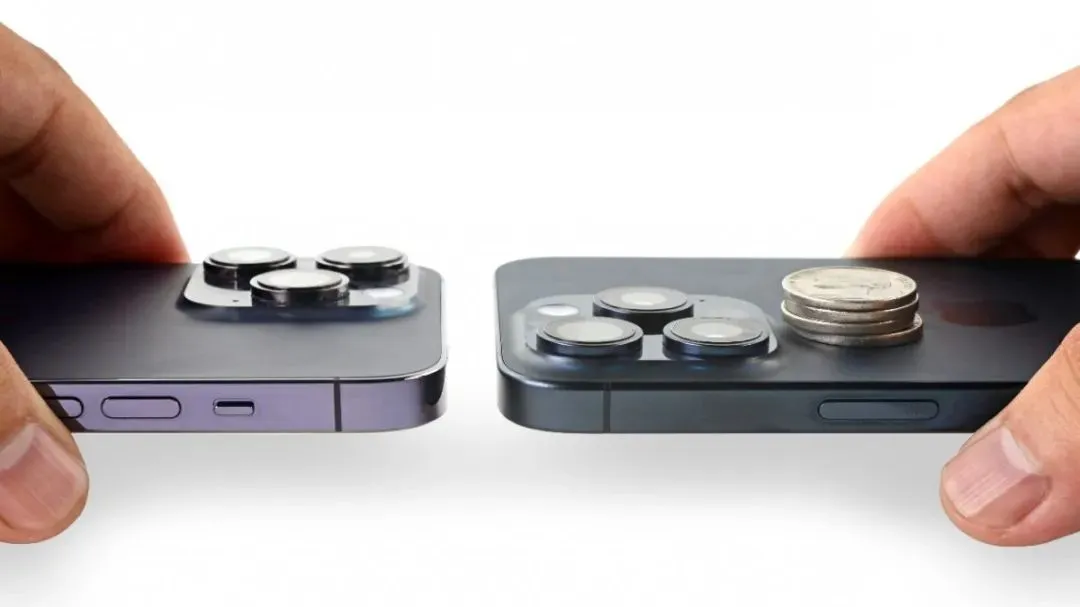
Left: iPhone 14 Pro Max 221 g. Right: iPhone 15 Pro Max plus four nickels 222 g. Source: iFixit
Apple uses an advanced metallurgical process to apply a titanium band around a new lower structure made from 100% recycled aluminum. The two metals are bonded with high strength using a solid-state diffusion process. The aluminum inner frame helps with heat dissipation and makes the rear glass easier to replace.
The diffusion bonding process likely involves heating two different metals to very high temperatures, creating a high vacuum, and applying very high pressure to form a solid-state bond. This is an expensive and technically demanding process, typically reserved for aerospace parts rather than mass-production smartphone frames.
There are sustainability implications. Recyclers accustomed to processing steel and aluminum may not be set up for titanium, and titanium fragments can damage shredding equipment. However, iPhones often receive special handling due to their residual value. While titanium itself is durable, surface coatings on the titanium band can be easily scratched.
Electronics
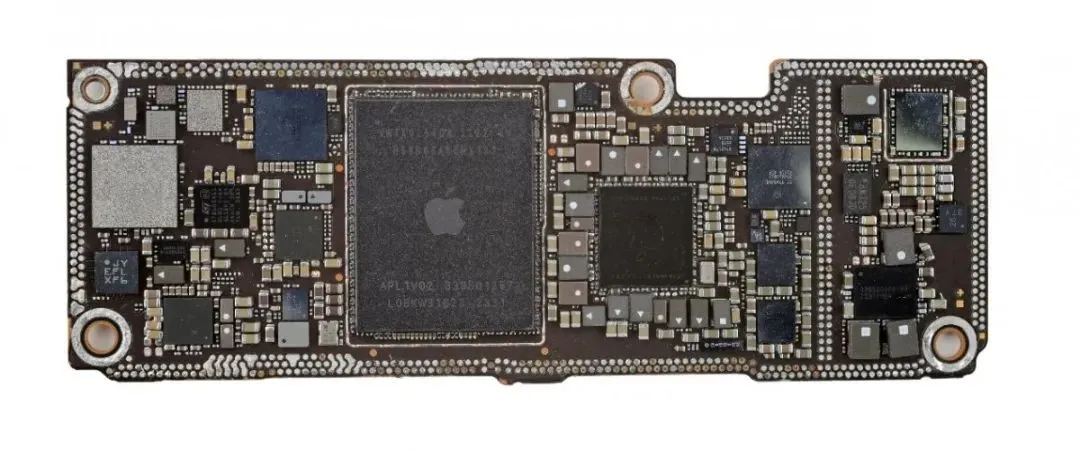
Contrary to some expectations, Apple did not ship an in-house 5G modem. The teardown confirmed that Apple uses Qualcomm's high-end Snapdragon X70 modem, which Qualcomm describes as AI-enabled for beam management and antenna tuning. The Apple A17 Pro six-core application processor includes a six-core GPU and is likely mounted above SK Hynix DDR5 memory.
Source: iFixit
The A17 Pro is manufactured on TSMC's leading 3 nm process. Rumors suggest limited yields for the process, making it an expensive component and constraining supply.
Cameras
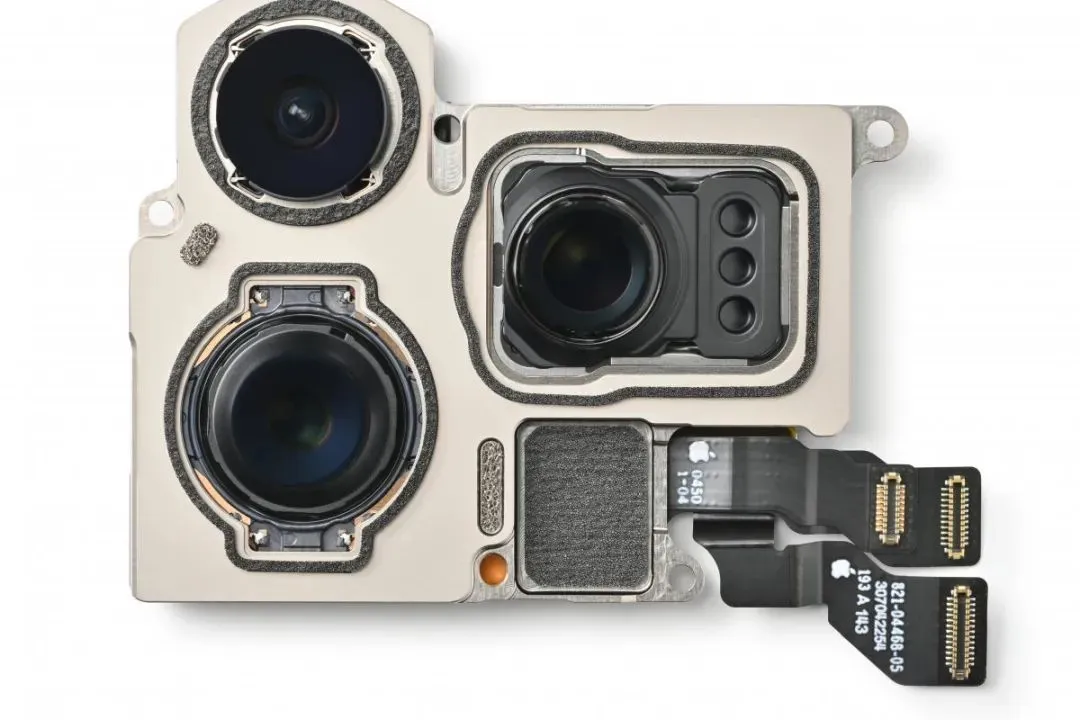
The major camera upgrade this year is a quad-prism periscope telephoto lens that increases optical zoom from 2x to 5x. Samsung's Galaxy S23 Ultra offers higher nominal zoom, but Apple's approach is notable. The "quad-prism" term describes a multi-element reflective periscope that simulates an approximately 120 mm focal length.
Source: iFixit
Rather than using a sequence of electromagnetically actuated lens elements, Apple designed a single periscope unit that reflects light multiple times to achieve a long focal length while keeping module thickness low. Aside from the periscope, the main and wide sensors on the iPhone 15 Pro Max appear to be the same size as last year's 14 Pro Max sensors, suggesting that image quality improvements may be driven more by the A17 Pro image processing than by larger sensors.
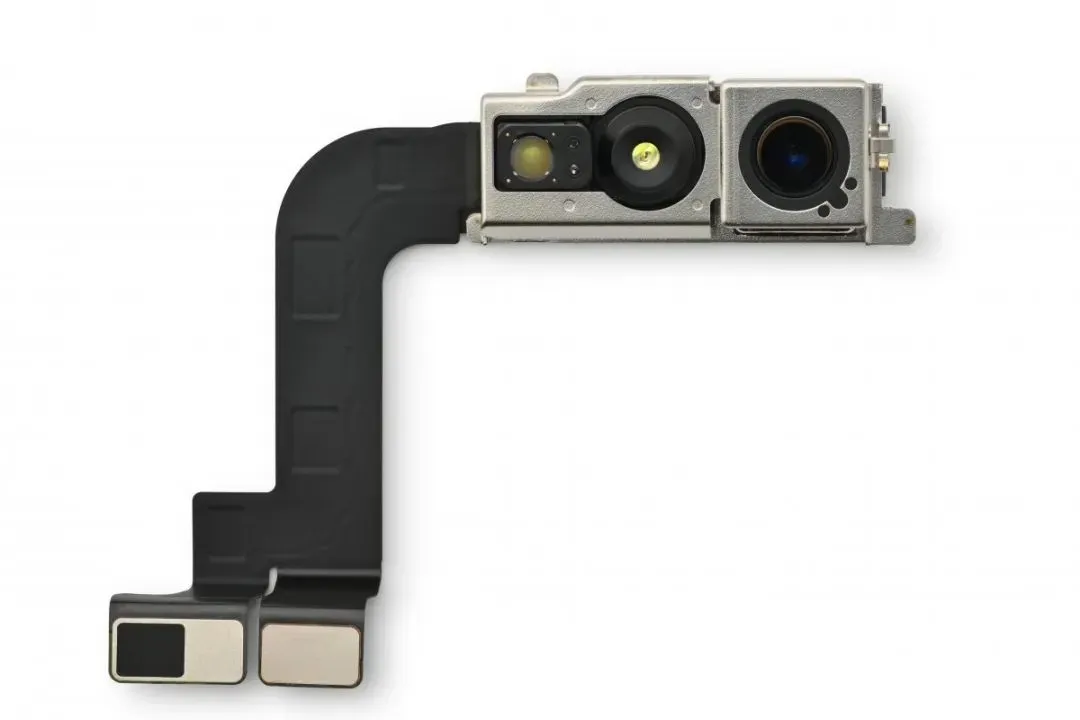
Source: iFixit
One surprising observation is that the screws securing the cameras are significantly larger than before. The reason for this change is not clear.
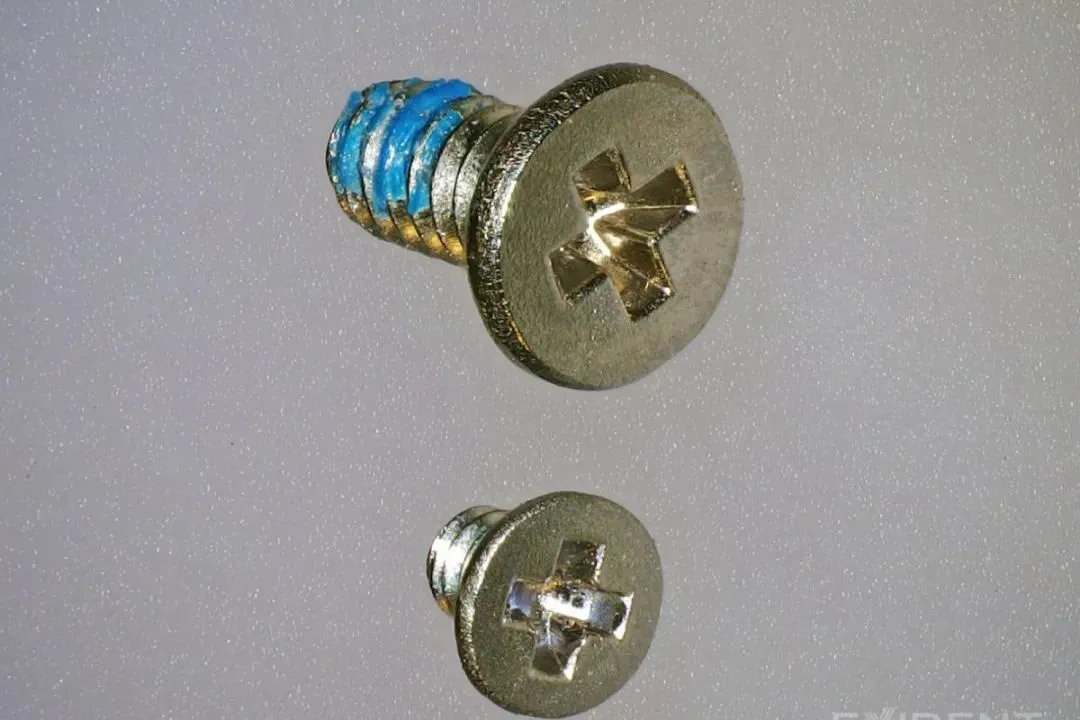
Top: iPhone 15 camera screws; Bottom: iPhone 14 camera screws. Source: iFixit
Part Pairing and Repair Limitations
Although the iPhone 15 series continues modular mechanical design, part pairing remains an issue. Swapping certain parts between two iPhone 15 Pro Max units resulted in nonfunctional components. Last year this appeared as a fixable bug; now the issue is persistent.
These parts require electronic authentication and pairing through Apple's system configuration tools. Without proper pairing and calibration, parts either do not work or operate with degraded functionality and warnings. This restriction limits independent repair options and has implications for electronic waste management.
iFixit purchased two iPhone 15 Pro Max units and swapped their lidar modules. The Camera app initially loaded and then crashed consistently. The team systematically tested components across identical new devices to determine which modules are repairable and which are effectively locked. The lidar module used for augmented reality and Vision Pro content creation was fully locked to its original device in the iPhone 15 Pro Max.
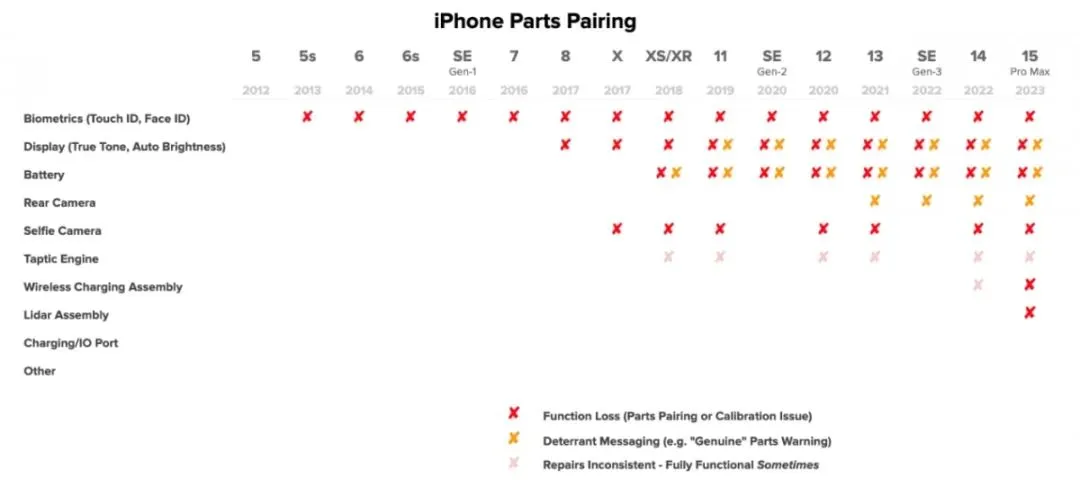
Source: iFixit
These pairing systems extend beyond simple mechanical compatibility and require Apple-specific verification. The result is further restriction of genuine part replacements supported by Apple and additional barriers for independent repair shops. Similar trends have been observed on MacBooks and iPads, indicating a broader tightening of repairability through software restrictions. Such limitations impact ownership rights and could exacerbate electronic waste issues.
Repairability Score
iFixit's provisional repairability score for the iPhone 15 Pro Max, 15 Pro, 15 Plus, and 15 is 4 out of 10. This score is temporary pending the availability of official service manuals and the sale of repair parts, which have not yet been fully published by Apple. Software-based restrictions significantly affect practical repairability even when mechanical design appears modular. Due to these limitations, iFixit stated they will not purchase iPhone 15 units for internal use when scores are below 5.