ALLPCB


Overview
Single-photon detection capability has driven progress across many research areas. Although various types of single-photon detectors have been developed, many require low-temperature operation and are incompatible with complementary metal-oxide-semiconductor (CMOS) fabrication processes. To date, silicon-based single-photon avalanche diodes (SPADs) are the only devices that have been successfully integrated into consumer electronics products.
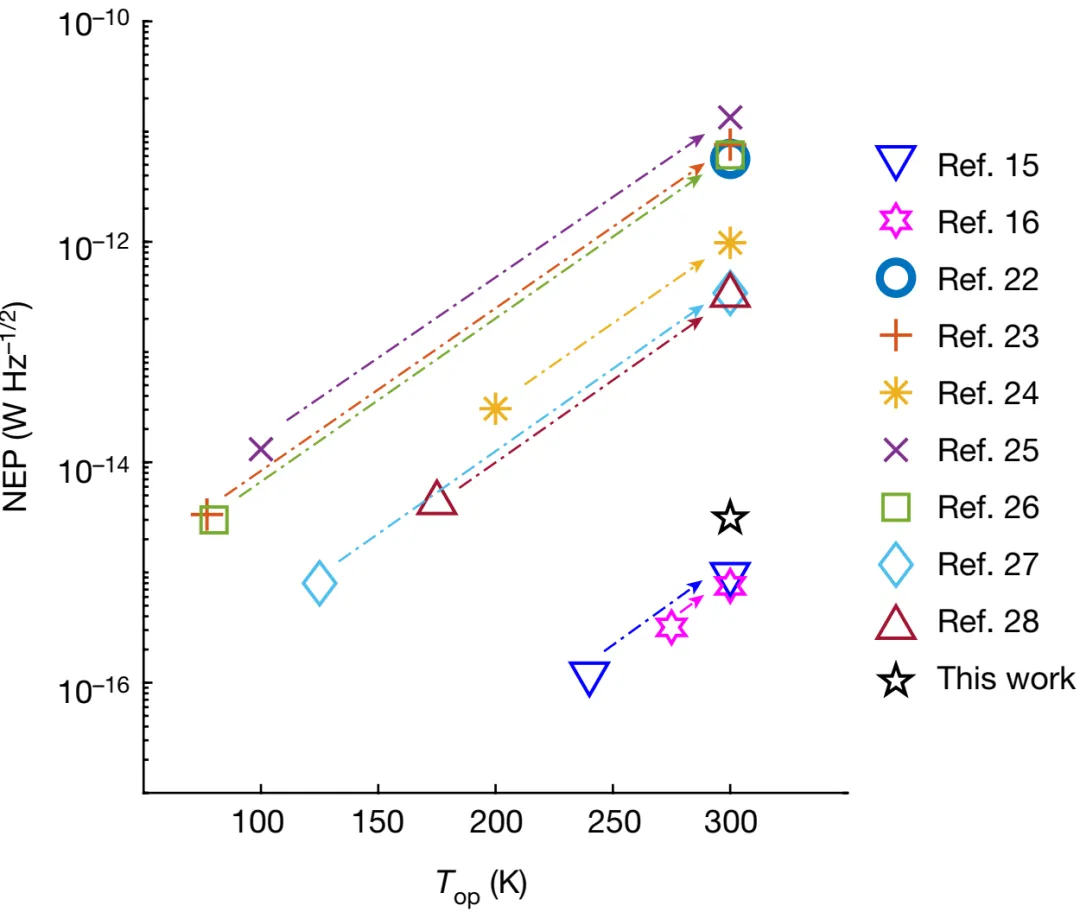
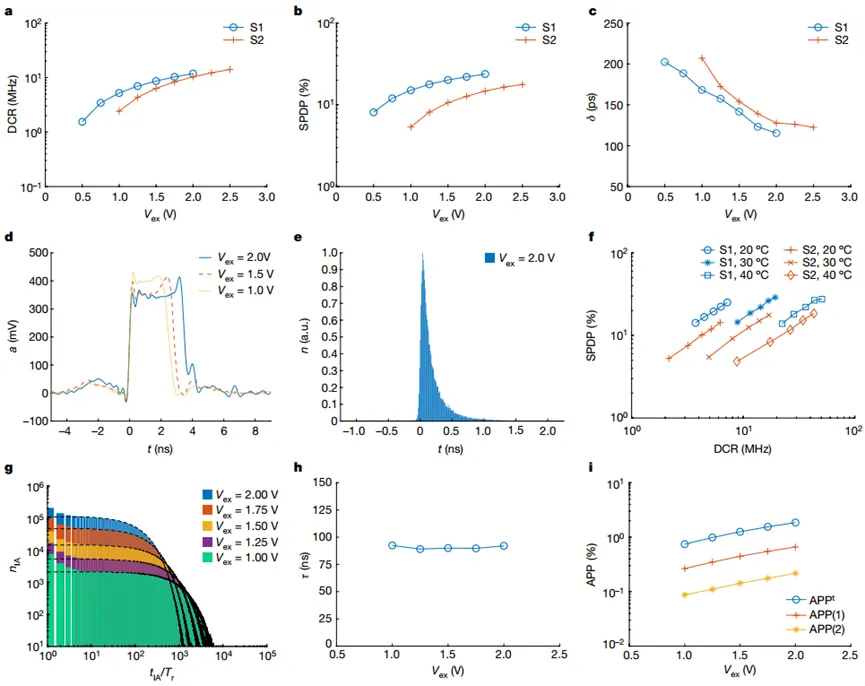
Researchers at Artilux Inc. reported a CMOS-compatible, high-performance germanium-silicon (GeSi) SPAD that operates at room temperature. The device exhibits a noise-equivalent power (NEP) that is 2 to 3.5 orders of magnitude better than previously reported Ge-based SPADs. Key metrics include a dark count rate (DCR) of 19 kHz μm^-2, a single-photon detection probability of 12% at 1310 nm, timing jitter of 188 ps, an afterpulse characteristic time of ~90 ns, and an afterpulse probability <1%. The device also shows a low breakdown voltage of 10.26 V and a small excess bias of 0.75 V. The authors note future directions including (1) reducing device area to develop sensing and imaging pixels with pitch below 10 μm; (2) minimizing contact resistance; and (3) heterogeneous integration with CMOS circuits via wafer-level bonding.
GeSi SPAD Device Characterization
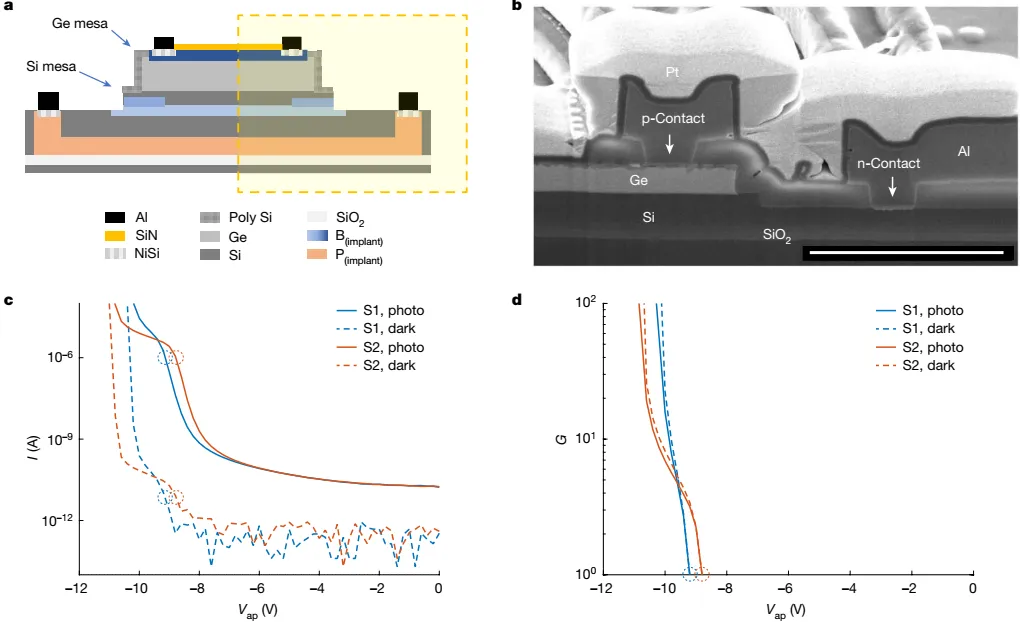
The article present wafer-level I-V measurements showing that, at room temperature, the demonstrated GeSi SPAD achieves the lowest primary dark current and lowest DC R among reported Ge-based APDs or SPADs. The DCR increases by approximately 2.5 times for every 10°C rise in temperature, suggesting that defects with energy levels near the Ge band edges are a dominant source of DCR and can be further reduced through process optimization. Additional measurements, including afterpulsing and other parameters, indicate that the presented GeSi SPAD performance may already surpass that of some previously reported InGaAs-based SPADs.
LiDAR System Demonstration
As a proof of concept, the article demonstrated the use of the GeSi SPAD in direct time-of-flight (TOF) LiDAR. Three-dimensional scanning and imaging were performed by replacing a variable optical attenuator with a coaxial transceiver; the coaxial transceiver uses x-y galvanometer mirrors to steer emitted laser pulses and to collect returned pulses along the same optical path. The demonstration validates the potential of GeSi SPADs for direct-TOF LiDAR applications.