ALLPCB


Overview
In a small company, a single person may be responsible for an entire project, including hardware, software, and testing. In more structured organizations, work is divided so that software development and testing are separate roles. To avoid disputes between development and testing teams, well-written test cases are important.
Are test cases necessary?
Coding is demanding, and writing documentation takes additional time. Junior engineers may not immediately appreciate the value of documentation, but disputes with colleagues often reveal its importance. Writing technical documentation is an essential skill for engineers. In my company, although relatively small (about 100 employees), each project produces a variety of documents, typically at least 50–60 and sometimes over a hundred.
Although documentation requires time up front, it brings multiple benefits: it reduces disputes between colleagues, lowers maintenance costs, and improves development efficiency and schedule.
What is a test case?
A test case is a description of the testing tasks for a specific software product, reflecting the test plan, methods, techniques, and strategies. Typical contents include test objectives, test environment, input data, test steps, expected results, and test scripts, which together form a document. In simple terms, a test case is a set of inputs, execution conditions, and expected results prepared to verify whether a specific software requirement is met.
Put plainly, test cases are testing instructions written for the testing team; testers execute tests according to those instructions.
Example: Serial Port Check
Pass criteria: Receive valid data.
Test method
- Use an RS-485 serial converter board to connect CON23 pin 1 (N) and pin 3 (P).
- After the mainboard powers on and runs normally (about 5 seconds), open a serial terminal and check whether UART 433 outputs data.
3A 2B 00 AA 56 55
Notes
If garbled characters appear, the pins may be connected in reverse. Try swapping pin 1 and pin 3.
How to write test cases
Test cases vary by project, but the principles are similar. They are technical documents that developers prepare for the testing team.
Main content
The main body of a test-case document normally covers:
- Pass criteria
- Test method
- Notes and precautions
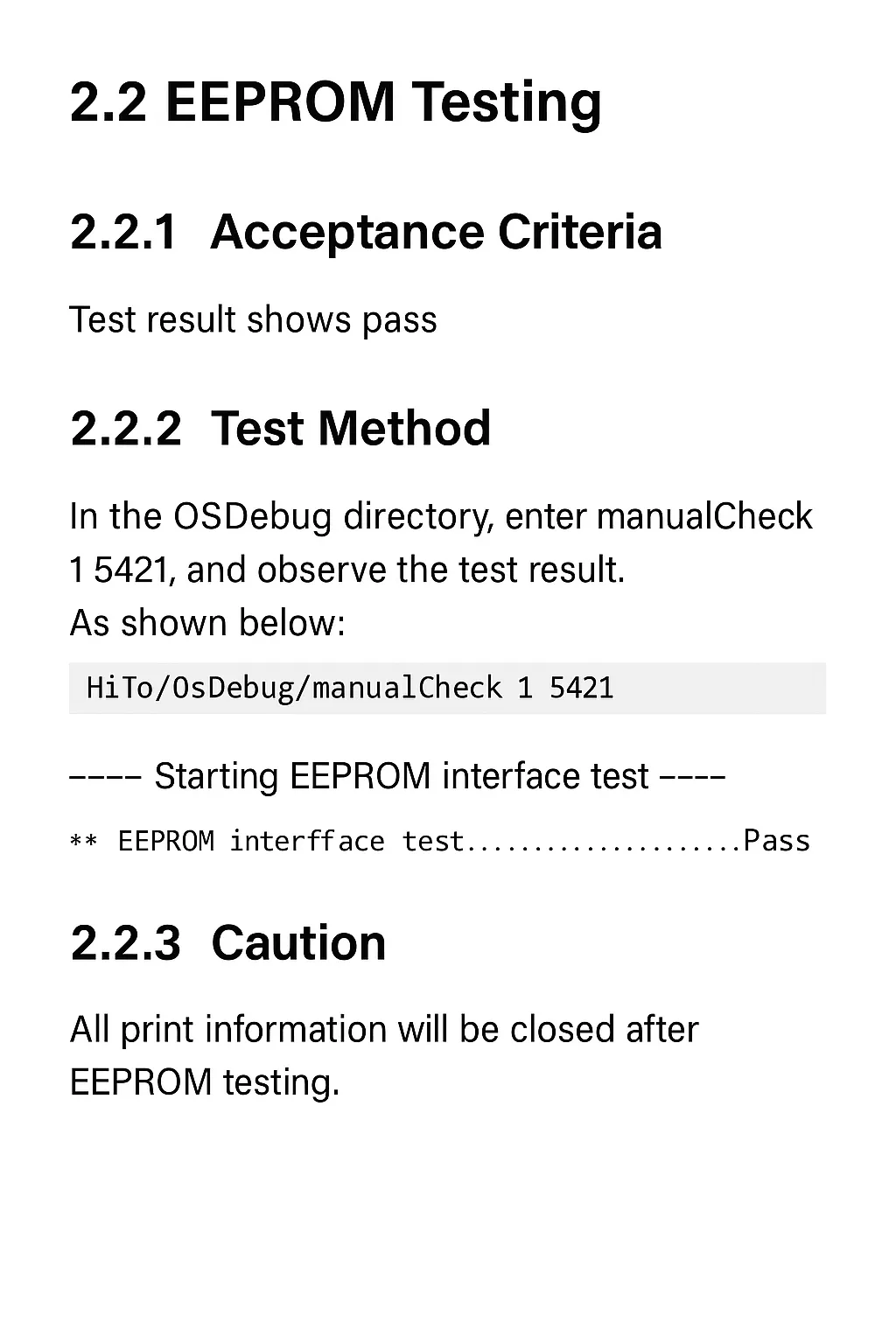
Debugging and test procedures should be developed together with engineers. For example, software engineers can add debug interfaces to the CLI so that test personnel can send commands through the CLI for debugging. For example, an EEPROM/ROM check:
I will not expand on further details here; specifics require hands-on practice. If you have worked in development for many years and are still unfamiliar with test cases, it is advisable to review your practices and experience.