ALLPCB


Overview
One key to improving verification productivity is thinking at the appropriate level of abstraction. UVM provides transaction-level communication interfaces for this purpose.
Transactions
In UVM, transactions model the information required for communication between two components (variables, constraints, etc.). Below is a simple bus-protocol transaction example:
class simple_trans extends uvm_transaction;
  rand data_t data;
  rand addr_t addr;
  rand enum {WRITE, READ} kind;
  constraint c1 { addr < 16'h2000; }
  ...
endclass
After defining transactions, an interface that operates on those transactions must be provided.
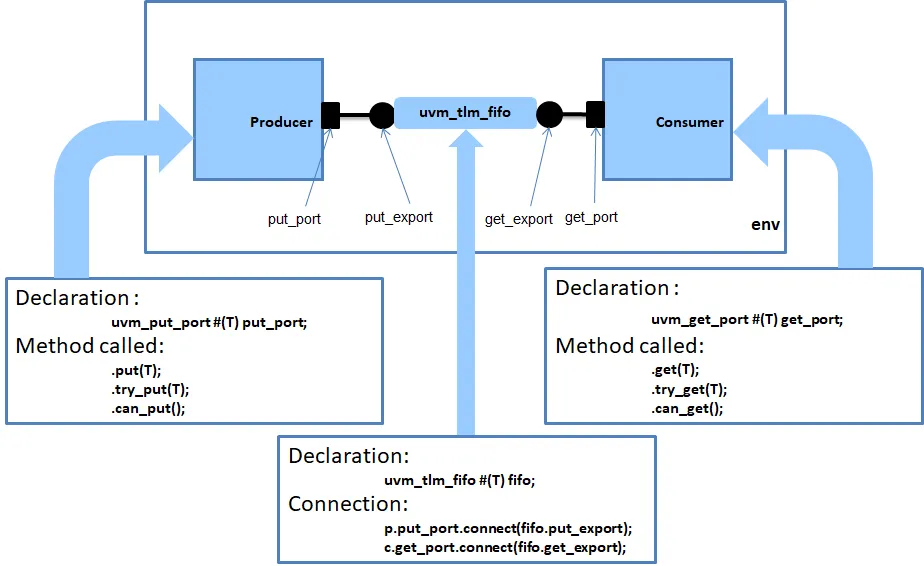
TLM ports initiate transaction operations; TLM exports provide concrete implementations of those transaction methods.
Basic TLM Communication: put operation
The most basic transaction-level operation is one component putting a transaction to another component.
In the diagram, the square on the producer represents a port; the circle on the consumer represents an export.
class producer extends uvm_component;
  uvm_blocking_put_port #(simple_trans) put_port; // 1 parameter
  function new(string name, uvm_component parent);
    put_port = new("put_port", this);
    ...
  endfunction
  virtual task run();
    simple_trans t;
    for (int i = 0; i < N; i++) begin
      // Generate t.
      put_port.put(t);
    end
  endtask
endclass
The producer declares a uvm_blocking_put_port parameterized with simple_trans, then issues put operations inside its run() task.
class consumer extends uvm_component;
  uvm_blocking_put_imp #(simple_trans, consumer) put_export; // 2 parameters
  ...
  task put(simple_trans t);
    case (t.kind)
      READ:  // Do read.
      WRITE: // Do write.
    endcase
  endtask
endclass
The consumer declares a uvm_blocking_put_imp parameterized with simple_trans and specifying the implementing component. The put() method implementation resides in the consumer.
Basic TLM Communication: get operation
The get transaction-level operation is similar to put.
In the diagram, the square on the get_consumer represents a port; the circle on the get_producer represents an export.
class get_consumer extends uvm_component;
  uvm_blocking_get_port #(simple_trans) get_port;
  function new(string name, uvm_component parent);
    get_port = new("get_port", this);
    ...
  endfunction
  virtual task run();
    simple_trans t;
    for (int i = 0; i < N; i++) begin
      // Generate t.
      get_port.get(t);
    end
  endtask
endclass
The corresponding export implements the get operation:
class get_producer extends uvm_component;
  uvm_blocking_get_imp #(simple_trans, get_producer) get_export;
  ...
  task get(output simple_trans t);
    simple_trans tmp = new();
    // Assign values to tmp.
    t = tmp;
  endtask
endclass