ALLPCB


Overview
France Pixee Medical's augmented reality (AR) knee replacement navigation system Knee+ received CE certification. It is the first orthopedic navigation system approved for use with AR in total knee arthroplasty. Similar AR applications in surgical navigation are expanding worldwide. AR-assisted surgical techniques have significance for preoperative planning, intraoperative guidance, and postoperative rehabilitation. This article explains basic concepts, technical principles, market status, major companies and representative products, and discusses future development.
Basic Concepts
Augmented Reality (AR)
Augmented reality (AR) overlays computer-processed virtual model images onto real scenes to enhance perception of the physical environment. AR integrates virtual scenes, objects, and contextual cues (for example audio, video, graphics, or GPS data) into the real scene to provide enhanced information. The foundational discipline for AR is computer vision. AR systems use displays, cameras, and sensors to superimpose digital information on the real world.
Surgical Navigation Systems
Surgical navigation aligns preoperative or intraoperative patient imaging with the patient anatomy, tracks instruments during surgery, and updates instrument position on patient images in real time as a virtual probe. Navigation provides clear instrument location information, enabling faster, more precise, and safer procedures. After years of development, navigation has become standard in neurosurgery and is increasingly used in other specialties. In the United States, the annual number of navigation-guided procedures reached 578,375, and is projected to grow to 718,224 by 2025. In the U.S., navigation is most commonly used in neurosurgery, accounting for about 43.3% of cases; in Europe, total knee arthroplasty (TKA) is a common application.
Technical Principles
AR surgical navigation systems have three core components: virtual image or environment modeling, registration between the virtual environment and real space, and display technologies that combine virtual and real environments.
1. Virtual Image or Environment Modeling
AR systems reconstruct sub-surface 3D targets from CT or MRI tomographic imaging by exploiting differences in color or texture between anatomical structures and using angiography when needed. Non-photorealistic rendering or inverse reality techniques can improve visualization and depth perception.
2. Registration Between Virtual Environment and Real Space
Registration can be accomplished by multiple methods. Frame-based techniques using a three-dimensional Cartesian coordinate system can determine the position and orientation of imaging devices.
3. Display Technologies Combining Virtual and Real Environments
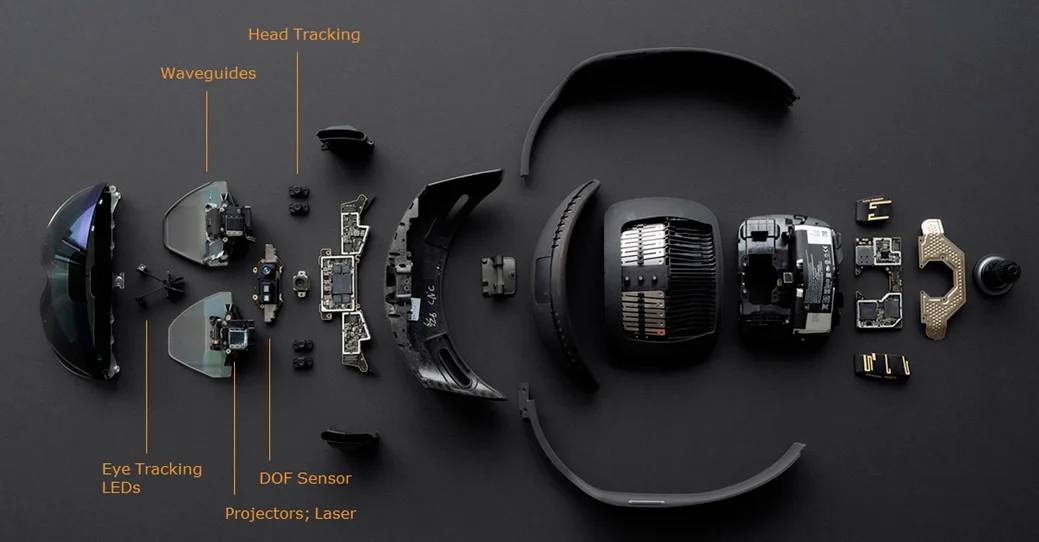
Display technologies broadly include head-mounted displays (HMD), augmented external displays, augmented optical systems, augmented window displays, and image projection. HMDs can overlay virtual environments onto the user's view of the real world (optical see-through) or onto video of the real environment (video see-through). Augmented external displays are standalone screens that show virtual content over video of the real world. Optical augmentation enhances surgical microscopes or binocular eyepieces directly. Window augmentation places a semi-transparent screen above the surgical field to display virtual objects overlaying real anatomy. Virtual environments can also be projected directly onto the patient using projectors.
Market Situation
AR applications in healthcare are growing strongly, with an estimated compound annual growth rate (CAGR) of about 33.36%. Market value is projected to increase from $627 million in 2018 to $3.497 billion in 2024. AR is gaining attention from clinicians across a broad range of uses, from surgical preparation assessment to minimally invasive surgery and rehabilitation. According to Research and Markets, the global surgical imaging market is expected to reach $1.7 billion by 2025, with a CAGR of 5.4% during the forecast period. Advances in real-time visualization platforms are improving surgical treatments. Additional drivers include increasing government funding, a rise in sports injuries, and an aging population. By application, the market is segmented into neurosurgery, orthopedic and trauma surgery, cardiac and vascular surgery, general surgery, and other specialties.
Future Development of AR Surgical Navigation
AR in clinical surgery spans computer science, computer vision, sensors, communications, clinical medicine, and ergonomics, involving a wide range of technologies. Future tracking and image processing are likely to shift toward intelligent methods such as deep learning. Displays and sensors will trend toward technologies closely integrated with human anatomy, such as retinal displays and symbiotic human-machine interfaces.
Challenges remain for AR-assisted surgery, including rendering realistic 3D virtual objects within the real scene for certain display technologies; temporal synchronization between virtual and real environments, especially during rapid perspective changes; the need for specialized computing teams for some image compositing tasks; compatibility and interoperability between AR navigation systems and related devices and solutions; and data privacy concerns.
Conclusion
Surgical navigation is a key application of AR technology. In the era of image-guided surgery, AR represents the next frontier for integrating guidance systems into surgical workflows. With rapid advances in display and interaction technologies, AR's role in modern operating rooms is expected to grow.