ALLPCB


Overview
Ambient energy is widely available, and traditional energy harvesting has long been applied to solar panels and wind turbines. New transducer types can generate electrical energy from many environmental sources. For many applications the key metric is not peak conversion efficiency but the average harvested energy available to power the circuit. Examples of harvesters include thermoelectric generators that convert heat to electricity, piezoelectric elements that convert mechanical vibration, photovoltaic devices that convert light (from the sun or other photon sources), and hygroscopic or flow-based devices that extract energy from moisture or airflow. These sources can power remote sensors or trickle-charge energy storage devices such as capacitors or thin-film batteries so that microprocessors or transmitters can be powered without a local mains supply.
Challenges for Energy-Harvested Systems
Because these sources operate at the low end of the power spectrum, milliwatt-to-nanowatt power conversion is increasingly common in wireless sensor networks (WSNs) and sensor nodes. Power-conversion ICs must operate at very low power and current levels, often tens of microwatts and tens of nanoamps. Products that operate with supply currents below 1 μA, including battery chargers, are limited.
Required Power-Management Features
To be practical for energy-harvested applications, power-conversion ICs typically need:
- Low standby quiescent current, often below 6 μA and down to a few hundred nA
- Low startup voltage, possibly as low as 20 mV
- High input-voltage capability, e.g., up to 34 V continuous and up to 40 V transient
- Ability to handle AC inputs
- Multiple outputs and autonomous system power management
- Maximum power point control (MPPC) for solar inputs
- Compact solutions with minimal external components
System Considerations
WSNs are effectively self-contained systems in which sensors convert environmental energy into electrical signals. Downstream components such as DC/DC converters and power managers supply the appropriate voltage and current to a microcontroller, a sensor, and a transceiver. When designing WSNs, an important question is how much energy the system needs. Factors include sampling interval, data packet size, and transmission energy. Transceiver energy can account for roughly half the energy used in a single sensor read and packet transmission. Many factors affect the energy characteristics of an energy-harvesting system and must be considered in the design.
Harvested energy depends on how long the source can supply power, so power density, rather than energy density, is the primary metric for comparing harvesters. Harvested power is typically low, variable, and unpredictable. Most systems therefore use a hybrid architecture that couples an energy harvester to an auxiliary energy storage device. The harvester is the energy source, while the auxiliary storage (a battery or capacitor) can provide higher output power for short durations and is periodically recharged by the harvester. Designers must therefore determine how much energy to store in the auxiliary device to make up for periods when the harvester produces little or no power.
Low-Quiescent Parts for Harvested Power
To be usable, WSNs must operate on extremely low energy budgets, so components must tolerate very low power levels. While low-power transceivers and microcontrollers are available, power conversion and battery charging at submicroampere quiescent levels have been scarce. Linear Technology provides parts that address these requirements: the LTC3388-1/-3 synchronous buck regulator and the LTC4071 battery charger.
LTC3388-1 / LTC3388-3 Features
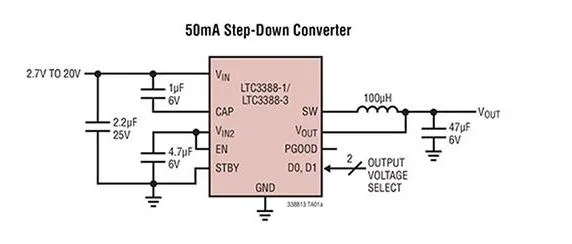
The LTC3388-1 and LTC3388-3 are synchronous buck regulators that accept up to 20 V input and deliver up to 50 mA continuous output current in a 3 mm x 3 mm package or MSOP10-E package. They operate from 2.7 V to 20 V input, making them suitable for various energy-harvesting and battery-powered applications, including always-on circuits, sensors, and industrial control power supplies.
The LTC3388 devices use a hysteretic synchronous-rectification scheme to optimize efficiency across a wide load range. They can achieve over 90% efficiency across a 15 μA to 50 mA load range while drawing only 400 nA of static current, which helps extend battery life when a battery is used as auxiliary storage.
The devices incorporate an accurate undervoltage lockout (UVLO) that disables the regulator when input voltage falls below 2.3 V, reducing static current to 400 nA. When regulated with no load, the part enters a sleep mode that reduces quiescent current to about 720 nA. The buck regulator switches on and off as needed to maintain regulation; an additional standby mode can inhibit switching to support short-term loads that require low ripple, such as wireless modems. These characteristics make the devices well suited to energy-harvesting applications that require long charge cycles and short burst loads for sensors and wireless modems.
LTC4071 Battery Charger
Batteries are commonly used as auxiliary power in WSNs, and charging them from low-power sources presents design challenges. The LTC4071 is a parallel battery charger with integrated battery-protection and low-battery disconnect features that prevent small-capacity batteries from being damaged by self-discharge. The LTC4071 supports lithium-ion and lithium-polymer chemistries and has an ultra-low operating current of 550 nA, enabling charging from previously unusable, very-low-current intermittent or continuous sources such as energy harvesters. An internal thermal regulator reduces float voltage when battery temperature rises to protect batteries. The LTC4071 is available in a 2 mm x 3 mm flat 8-pin DFN package and provides a compact charger solution that requires only a single external resistor in series with the input voltage.
Conclusion
Although portable and energy-harvesting applications span wide power ranges, many power-conversion ICs are available for higher power levels. At the low end, where power approaches microwatt and nanowatt levels, options have historically been limited. Parts such as the LTC3388 series and the LTC4071 provide low-quiescent-current power conversion and battery charging solutions, with submicroampere static currents that help extend battery life in low-power sensors and next-generation wireless sensor networks.