ALLPCB


Application
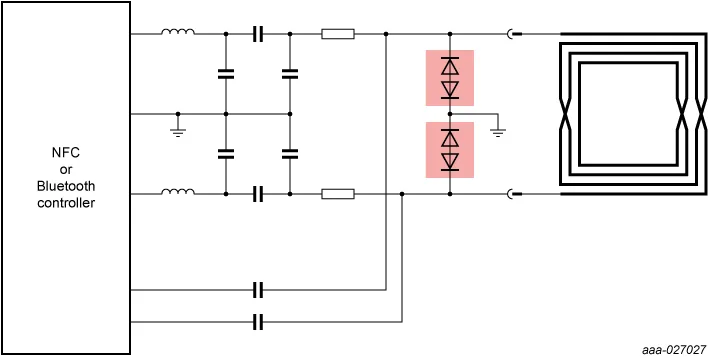
In the IoT era and amid ongoing public-health concerns, many products use near-field communication (NFC) or other wireless links. All wireless products include antennas; designers of compact devices often need guidance on how to provide effective interface protection for these antennas.
Selection Criteria
- Size: To meet demands for thin, compact, and portable electronics, ESD protection components should be very small, for example 0402 or even 0201 package sizes, enabling high integration and layout flexibility on the PCB.
- Parasitic capacitance: The parasitic capacitance of the protection component pins must be small to avoid signal degradation. For antenna applications, consider the antenna frequency band and the maximum acceptable parasitic capacitance. ESD protection for antennas typically requires capacitance below 1 pF, or even lower.
- Working voltage and directionality: Choose the maximum operating voltage and whether a unidirectional or bidirectional device is required based on the signal swing. For example, NFC antenna signals can reach about 18 V or swing negative, so a bidirectional ESD protector rated for that range is required. GPS antenna signals typically stay below 5 V and do not go negative, so a 5 V unidirectional protector may be appropriate.
- ESD robustness: The protection component must withstand high levels of ESD; at minimum it should survive an IEC 61000-4-2 contact-mode 8 kV discharge.
- Clamping voltage: During an ESD event the clamp voltage provided by the protection device must be low enough to prevent permanent damage to the protected circuit and to minimize disturbance to signal transmission.