ALLPCB


Overview
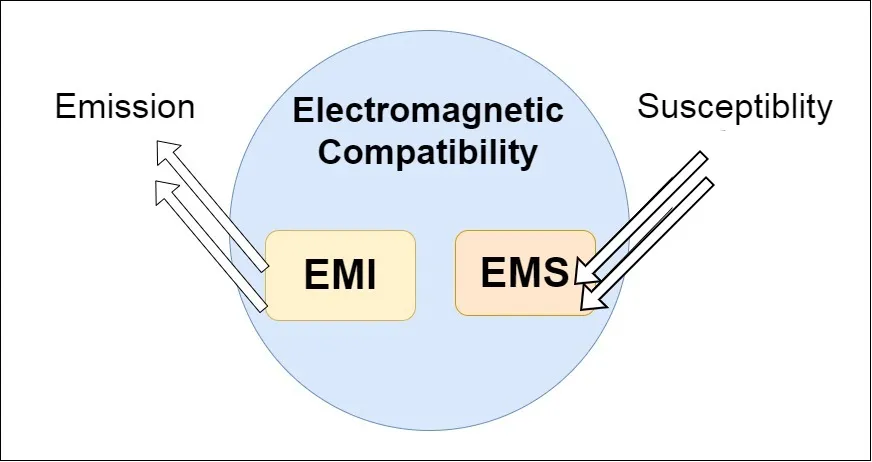
Electromagnetic compatibility (EMC) covers two related aspects: electromagnetic interference (EMI), which is the electromagnetic noise a device emits that can affect other devices or people; and electromagnetic susceptibility or immunity (EMS), which is a device's tendency to malfunction when exposed to external electromagnetic disturbances. The term EMC refers to managing both emission and immunity so that systems operate without faults.
EMI and Typical Semiconductor Categories
Explaining EMC using integrated circuits (LSIs, ICs) makes the concepts more concrete. Semiconductor products can be roughly grouped as follows:
- Power-related linear regulators such as legacy three-terminal regulators (e.g., 7805, 7905) and low-dropout regulators (LDOs). These handle DC signals.
- Analog components such as differential operational amplifiers, comparators, and voice-signal processors. These handle sinusoidal and linear analog signals.
- Digital components such as microcontrollers, memories, and logic devices. These handle digital signals.
- Switched or switching devices such as switching power supplies, charge-pump converters, LED and LCD drivers, and PWM motor drivers. These involve switching techniques.
Categories 1 and 2 typically do not generate significant EMI, while categories 3 and 4 commonly produce EMI. In short, analog and linear ICs generally produce little electromagnetic noise, whereas digital and switching ICs tend to generate more.
Why Some Circuits Generate More EMI
DC voltages have no fundamental frequency or harmonic components, and pure sinusoidal signals have limited high-order harmonics, so they are less likely to generate electromagnetic noise. Digital and switching ICs process square waves or pulse signals, which inherently contain high-order harmonic components, often reaching into the gigahertz range (primarily odd harmonics). Those high-frequency components are the essence of electromagnetic interference.
Although digital and switching ICs generate EMI, they enable high-speed, large-scale processing and low-power operation, which is why they remain widely used despite their EMI challenges.
Electromagnetic Susceptibility (EMS)
EMS describes a circuit's resistance to external electromagnetic noise and the requirement that it be strong enough to avoid false operations. EMS can be analyzed from two main perspectives: voltage tolerance and frequency behavior.
Voltage Axis: Lower Supply Voltages and Thresholds
Process scaling has driven supply voltages lower, making devices more susceptible to disturbances. Older logic ICs used 5 V supplies, but modern devices commonly operate at supply voltages as low as 0.9 V. Internal threshold voltages in logic circuits have dropped accordingly, for example from around 2.0 V down to about 0.4 V. A 5 V logic IC would tolerate a 1 V external disturbance without false switching, while a 0.9 V logic IC can be much more easily upset. Designers accept this trade-off because low-voltage operation delivers essential power-saving benefits.
Frequency Axis: Parasitics and Resonance on the PCB
ICs do not operate in isolation; they are mounted on printed circuit boards where parasitic elements from routing and component interconnections exist. Typical parasitics include parasitic resistance R, parasitic capacitance C, and parasitic inductance L. Commonly referenced parameters include ESR (equivalent series resistance) and ESL (equivalent series inductance). The most problematic parasitics are capacitance and inductance because they can form resonant circuits.
Parasitic capacitances and inductances within an IC and across the PCB can create LC resonances. Series and parallel resonances can occur across a wide frequency range. At resonance the impedance can approach zero or infinity, creating frequencies at which the circuit is prone to false operation. This is a major reason why strong electromagnetic immunity is required.
EMS is generally harder to address than EMI because immunity depends on many interacting factors. Identifying the dominant cause of a susceptibility problem often requires time and skill.