ALLPCB


Meeting medical wearable application requirements
Demand for medical wearable devices is growing due to increased attention to personal health and aging populations in many countries. These devices are typically battery powered and therefore require very low power consumption and compact form factors, which creates design challenges. This article outlines the design requirements for medical wearables and describes related solutions from onsemi.
Miniaturization and comfort
Design requirements vary by use case and target user, but designs commonly prioritize space optimization and component miniaturization. To improve wearer comfort and convenience, medical wearables should minimize size and weight, using miniaturized components and systems to integrate sensing, processing, and communication functions.
To support diverse functionality, wearable devices often adopt flexible circuit technologies so the device can conform to body contours, improving design flexibility and mechanical reliability. Because the primary purpose is to deliver accurate physiological data to healthcare providers quickly and reliably, designs must ensure sufficient power and high signal integrity. This requires efficient power design, appropriate board-to-board and FPC connectors, and suitable signal processing and transmission algorithms.
Medical wearables, which affect health and safety, must comply with applicable regulations and standards such as US FDA and EU CE. Risk assessment and validation testing should be conducted during the design phase to ensure product quality and regulatory compliance.
Complete low-power wearable solutions
onsemi incorporated feedback from implantable medical customers when developing the RSL10 to support devices that must run for many years on small batteries without recharging. For wireless connectivity in wearables, the RSL10 Bluetooth Low Energy (BLE) devices provide ultra-low power characteristics. In sleep modes, devices in the RSL family can operate at very low duty cycles with sleep currents measured in the nanoamp range.
Audio applications such as hearing aids require an audio codec. The RSL10 integrates an LP DSP32 capable of running codecs such as G.722 or CELT. The LP DSP32 is a dedicated hardware block for efficient, low-power audio compression and decompression. The EZAIRO 7160 wireless preconfigured DSP that includes RSL10 supports small-form, low-power audio applications like hearing aids.
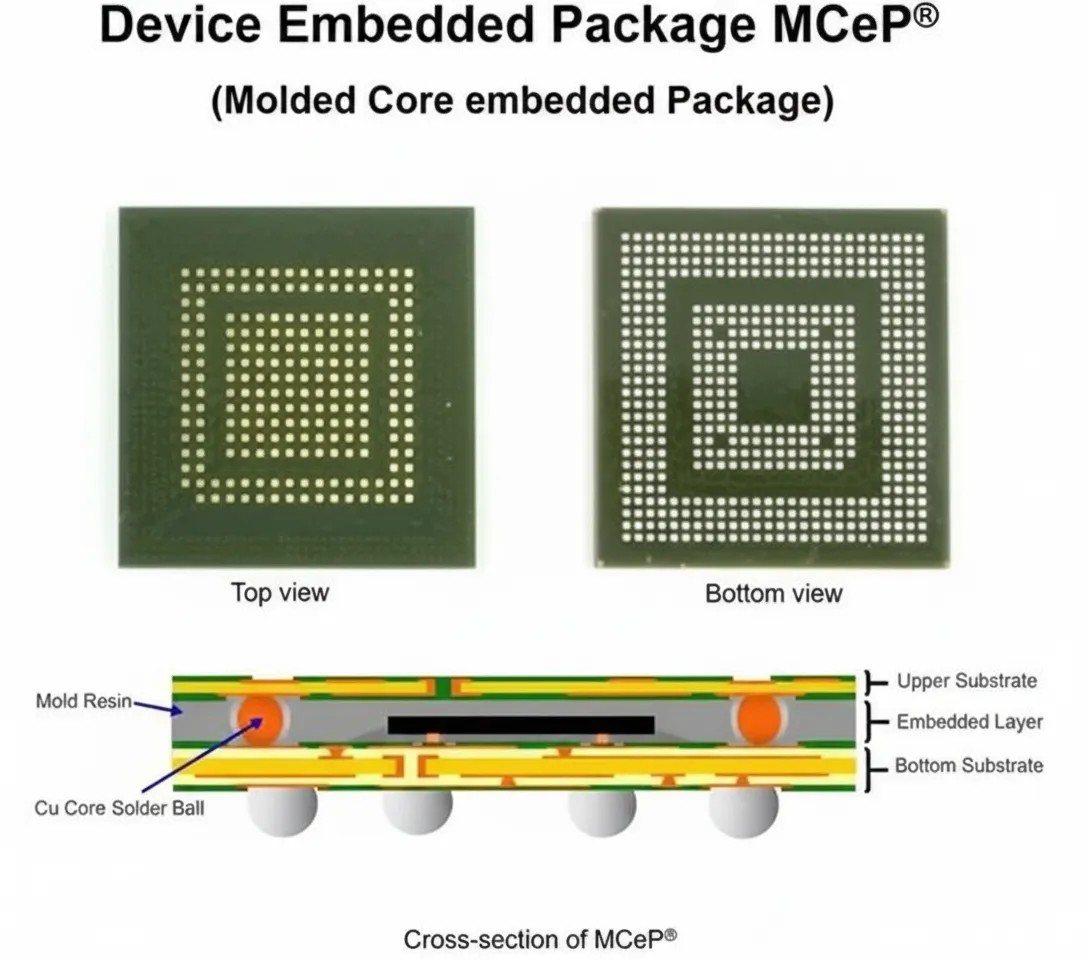
Wearable devices often require minimal package size. Wafer-level chip-scale packages (WLCSP) with solder balls are suitable for space-constrained applications such as disposable medical items, wearables, or ID tags. The RSL10 WLCSP measures 2.32 mm x 2.36 mm with a thickness of 0.35 mm. RSL10 is also available in a 6 mm x 6 mm QFN, and RSL15 in a 5 mm x 5 mm QFN.
RF system development requires selecting surrounding components and antennas to match the hardware environment. To simplify regulatory compliance with bodies such as the FCC or CE, a pre-certified module that integrates passive components (crystal, power decoupling, antenna matching) and an integrated antenna can be used. The RSL10 SiP integrates these components and antenna in a certified module measuring 6 mm x 8 mm x 1.46 mm.
onsemi applied its experience to design MD-RSL10 variants intended for implantable or life-critical applications, including cardiac monitoring and neurostimulation.
onsemi provides validated reference designs that include application hardware, firmware, bill of materials, schematics, and PCB manufacturing files. Several low-power reference designs are available, such as RSL10 sensor development kits, asset tags, energy-harvesting BLE switches, smart camera platforms, and secure transport solutions.
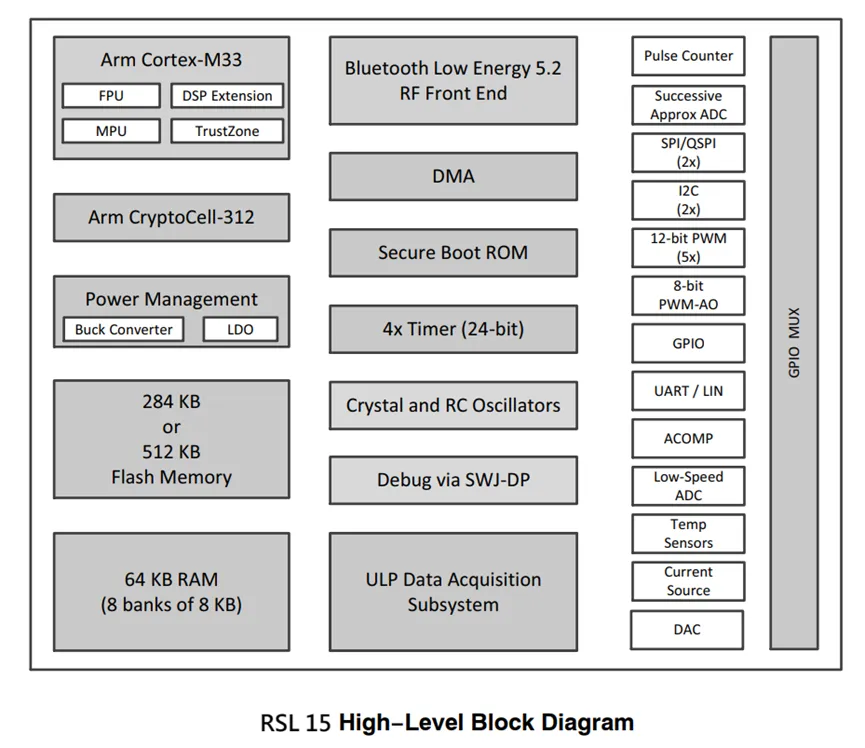
Protecting sensitive data such as personal health or payment information requires integrated security. RSL15 includes embedded security features with a hardware-based root of trust and an Arm cryptographic engine for hardware-accelerated encryption algorithms.
Remote monitoring devices are a common IoT use case where the device spends most of its time in sleep mode and wakes intermittently to send a few data packets. RSL15 supports multiple low-power modes suited to those applications.
Multi-protocol low-power radio system-on-chip
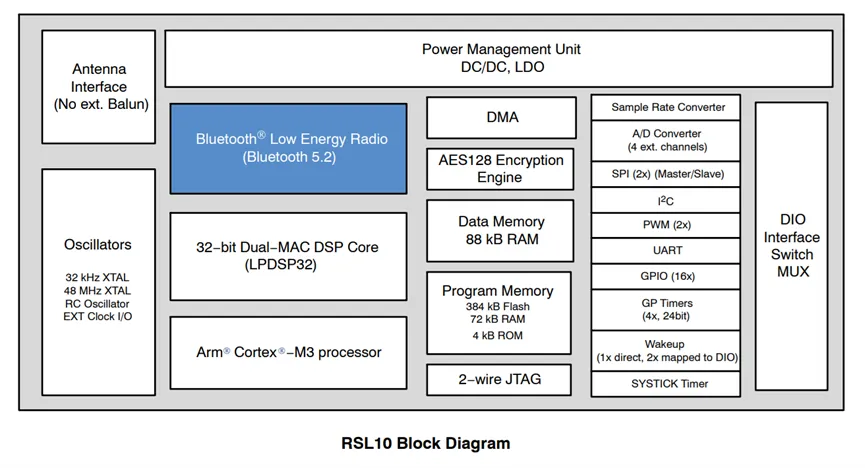
RSL10 is a Bluetooth 5.2, multi-protocol radio system-on-chip (SoC) designed for ultra-low-power wireless applications. It reaches industry-leading low power levels, with deep sleep mode at 62.5 nW and receive mode at 7 mW, optimizing system size and battery life while supporting advanced wireless features. The integrated radio SoC uses a dual-core architecture and a 2.4 GHz transceiver, supporting Bluetooth Low Energy and custom 2.4 GHz protocols, and supports firmware over-the-air (FOTA) updates.
RSL10 supports a flexible voltage range (1.1 V to 3.3 V) and can be used with 1.2 V and 1.5 V batteries without requiring an external DC/DC converter. Package options include a 5.50 mm2 WLCSP and a 6 x 6 mm QFN. A full SiP option is also available for smaller system solutions.
The SoC features a dual-core architecture with a programmable Arm Cortex-M3 processor running up to 48 MHz, supporting 2.4 GHz proprietary and custom protocol stacks. An embedded digital signal processor (DSP) supports signal-processing-intensive applications such as wireless audio codecs.
On-chip and software radio support includes a 2.4 GHz RF front end and a Bluetooth 5.2 certified baseband controller supporting 2 Mbps data rates. The RSL10 development kit provides BLE protocol stacks. This highly integrated SoC includes a power management unit, oscillator, flash and RAM, DMA controller, peripherals and interfaces, and 384 kB of embedded flash with IP protection for flash contents. Configurable analog and digital sensor interfaces are provided, including GPIO, LSAD, I2C, SPI, and PCM.
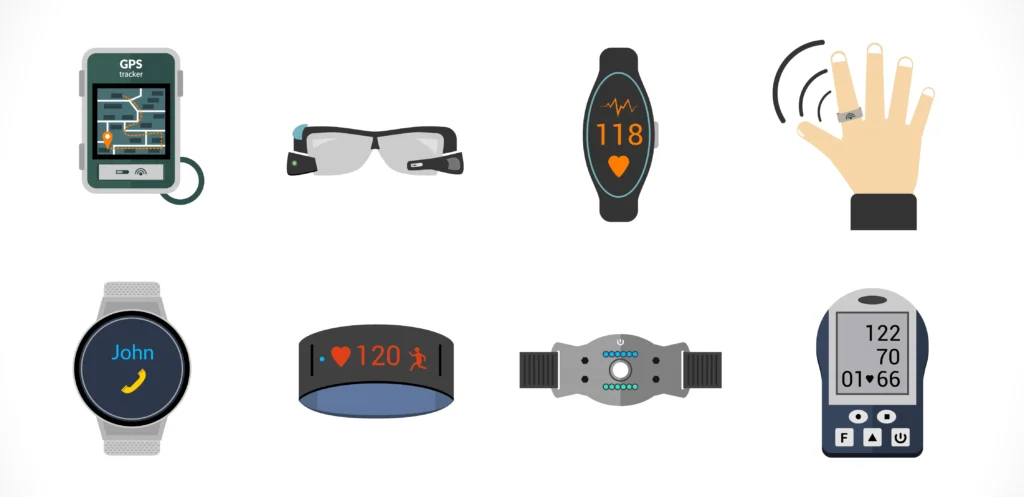
RSL10 is suitable for many medical wearable endpoints such as fitness trackers, smartwatches, hearing aids, heart rate monitors, blood glucose meters (BGM), continuous glucose monitors (CGM), and pulse oximeters.
The RSL10 software development kit (SDK) is an Eclipse-based IDE provided by onsemi and also supports Keil μVision and IAR Embedded Workbench. The SDK includes a complete Bluetooth Low Energy protocol stack, support for Android and iOS applications (with FOTA), and a free RTOS.
Wireless microcontroller and audio processors for connected medical devices
RSL15 is an ultra-low-power, secure Bluetooth Low Energy 5.2 wireless MCU based on an Arm Cortex-M33 processor, designed for industrial and medical connected devices. RSL15 integrates power management, supports a broad supply voltage range, flexible GPIO and clock options, and a wide set of peripherals, offering design flexibility for high-performance, low-power applications. RSL15 includes 80 kB of RAM and is available with 284 kB or 512 kB of flash. Typical applications include industrial automation and sensing, medical connected sensors, wearables, asset tracking, electronic tags and access control, digital signage, data loggers, smart appliances, and energy-harvesting switches.
RSL15 is a general-purpose MCU that supports embedded security features with a hardware root of trust, Bluetooth Low Energy 5.2, long-range and positioning features, and a comprehensive SDK including drivers, libraries, example code, development tools, and mobile applications for iOS and Android.
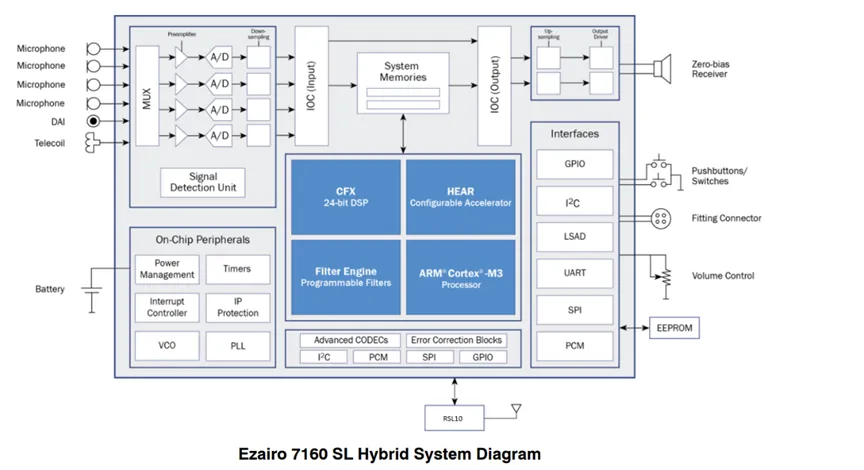
onsemi also provides an audio processing DSP for hearing aids, the EZAIRO 7160 SL. The Ezairo 7100 DSP within the EZAIRO 7160 SL features a high-precision, multi-core architecture delivering substantial MIPS performance without sacrificing power efficiency. The module includes 2 Mb of EEPROM to store hearing aid parameters and firmware, and is offered with configurable evaluation and development kits. Typical use cases include wireless connectivity, audio processing, stereo audio streaming, and BLE control in hearing aids.
Conclusion
Designing medical wearables requires low power consumption, small form factors, and regulatory compliance. Highly integrated low-power components are necessary to meet these strict requirements. onsemi offers multiple component solutions for medical wearables, including radio SoCs, microcontrollers, BLE radios, and audio processors, along with software and hardware development tools to support product development.