ALLPCB


Introduction
What is FCC (Federal Communications Commission) certification, and why is FCC testing required?
FCC (Federal Communications Commission) certification is the authorization required for radio equipment to enter the US market. FCC testing evaluates electronic and digital products against FCC technical standards. Communication products exported to the United States must be tested and approved by government-authorized laboratories according to FCC technical standards to obtain an FCC grant. After testing, a device receives an FCC ID, a unique identifier indicating that the device met FCC requirements for RF signal levels and safety and may be legally sold and used in the US market.
For 5G devices, FCC certification is also an important market entry requirement.
Part 01 — How to build an FCC test station
Whether for laboratory pretests during development or official testing in a certification lab, a complete FCC test system is required. Below is an example FCC test environment assembled with test instruments to illustrate the main items of this testing.
Typical FCC certification process
- 1. Select test samples
- 2. Pre-certification tests during R&D
- 3. FCC registration
- 4. Accredited laboratory certification testing
- 5. Telecommunication Certification Body (TCB) approval and filing
- 6. FCC grants equipment authorization
Test system example:
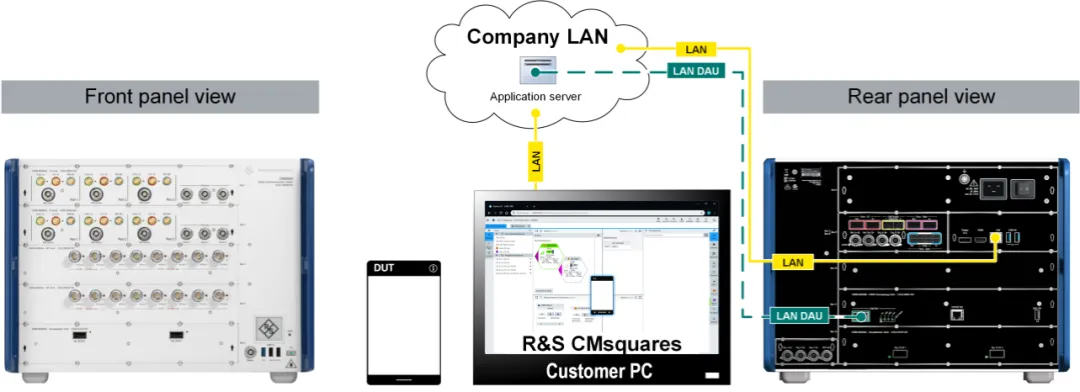
Typical system configuration
- CMX500: OBT (Baseband ASIC license)
- FSVA3030/3044 or FSW26.5 or FSW50 (basic spectrum analyzer mode)
- RS CNC ATE FCC test tool
Part 02 — 5G user equipment: Which technical parameters does FCC require?
Below are some main FCC test cases referenced from CFR Title 47, Part 27 and Part 2.
01 RF output power
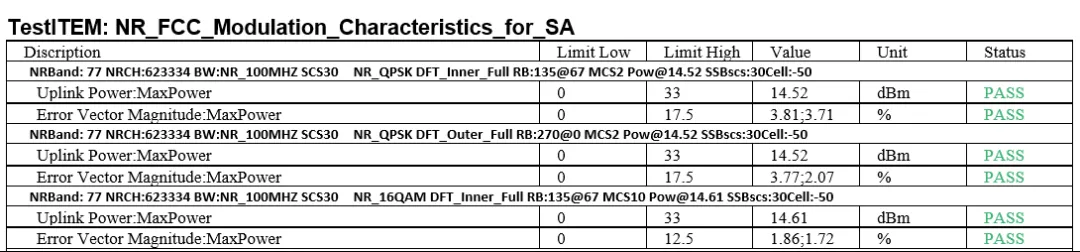
According to CFR Title 47 Part 2.1046 and 27.50(h)(2), measure the device output power on specified channels with the device configured for maximum power transmission, ensuring it does not exceed the specified maximum. The device must transmit with the correct modulation and maximum power settings. The test is typically performed using an OBT on a test set. Example result:

02 Occupied bandwidth
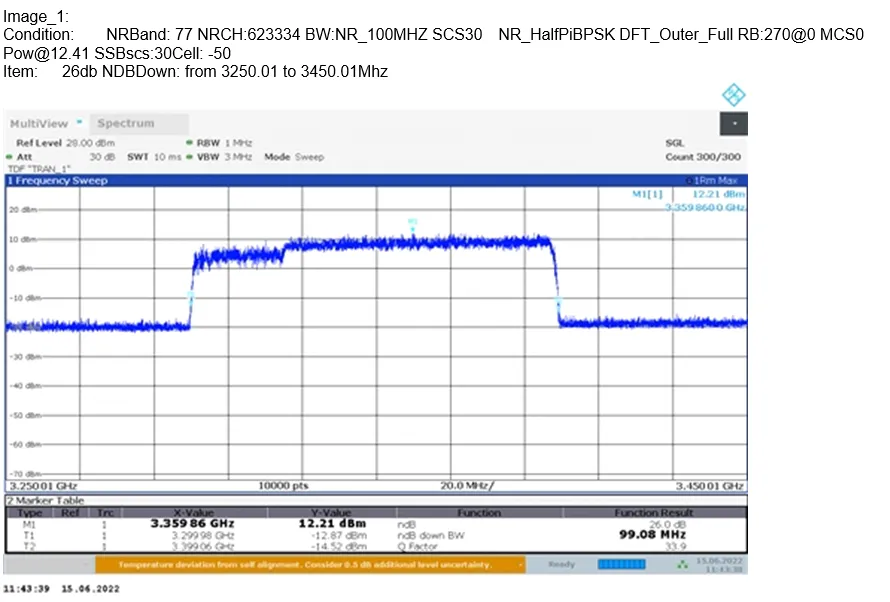
According to CFR Title 47 Part 2.1049, determine the actual occupied bandwidth of the transmitted signal and verify it remains within the assigned channel to avoid interference to adjacent bands. This test is performed using the spectrum analyzer's occupied bandwidth function with appropriate measurement settings. The test report should include the spectrum analyzer output.

03 Frequency stability
According to CFR Title 47 Part 2.1055 and 27.54, frequency stability is evaluated by measuring frequency error. The test is typically performed using an OBT or similar test instrument.

04 Conducted spurious emissions
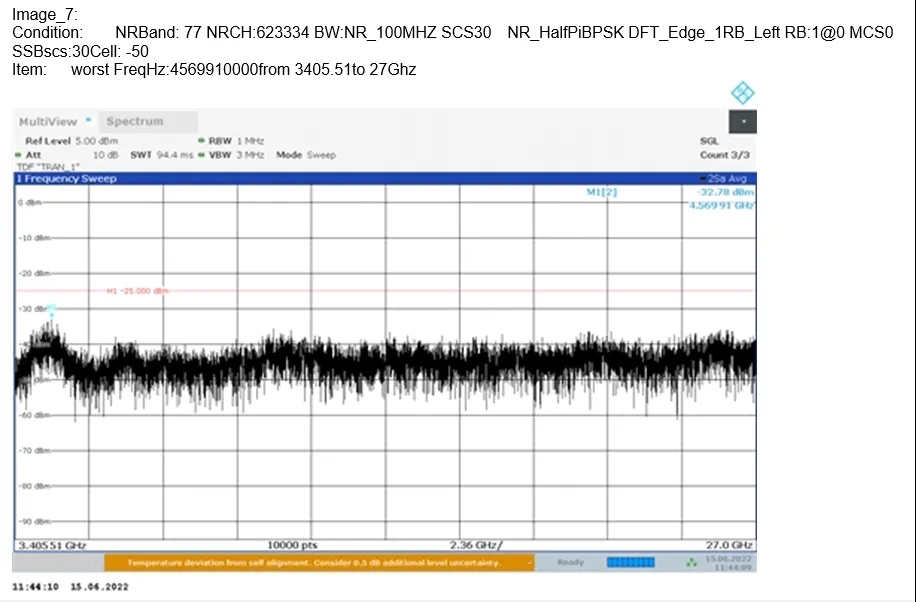
According to CFR Title 47 Part 2.1051 and 27.53, conducted spurious emission testing focuses on unwanted electromagnetic energy transmitted via cables connected to the device, such as power and signal lines. These spurious signals can interfere with other electronic equipment, especially those operating in the same frequency range. The test is performed using spectrum analyzer scans.

05 Band edge
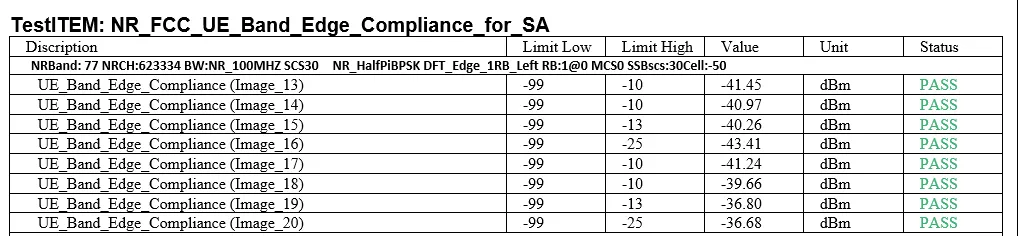
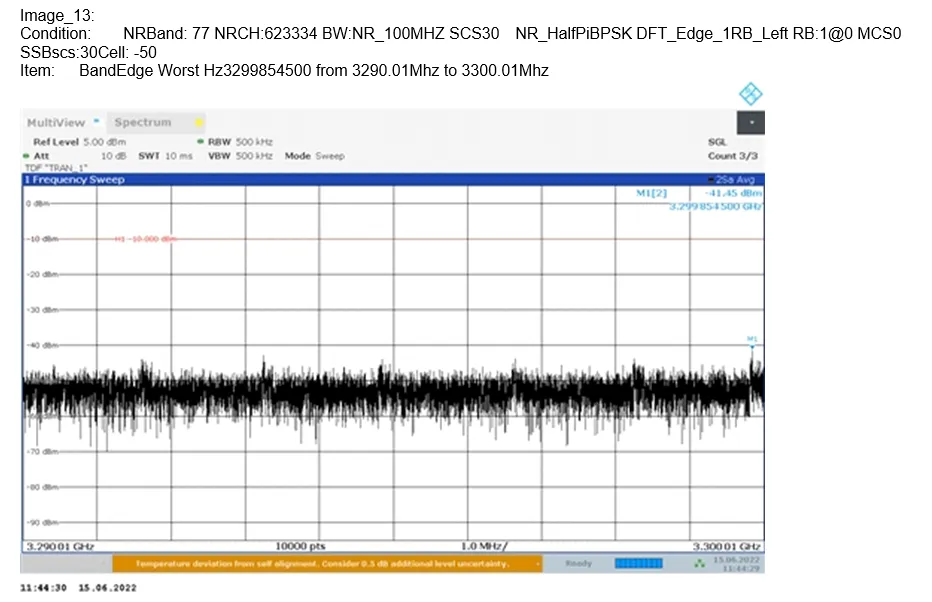
According to CFR Title 47 Part 2.1051 and 27.53, the purpose is to ensure the device's emissions at the band edge frequencies meet specified limits for power and other parameters. FCC rules specify several edge band ranges and differing measurement requirements for each. This test is performed using a spectrum analyzer.
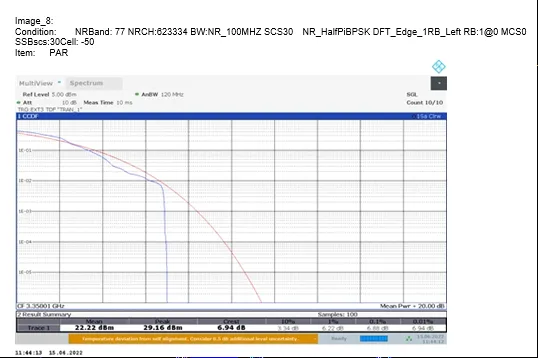
06 Peak-to-average ratio (PAR) / Crest factor
Peak-to-average ratio, also called crest factor, describes the relationship between the maximum instantaneous amplitude of a signal and its effective value (RMS). PAR is important when evaluating RF signal characteristics of wireless communication devices. A high PAR indicates large transient components, which may increase radiated interference or stress internal circuits. This test is performed using the spectrum analyzer CCDF function. CCDF is the complementary cumulative distribution function, a statistical method that describes the probability that a random variable exceeds a threshold.
CCDF is defined as the probability that random variable X is greater than threshold x: CCDF(x)=P(X>x)
In communications, X typically represents instantaneous power or amplitude, and x is a given threshold.

07 Modulation quality (EVM)
FCC requires testing of the modulation quality of the transmitted signal. This mainly involves measuring Error Vector Magnitude (EVM), which quantifies the difference between the received signal and the ideal reference signal. EVM is used to assess signal transmission quality in digital communication systems. Lower EVM indicates better signal quality, while higher EVM may indicate significant distortion.