ALLPCB


Overview
5G (fifth-generation mobile communications) network interfaces include the following categories.
Radio interfaces
Radio interfaces cover links between user equipment (UE) and base stations, as well as links between base stations. These interfaces are defined at both the physical layer and the protocol layers for uplink and downlink directions.
Access network protocols
Interfaces also exist between the access network and the core network. The 5G access network architecture includes NG-RAN (next-generation radio access network) and NG-Core (next-generation core). Between NG-RAN and NG-Core there are interfaces such as the Service-Based Interface (SBI) in the core and the Xn radio interface; these support functions like radio resource management and user/control plane transport.
Core network protocols
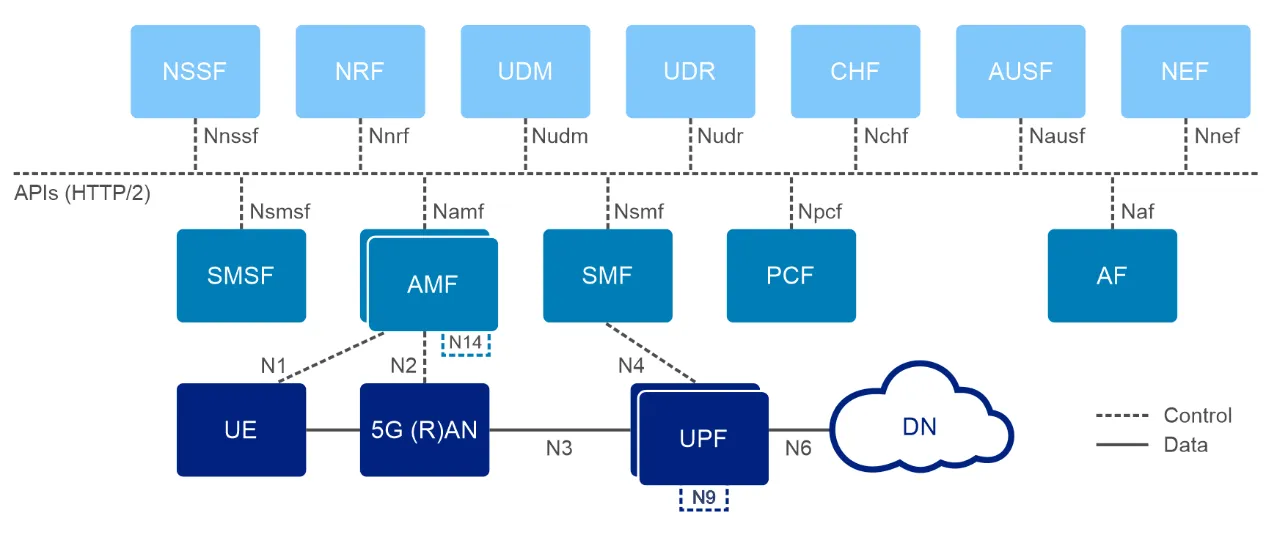
The core network defines interfaces such as UE/AMF, AMF/SMF, AMF/AUSF, UPF/SMF, and UPF/PCF. These interfaces support mobility management and session management, including features such as network slicing, QoS (Quality of Service), security policies, and user authentication.
Channel coding in 5G eMBB
In 5G eMBB (enhanced mobile broadband) scenarios, traffic channels primarily use LDPC (low-density parity-check) coding. LDPC is a block code that partitions information bit streams into blocks and uses a parity-check matrix to convert the information bits into codewords. Proposed by Gallager in 1962, LDPC offers strong performance with relatively low complexity and fast decoding, and it is widely applied in 5G service channels.
Key network elements
- UE (User Equipment): Terminal device in the 5G network, supporting multiple radio access technologies and user services.
- gNB (next-generation NodeB): Radio access network element that communicates with UE and interacts with the core network.
- AMF (Access and Mobility Management Function): Core network function responsible for UE access and mobility management.
- SMF (Session Management Function): Core network function responsible for session management and network slicing.
- UPF (User Plane Function): Core network function responsible for user-plane data forwarding and traffic control.
- AUSF (Authentication Server Function): Core network function responsible for UE authentication.
- PCF (Policy Control Function): Core network function responsible for policy control.
- NEF (Network Exposure Function): Core network function that exposes network capabilities to third-party applications.
- NRF (Network Repository Function): Core network function responsible for registration and discovery of network functions.
Common interfaces
- Xn-Interface: Interface between gNBs.
- F1-Interface: Interface between gNB and elements in the EPC (Evolved Packet Core) or between distributed gNB components.
- SBI (Service Based Interface): Service-based interfaces between core network functions, enabling flexible service configuration.
- N4-Interface: Interface between SMF and UPF, responsible for control-plane policy transfer.
- N6-Interface: Interface for user-plane data transfer involving UPF and data networks.