ALLPCB


Introduction
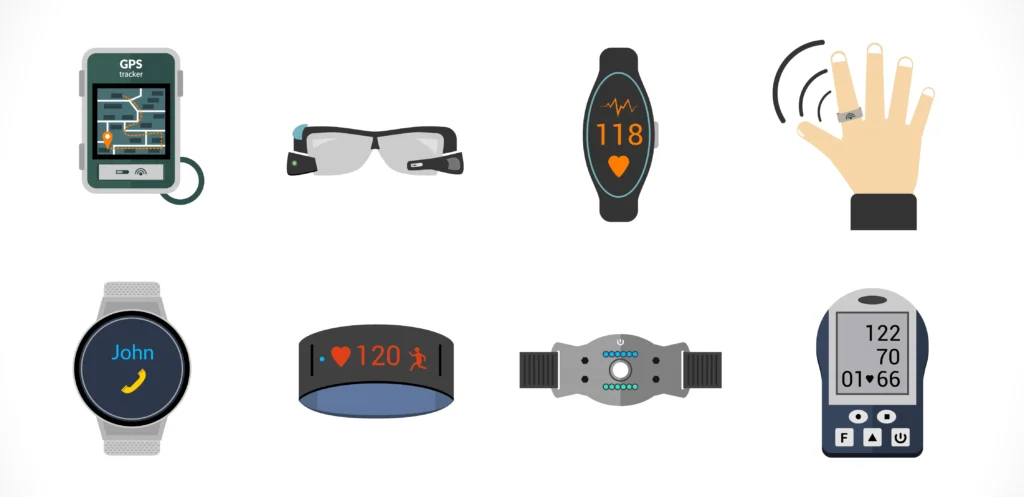
As device intelligence, ecosystems, and technologies mature, wearable devices have developed rapidly in recent years. From daily use to health monitoring and entertainment, wearables are present across many applications. The most common devices are smartwatches and fitness bands, which integrate high-resolution color displays, Bluetooth modules, and multiple sensor modules to support rich information exchange and routine health monitoring. Augmented reality (AR) glasses have also advanced quickly and may see wider consumer adoption.
Power Conversion Needs in Wearables
Wearable systems typically integrate multiple modules and require boost or buck-boost converters to raise the lower battery voltage to the input voltages required by various subsystems. Texas Instruments (TI) introduced the TPS631000 buck-boost converter in 2022 to address these requirements. The TPS631000 is a constant-frequency peak-current-mode buck-boost converter with a 3 A peak current limit (typical), an input voltage range of 1.6 V to 5.5 V, and an output voltage range of 1.2 V to 5.3 V. Its quiescent current is only 8 uA, and it is available in a small 1.2 mm x 2.1 mm SOT-583 package, which supports long standby times and compact designs.
Optical Biosensing and LED Forward Voltages
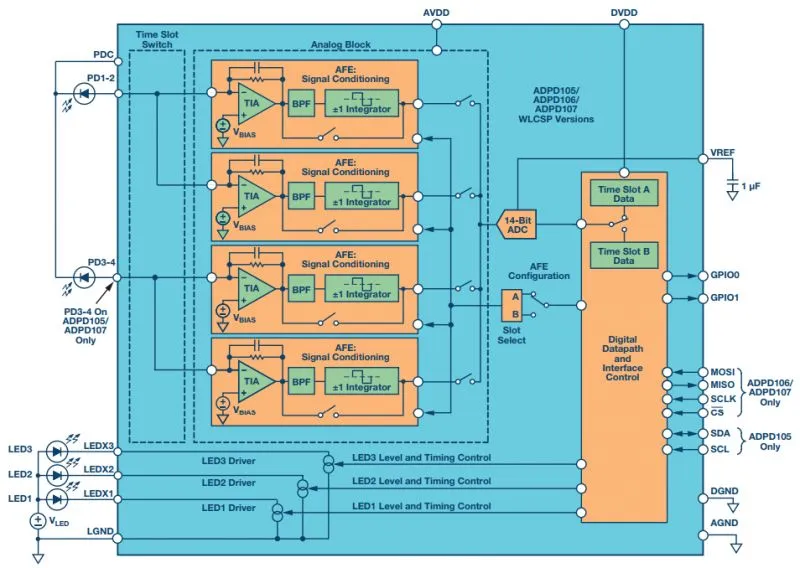
Most smartwatches and fitness bands include biosensing capabilities that typically use optical bio-sensing modules such as the AFE4410. Green light is commonly used for heart rate sensing, while red or infrared light is used for blood-oxygen saturation (SpO2) measurements. LEDs emitting different colors have different forward voltages.
Design Example
The TPS631000 datasheet parameters meet the requirements of these applications. When the input voltage is approximately equal to the output voltage, the TPS631000 automatically operates in boost, buck, or a 3-switch buck-boost mode. It can also switch modes at a defined duty cycle to avoid unnecessary internal mode transitions and reduce output voltage ripple. Optical biosensor modules are usually duty-cycled rather than continuous, so they spend most of their time in standby. With a quiescent current of only 8 uA, the TPS631000 achieves good light-load efficiency and minimizes unnecessary energy loss to extend standby time. The TPS631000 also supports a small-size solution using the 1.2 mm x 2.1 mm SOT-583 package, a 1 uH inductor, and an 0805 output capacitor to facilitate compact designs for developers.
Applications in AR Glasses
Compared with mature wearables such as smartwatches, AR glasses are a newer product category with richer functionality and higher technical complexity, which increases reliability requirements for components. Common modules in AR glasses include haptic vibration, motors, Bluetooth, and TOF sensors. These modules can be powered in system designs that use the TPS631000.
Summary
The TPS631000 combines a small package, low quiescent current, and a wide input/output range, making it suitable for compact, low-power wearable device designs.