ALLPCB


Introduction
Consumers, industry and governments are taking measures to increase the use of renewable energy. This is transforming generation and transmission systems from centralized grids into smarter, more meshed topologies that support local generation and smooth supply and demand through smart grid interconnections.
Renewable Growth
According to the International Energy Agency (IEA) report from October 2019, renewable generation is expected to grow by 50% by 2024. That implies an increase of about 1,200 GW of renewable capacity worldwide, roughly equivalent to the current installed capacity of the United States. The report projects that about 60% of that growth will be in solar photovoltaic (PV).
Distributed PV
The IEA report also emphasized the importance of distributed PV systems as households, commercial buildings and industrial facilities begin to produce their own electricity. It predicts that distributed PV capacity will more than double by 2024, exceeding 500 GW, which would represent nearly half of total PV growth.
Advantages of Solar PV
Why is solar PV such an important part of renewable capacity growth? One reason is the ease of direct use of solar energy, especially in remote or off-grid locations. Solar resource is abundant: at sea level, solar irradiance can reach about 1 kW per square meter, and accounting for day/night cycles, incidence angle and seasonal variations, a square meter can generate on the order of 6 kWh per day under typical conditions.
Solar cells convert incident light into electrical energy via the photoelectric effect. Photons are absorbed by semiconductor materials, such as doped silicon, exciting electrons out of their atomic or molecular orbitals. Those electrons can either return their excess energy as heat or move to electrodes and form current.
Not all incident energy is converted to useful electrical power. Monocrystalline silicon solar cell efficiencies have historically been in the 20% to 25% range. However, research has continuously pursued higher efficiencies through more complex structures and materials, as illustrated by data from the U.S. National Renewable Energy Laboratory (NREL).
Efficiency Challenges
Theoretical efficiencies of 20%–30% are ideal; real-world conversion efficiency can be degraded by factors such as rain, snow and dust accumulation, material aging and environmental changes like increased shading from vegetation growth or new buildings. Therefore, although sunlight is free, extracting usable electrical energy requires careful optimization across conversion, storage and other stages.
One major technical target for improving overall system efficiency is inverter design. Inverters convert the DC output of PV arrays or battery storage into AC for consumption or grid export. They do this by switching the polarity of the DC input to approximate an AC waveform. Higher switching frequencies generally improve conversion efficiency, but simple switching generates square waves with significant harmonic content, which causes additional losses. Inverter design balances switching frequency, operating voltage, power rating and the cost of auxiliary components needed to minimize waveform distortion.
Benefits of Silicon Carbide
Silicon carbide (SiC) offers multiple advantages over silicon in solar power applications. SiC has breakdown voltages an order of magnitude higher than conventional silicon, lower on-resistance, lower gate charge and lower reverse-recovery charge characteristics, and higher thermal conductivity. These properties allow SiC devices to switch at higher voltages, frequencies and currents than equivalent silicon devices, while managing heat more effectively.
MOSFETs are preferred for switching because they are unipolar devices and do not rely on minority carriers. Bipolar silicon devices, such as IGBTs, can operate at higher voltages than silicon MOSFETs, but their switching speed is limited by the need for electron-hole recombination during switching, which causes slower transitions and higher switching losses.
Silicon MOSFETs are commonly used for switching up to about 300 V; above that, their on-resistance increases and designers historically have turned to slower bipolar devices. The high breakdown field of SiC enables MOSFETs that operate at much higher voltages while retaining the fast switching benefits of low-voltage silicon MOSFETs. Switch performance is also relatively temperature-independent, yielding stable behavior as system temperatures rise.
Because conversion efficiency is tied to switching frequency, SiC enables both higher-voltage handling and the very high switching frequencies associated with improved conversion efficiency, creating a dual benefit. SiC also has roughly three times the thermal conductivity of silicon, allowing higher-temperature operation. Silicon typically fails to operate correctly around 175°C and can become conductive near 200°C, whereas SiC maintains operation up to roughly 1000°C. These thermal properties can be exploited in two ways: reduced cooling requirements for power converters compared with equivalent silicon systems, and denser power conversion systems for space-constrained applications such as vehicles and cellular base stations.
SiC in Boost Converters and Inverter Design
These advantages are particularly valuable in solar boost converter stages, where the goal is to match the varying output impedance of a PV array, which changes with irradiance, to the inverter input impedance for optimal conversion. Introducing SiC devices can raise power density and conversion efficiency in these circuits.
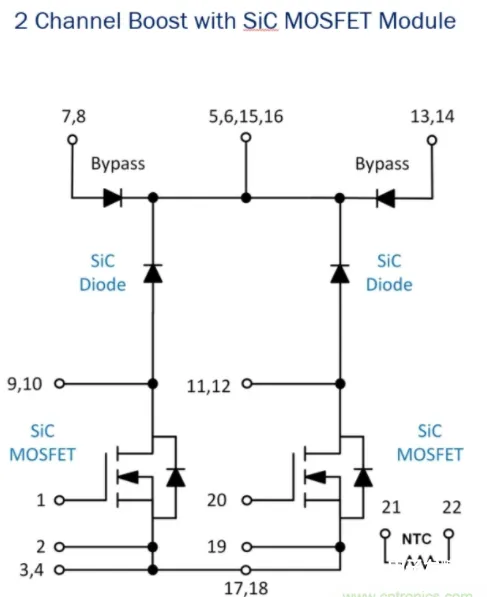
Figure 4: Using SiC devices to improve efficiency of a solar boost converter (source: ON Semiconductor)
The leftmost diagram shows a low-cost approach using silicon diodes and MOSFETs. The first optimization replaces the silicon diode with a SiC diode, improving power density and conversion efficiency and reducing system cost. Replacing the silicon MOSFET with a SiC MOSFET offers designers additional switching frequency options, further improving conversion efficiency and power density.
SiC Devices and Modules
ON Semiconductor offers SiC Schottky diodes in familiar TO-220 and TO-247 packages, rated up to 1200 V and 20 A, and bare die up to 1200 V and 50 A. There are also many 1200 V SiC MOSFETs in D2PAK and TO-247 formats with typical RDS(on) down to the milliohm range.
Hybrid modules that combine silicon IGBTs with SiC diodes are available, such as power integrated modules (PIMs). These modules can incorporate dual boost features, for example two 40 A / 1200 V IGBTs, two 15 A / 1200 V SiC diodes and two 25 A / 1600 V anti-parallel diodes for the IGBTs. Additional 25 A / 1600 V bypass rectifiers can limit surge currents, and modules may include thermal sensor protection.
For designers seeking to exploit SiC in PV systems, manufacturers also offer two-channel and three-channel SiC boost modules intended for solar inverters.
System-Level Considerations
SiC power devices offer several system-level benefits over silicon alternatives, including high-voltage switching capability, high speed, low loss and strong thermal performance. Although SiC parts may presently be more expensive than silicon equivalents on a device-for-device basis, the improved system performance can yield total-cost reductions in areas such as cooling and footprint. Even modest efficiency gains at scale are significant: a 2% increase in deployed conversion efficiency could translate into an additional 10 GW of generated power.