ALLPCB



Overview
Satellite communication networks integrated with ground mobile networks can provide low-latency, wide-coverage ubiquitous access. Phased array antennas serve as the RF front end for end-to-end information transfer between satellites and ground, offering low profile, flexible beamforming, and fast multi-parameter beam steering. They also face challenges including reducing cost and power consumption, increasing broadband capability, and improving wide-angle scan performance. This article reviews research on phased array antennas in space-ground integrated networks, focusing on practical application issues rather than manufacturing process details. It first explains different phased array architectures and their characteristics, then summarizes key enabling techniques such as beam squint mitigation, high-precision beam pointing, low-cost implementations, and multi-beam operation, and finally outlines future directions including distributed satellite constellations, migration to higher frequency bands, and communication-sensing integration.
Need for Satellite Extension of Terrestrial Coverage
To meet massive connectivity requirements of future mobile networks, terrestrial base station coverage must be extended to oceans, deserts, and remote areas. Satellite links provide large capacity and wide coverage. By using satellites at different orbital altitudes, terrestrial cellular signals can be transparently forwarded or regenerated in the sky to provide broadband wireless access anywhere. Three geostationary satellites can cover all regions except the poles, but their long propagation distance causes high path loss and an end-to-end round-trip delay on the order of 600 ms, which cannot satisfy low-latency service requirements.
Low Earth Orbit Constellations
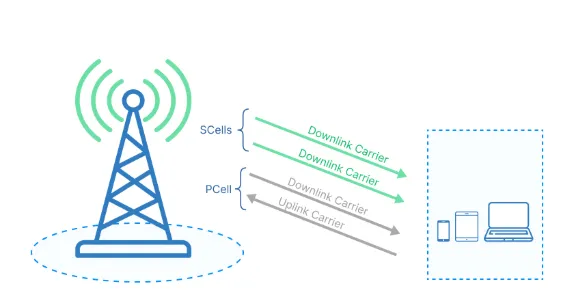
With reduced satellite manufacturing and launch costs and the maturation of low-cost commercial components, large-scale low Earth orbit (LEO) constellations represented by Starlink and OneWeb have attracted attention. LEO constellations deploy thousands of satellites across multiple orbital planes, using near-polar and inclined orbits combined with inter-satellite links to provide seamless global coverage. Operating at altitudes between about 300 km and 2000 km, LEO satellites can achieve end-to-end latencies as low as about 3 ms. As a network layer with enhanced regional coverage and low transport latency, LEO constellations together with higher-orbit backbones and terrestrial networks form space-ground integrated networks. Because space-to-ground wireless links involve long distances and large path loss, user terminals and satellite antennas typically use high-gain directional antennas and rely on beam alignment to increase throughput.
Role and Challenges of Phased Array Antennas
LEO satellites move at high speed and ground terminals may also be mobile, placing stringent requirements on rapid beam steering at both terminals and satellites. Compared with mechanically steered reflector antennas, phased array antennas enable fast electronic beam scanning, greatly reducing scan latency while offering low profile, light weight, easier maintenance, and convenient conformal installation, which suits space-ground integrated deployments. However, phased arrays also face significant challenges. Limited power availability on satellites and some terminals imposes strict requirements on low power consumption and low cost, especially for spaceborne arrays under harsh operating conditions. Phased arrays rely on active components for beam control, which inevitably increases power consumption and cost, so a design tradeoff between performance and cost is necessary. In addition, electronic beam scanning can cause gain drop, degradation of axial ratio, and beam pointing errors, leading to variations in satellite beam coverage and increased interference to nearby terminals, which can severely degrade link signal-to-noise ratio.
Research Scope and Structure
Addressing inherent defects of electronic scanning to achieve service performance comparable to terrestrial cellular networks is an important research objective. As space-ground integrated networks evolve toward software-defined intelligence, communication-sensing integration, and operation at higher frequency bands, further research directions emerge. Existing surveys have compared different terminal antenna implementations in terms of power, cost, and bandwidth, reviewed methods to mitigate grating lobes and mutual coupling in phased arrays, summarized implementations across frequency bands, and analyzed large array techniques such as precoding and multiple access.