ALLPCB


Overview
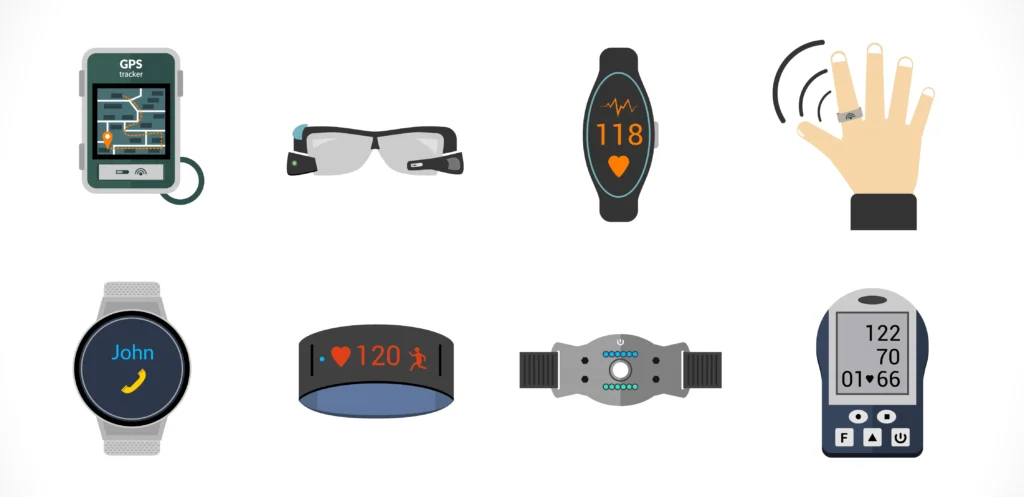
Powering wearable devices and systems is a key challenge. Flexible batteries have been developed for wearables, but they still face limited energy density and the need for intermittent charging. Alternative approaches aim to harvest energy autonomously from ambient stimuli such as piezoelectric, triboelectric, and thermal gradients. Among these, quasi-solid-state thermocells are a promising option because they can harvest waste heat from the environment for continuous energy conversion on the body while avoiding leakage risks associated with liquid electrolytes.
Quasi-solid thermocells generally require intimate contact with a heat source, such as the human body, to create a temperature difference across electrodes, which limits non-contact applications. Ideal quasi-solid thermocells also need high output power density and robust mechanical properties. However, ionogels often cannot simultaneously deliver high ionic conductivity and strong mechanical performance, resulting in poor fatigue resistance in many reported quasi-solid thermocells.
Research teams from Henan Normal University and Donghua University reported a high-performance supramolecular hydrogel composed primarily of poly(N-acryloyl glycinamide) (PNAGA) crosslinked with a block copolymer macromer, Pluronic F68 modified with acrylate (F68-DA). The network is reinforced by multiple hydrogen bonds, yielding a hydrogel that maintains high ionic conductivity while exhibiting improved mechanical properties. The hydrogel is loaded with the Fe(CN)6 3-/4- redox couple to enable thermoelectric power generation and near-infrared photothermal conversion. Thermocells assembled from this hydrogel combine robust mechanics with non-contact, light-responsive self-powered sensing. The work was published in Advanced Functional Materials under the title "Double Hydrogen-bonding Reinforced High-Performance Supramolecular Hydrogel Thermocell for Self-powered Sensing Remote-Controlled by Light".
PNAGA-F68 hydrogel design and thermoelectric performance
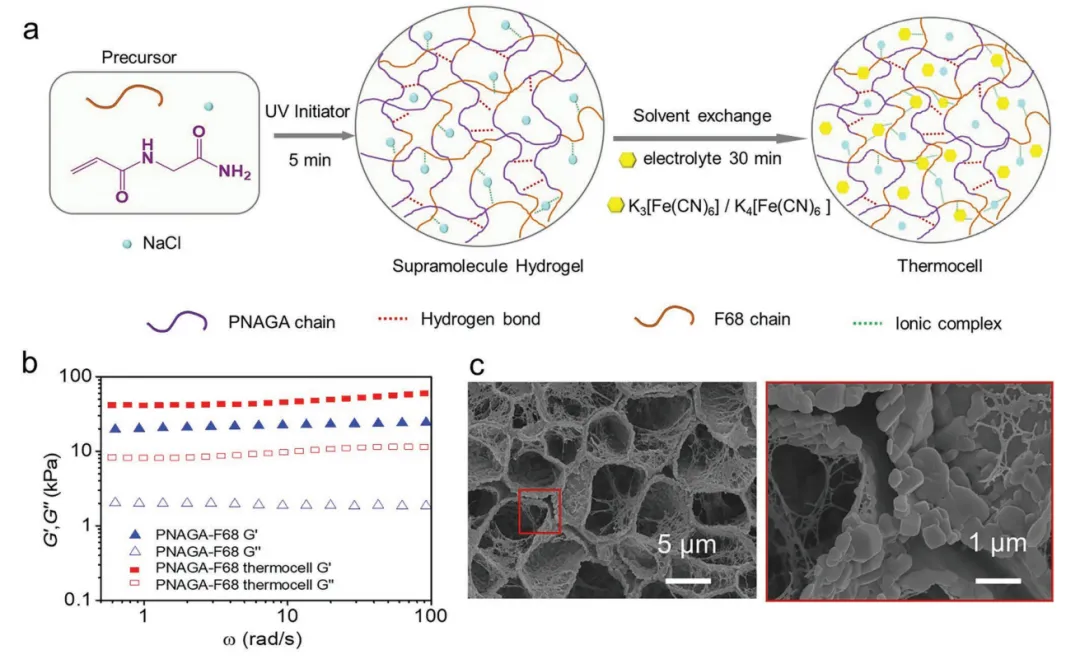
Monomer and macromolecular crosslinker were dissolved in a sodium chloride solution to form a precursor. The PNAGA-F68 supramolecular hydrogel can be cured by 5 minutes of ultraviolet irradiation of the precursor. The presence of salt ions in the hydrogel provides ionic conductivity and enhances mechanical strength. Hydrogen bonding within the polymer yields a high-strength supramolecular network based on PNAGA, while the ether-rich F68 chains complex with metal ions to improve conductivity and stability.
After polymerization, the PNAGA-F68 hydrogel was immersed in an Fe(CN)6 3-/4- aqueous solution for ion exchange. Owing to strong intermolecular hydrogen bonds and metal ion complexation, the hydrogel is sufficiently tough to accommodate high electrolyte concentrations. No obvious degradation of the hydrogel was observed even after soaking for a month in saturated Fe(CN)6 3-/4- solution.
Loading Fe(CN)6 3-/4- causes hydrogel volume shrinkage, increasing hydrogen-bond density between chains and further reinforcing the network's mechanical performance.
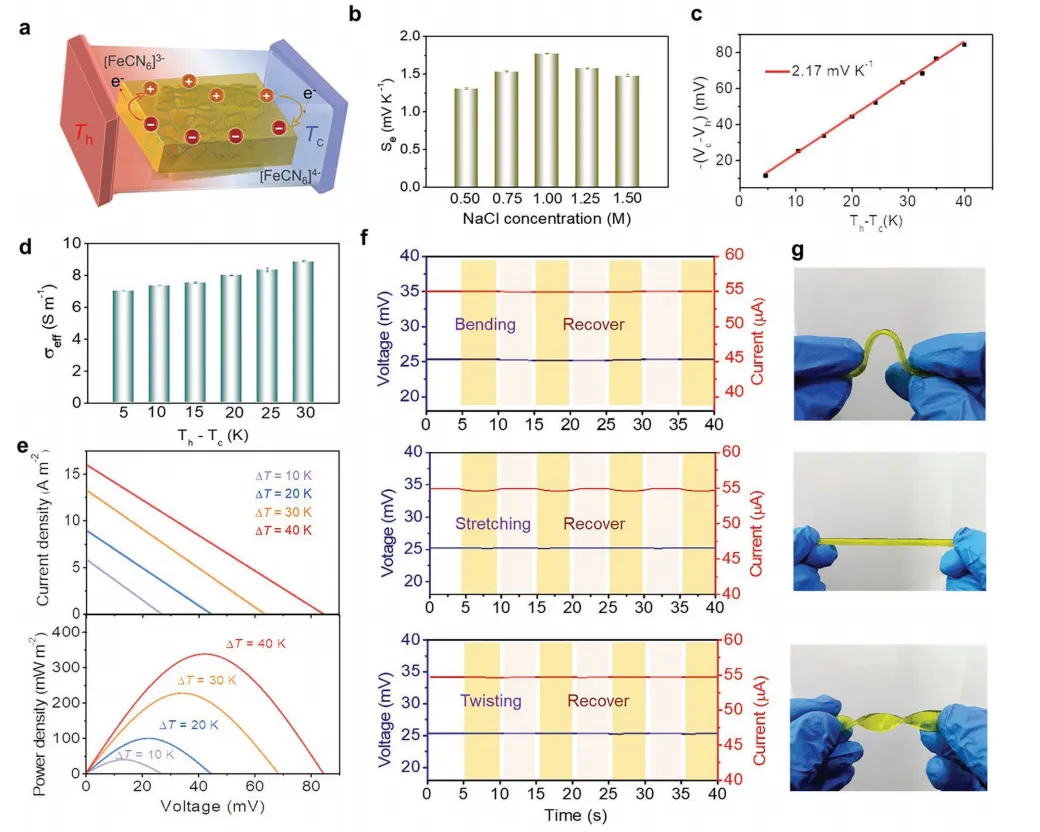
Thermocells were assembled from the resulting gel. Samples prepared in 1 M NaCl showed the highest Seebeck coefficient of 1.76 mV K-1, and the thermovoltage increased almost linearly with temperature difference. The ionic thermal power measured was -2.17 mV K-1, about 1.45 times higher than the value reported for state-of-the-art n-type quasi-solid thermocells (-1.5 mV K-1).
The effective ionic conductivity of the supramolecular hydrogel was 7.0 S m-1 at 298 K and rose to 8.9 S m-1 at 323 K. Compared with previously reported quasi-solid thermocells (0.1–1 S m-1), the PNAGA-F68 hydrogel with Fe(CN)6 3-/4- electrolyte shows one to two orders of magnitude higher ionic conductivity, confirming that the F68 segment effectively enhances electrochemical performance. The thermovoltage remained stable after various deformations of the PNAGA-F68 hydrogel thermocell.
Mechanical performance and light-driven application
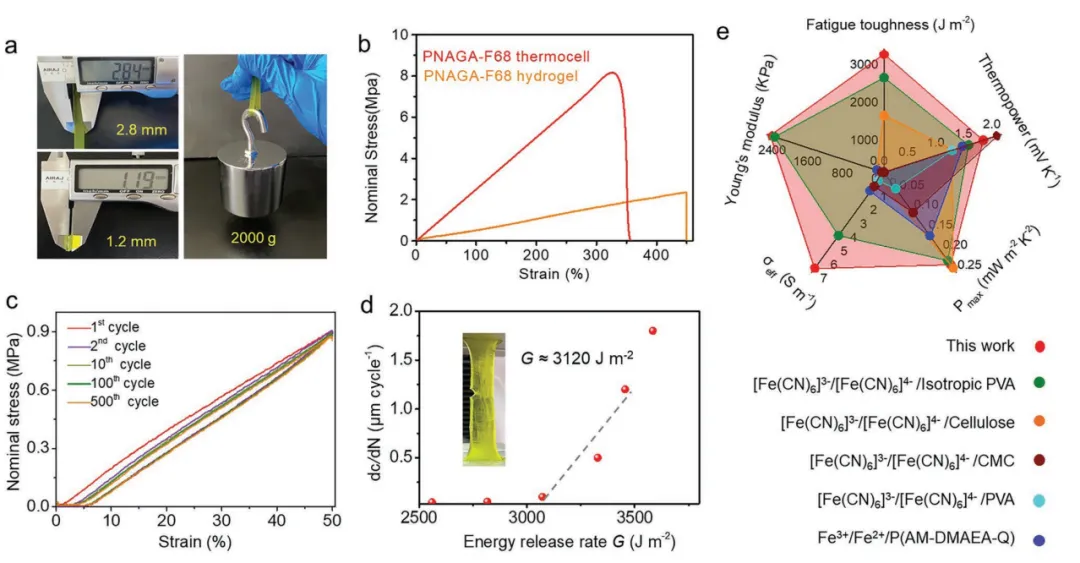
A PNAGA-F68 supramolecular gel strip 1.2 mm thick and 2.8 mm wide could repeatedly lift a 2000 g weight without fracture, indicating high strength and toughness. The hydrogel has a Young's modulus of approximately 2.6 MPa, an elongation at break of 355%, and a fatigue threshold of 3120 J m-2, properties compatible with body motion.
Under cyclic tensile testing at a fixed strain rate of 50 mm min-1 up to 50% strain, the thermocell showed negligible energy dissipation and minimal hysteresis over hundreds of cycles, indicating no obvious breakage of physical or covalent bonds during early strain stages. These characterizations confirm excellent mechanical resilience for the PNAGA-F68 hydrogel.
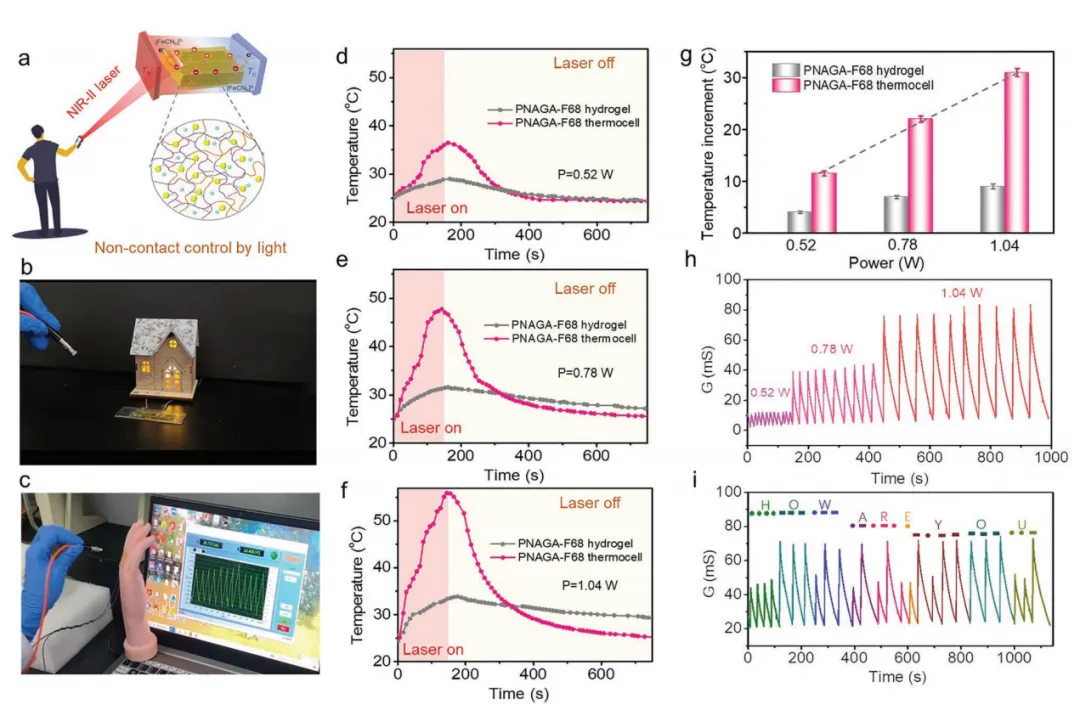
Introducing K4[Fe(CN)6]/K3[Fe(CN)6] as the electrolyte ions forms ion complexes with the hydrogel network that act as photothermal elements, giving the thermocell significant absorption in the NIR-II region. Under remote NIR-II irradiation (1064 nm), the thermocell temperature increases; the amplitude of the conductive response can be tuned by light intensity. At a fixed power of 0.52 W, 150 s of NIR-II laser irradiation raised the thermocell temperature from 25°C to 37°C. At 0.78 W, temperature rose from 25°C to 48°C in 150 s, and at 1.04 W it reached 57°C.
For a fixed irradiation time, increasing laser power produced a gradual increase in the time-dependent thermocell conductance. This enables emission of different signals by varying power. In practical scenarios, remote control of the thermocell can generate patterned visual conductance signals analogous to Morse code for encrypted information transmission. Thus, the device can function as a light-remote-controlled electrical switch and a self-powered sensor, enabling non-contact optical control of sustainable energy supply for wearable devices.
Summary
This work demonstrates a PNAGA-F68 supramolecular hydrogel used as a quasi-solid thermocell with strong antifatigue mechanical properties and excellent thermoelectric performance. The Fe(CN)6 3-/4- redox couple provides pronounced NIR-II absorption and a photothermal effect. The near-linear relationships among irradiation time, temperature, and thermovoltage enable remote light control of electrical output for self-powered sensing and switching, offering a route toward non-contact, light-controlled energy harvesting for wearable applications.