ALLPCB


Summary
Traditional photovoltaic power batteries (PVBs) suffer from low integration and difficulty in miniaturization. Perovskite materials can serve both as the light-absorbing layer in solar cells and as electrode materials, offering a path to address these limitations. This study proposes a dual-function material-sharing strategy using ethyl viologen diiodide (EVI2) to modify perovskite devices. The modified perovskite solar cells (PSCs) achieved a power conversion efficiency (PCE) of 26.11% (retaining 96.2% after 1000 hours). Maximum power point tracking (MPPT) tests used an A+AA+ grade LED solar simulator as the aging light source, with temperature and atmosphere control to enable long-term stability evaluations.
By deriving an EVSn2I6 cathode from EVI2, the cathode delivered 296.1 mAh g-1 at 0.5 A g-1 (retaining 89% capacity after 10,000 cycles at 5 A g-1). An integrated all-perovskite PVB achieved an overall energy conversion efficiency of 18.54% (flexible version 17.62%) with stable charge/discharge cycling. The flexible PVB also provided continuous 24-hour power to a wearable glucose monitor in a controlled test, demonstrating potential for portable electronics.
Interaction Mechanism between EVI2 and Perovskite
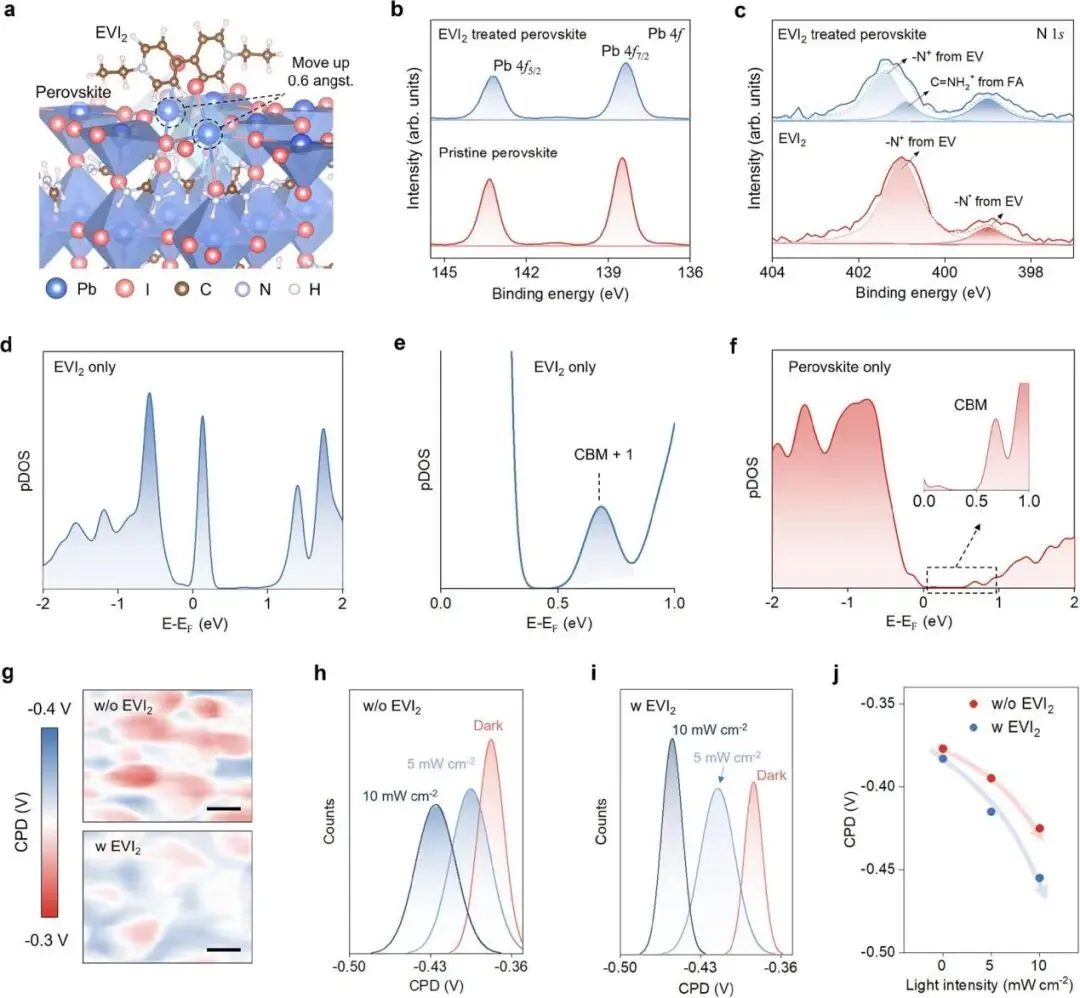
EVI2 acts by forming a surface modification layer on the perovskite without altering the bulk crystal structure. XPS and DFT calculations indicate electronic interactions between the viologen moiety of EVI2 and the perovskite, increasing the electron density around surface Pb atoms and shifting the band structure (for example, a downward shift of the CBM). These changes facilitate interfacial charge extraction. KPFM measurements confirm a more uniform surface potential distribution after EVI2 modification. The optimized electronic structure significantly suppresses nonradiative recombination (PL lifetime increased from 223.5 ns to 457.4 ns) and reduces defect-state density (trap-filled limit voltage decreased from 0.56 V to 0.31 V), supporting high-performance PSCs.
Perovskite Photovoltaic Performance
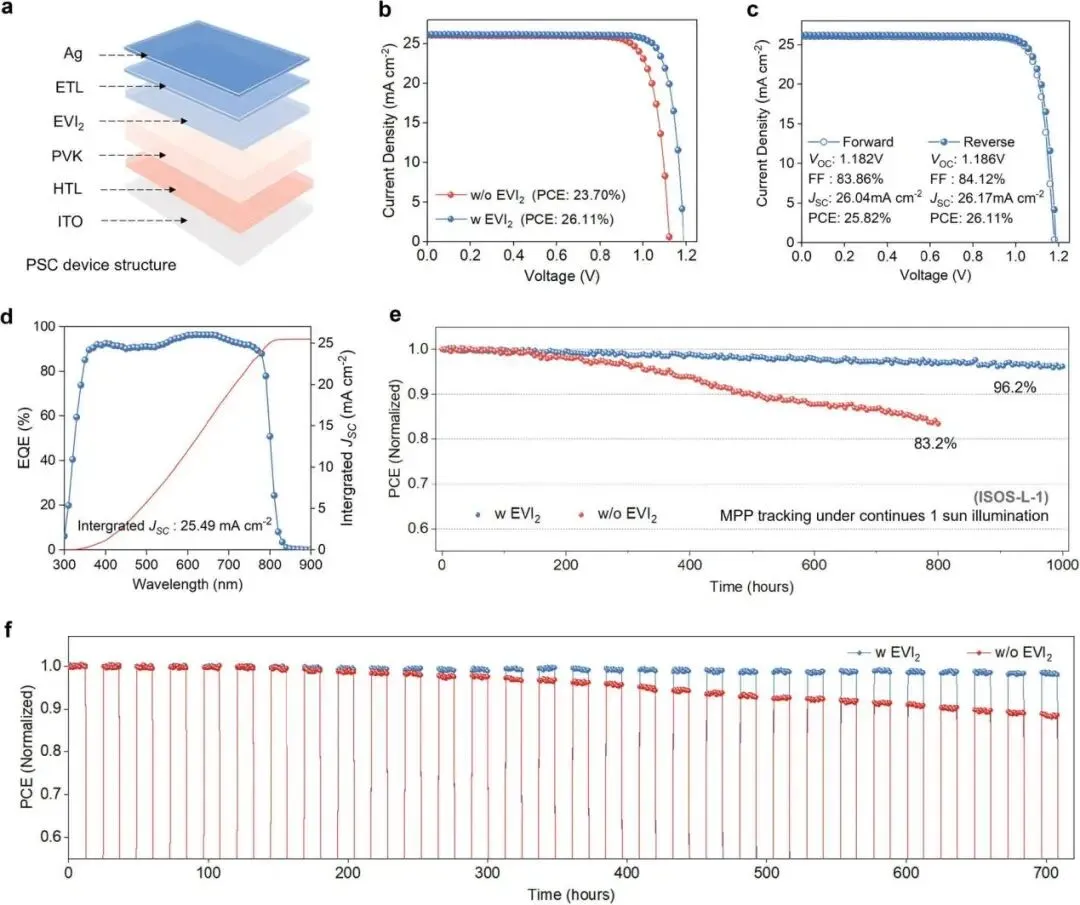
Using the EVI2 surface modification, p-i-n structured perovskite solar cells were fabricated (C60 as the electron transport layer and a p-type organic small molecule as the hole transport layer). Key device metrics for the best cells are:
- PCE: 26.11% (short-circuit current density 26.17 mA cm-2, open-circuit voltage 1.186 V, fill factor 84.12%). Forward scan PCE is 25.82%, indicating negligible hysteresis.
- The certified maximum power point tracking (MPPT) efficiency reached 25.43%.
- Stability: Under the ISOS-L-1 protocol (continuous 1 sun illumination), the modified cells retained 96.2% of initial efficiency after 1000 hours, whereas unmodified cells retained only 83.2% after 800 hours. Under the more stringent ISOS-L-3 protocol, the modified cells retained 93.7% after 1000 hours versus 76.2% for unmodified cells. In light/dark cycling (12 h light / 12 h dark, 30 cycles, 720 h), EVI2-modified cells lost 2% efficiency while unmodified cells degraded by 11%.
Electrochemical Performance of EVSn2I6 Cathode
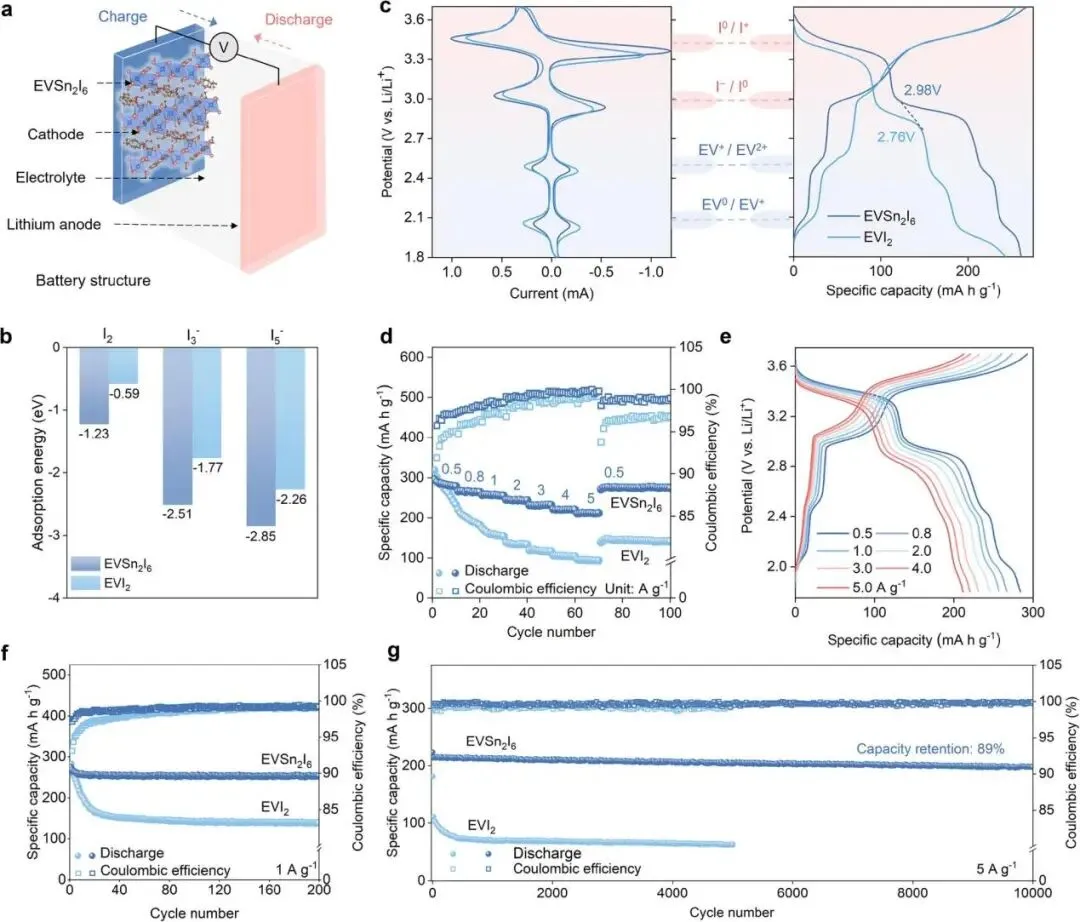
By introducing Sn2+ into EVI2, a one-dimensional organic–inorganic hybrid EVSn2I6 perovskite cathode material was synthesized. The material exhibits strong air stability and oxidation resistance (Sn2+ is less prone to oxidation). Theoretical calculations show strong adsorption energies for iodine species such as I2, I3-, and I5-, which helps suppress polysulfide-like iodine shuttling. Electrochemical tests demonstrate that the EVSn2I6 cathode undergoes multi-electron reversible redox reactions based on EV0/EV+/EV2+ and I-/I0/I+, with low polarization and a high average voltage (2.98 V). Rate capability is strong (296.1 mAh g-1 at 0.5 A g-1; 212.4 mAh g-1 at 5 A g-1), and at 5 A g-1 the electrode retained 89% capacity after 10,000 cycles, corresponding to a capacity fade rate of 0.0011% per cycle.
Photovoltaic-Powered Battery (PVB) Performance
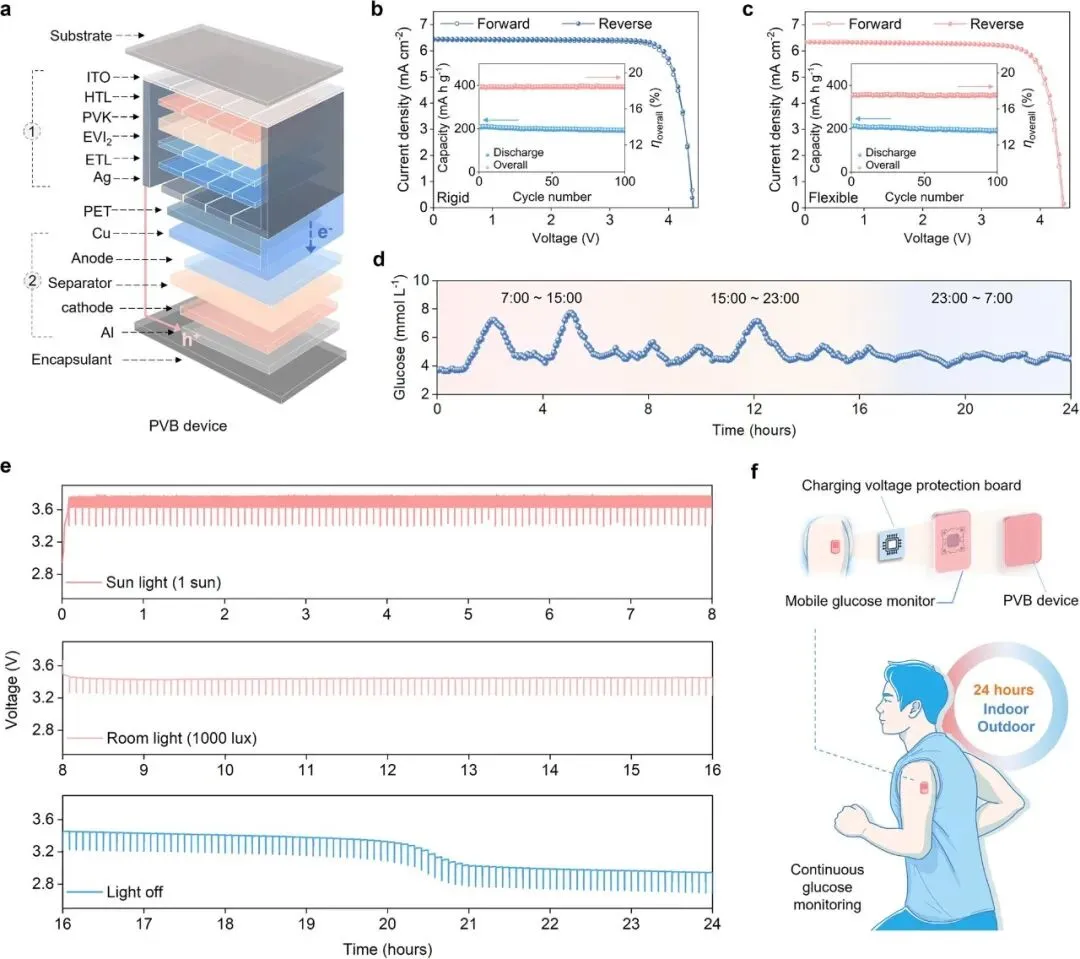
To integrate conversion and storage, a perovskite micro-module composed of four series-connected subcells (23.60% efficiency, VOC = 4.41 V) was combined with EVSn2I6 batteries to form an all-perovskite PVB. The PSC silver electrode was connected to the battery anode and the ITO electrode to the battery cathode, with a PET film isolating the electrolyte. The rigid PVB, under 1 sun illumination, achieved an overall energy conversion efficiency of 18.54% and demonstrated stable performance over 100 charge/discharge cycles. A flexible PVB on PEN substrate reached 17.62% overall efficiency and retained excellent mechanical durability and performance after 1000 bending cycles (radius 8 mm). The PVB operated normally at -20°C and 40°C. With an integrated protection and charge-control board, the flexible PVB supplied continuous 24-hour power to a commercial continuous glucose monitor in tests under sunlight, indoor light, and dark conditions.
Key Innovation
The central innovation is a "dual-function material-sharing" strategy: using EVI2 to simultaneously optimize charge transport in perovskite solar cells and the cathode stability of rechargeable perovskite batteries. This approach addresses traditional PVB limitations in integration and stability. Performance highlights include a 26.11% PCE for perovskite solar cells with 1000-hour stability at 96.2%, EVSn2I6 battery stability over 10,000 cycles, and an integrated PVB overall energy conversion efficiency of 18.54%. The flexible PVB demonstration powering a glucose monitor illustrates a practical route toward cord-free power for portable, wearable electronics.
MPPT Testing Setup
MPPT testing used an A+AA+ grade LED solar simulator as the aging light source, enabling controlled long-term testing of perovskite solar cells. Key simulator characteristics reported were:
- Source grading: A+AA+ (spectral match A+, uniformity A, long-term stability A+).
- Effective illumination area: ≥250 × 250 mm (customizable).
- Adjustable irradiance: 0.2–1.5 sun with 0.1 sun steps.
- Independently controllable spectral bands: 300–400 nm / 400–750 nm / 750–1200 nm.