ALLPCB


Industry 4.0 enables industrial solutions to adopt and use cloud computing's data collection and analysis capabilities for predictive analytics, reducing maintenance downtime, centralizing storage, and enabling remote management. However, with the rapid growth of IoT applications in recent years and inadequate network bandwidth allocation and utilization, cloud computing faces the following limitations for widespread adoption.
- Subscription-based cloud support
- Unused silicon capacity on edge devices (routers, gateways)
- Large volumes of raw data pushed to the cloud, causing high latency
- Always dependent on an Internet connection; cloud requires online access
- Excessive network bandwidth usage
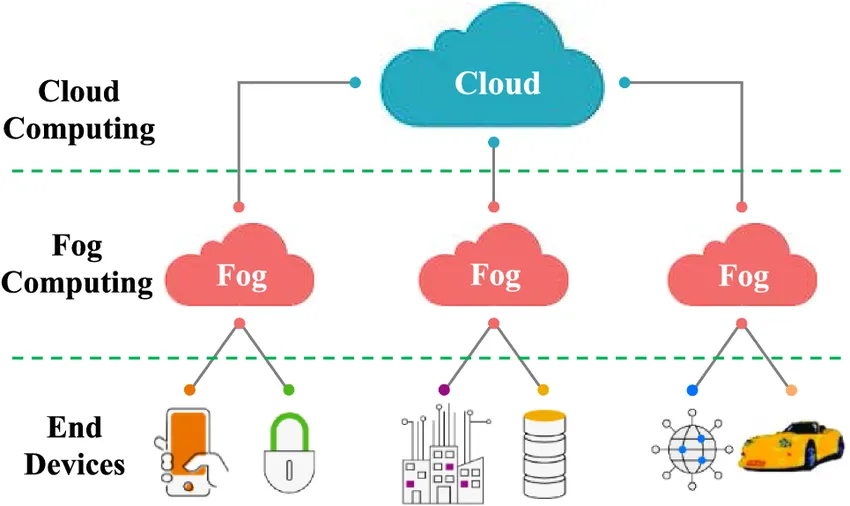
Fog computing helps overcome these limitations and bottlenecks by providing a distributed architecture. Acting as an extension of cloud computing and collaborating with one or more edge node devices, it provides localized control, configuration, and management for endpoint devices.
Business Impact of Fog Computing on IoT Solutions
Fog computing emerged as an extension of cloud services, not as a replacement. Applying fog computing to existing IoT solutions offers the following business advantages:
- Offline-capable solutions: By leveraging fog computing, IoT solutions can control, manage, and administer local edge device networks without external dependence on cloud-based or subscription services.
- Globally distributed networks: Fog-enabled edge nodes or gateways provide local decision-making and temporary data storage for analysis. This distribution ensures that even if cloud services are unavailable, IoT solutions can continue operating locally within certain constraints.
- Improved bandwidth utilization: Fog-enabled edge nodes process raw data from endpoints locally and periodically push processed data to central servers, ensuring optimal use of network bandwidth.
- Real-time operation and low latency: Fog-enabled edge devices classify data by time criticality and ensure most time-sensitive data is processed locally without central-server intervention, enabling real-time operation and very low latency.
- Optimized use of edge node resources: Fog-enabled edge nodes are designed to maximize available resources at the edge to overcome cloud limitations and to optimize network bandwidth usage.
Fog Computing Use Cases
Fog computing plays a critical role in the following application areas:
- Smart lighting: Fog-enabled edge nodes allow smart lighting OEMs to deliver solutions that are independent of cloud providers. Fog-enabled lighting solutions enable OEMs to:
- Provide local control, monitoring, and management of endpoint devices
- Schedule lights on/off using location features and sunrise/sunset data
- Extend reach to remote locations
- Consolidate energy consumption reports at per-device granularity
- Smart energy: As energy production and natural resource conservation evolve, continuous monitoring of endpoint devices used in wind farms, solar farms, and water and gas distribution networks has become a key concern. When fog computing is combined with existing IoT solutions in smart energy, providers can achieve:
- Low-latency real-time fault detection
- Data analytics supported at edge nodes
- Geographically distributed networks for precise fault localization
- Demand analysis via machine-to-machine interactions
- On-demand automatic distribution switching
- Smart agriculture: With advances in IoT-enabled devices, smart agriculture has become an important niche. Farmers are adopting smart practices that generate large volumes of data from soil sensors, temperature sensors, humidity sensors, motion detectors, and ambient light sensors. When fog computing capabilities are combined with existing IoT solutions in smart agriculture, solution providers can achieve:
- Predict ideal harvest times using location features
- Extend operations to remote rural areas without Internet connectivity
- Generate crop health analysis reports locally
- Monitor livestock, perform health analysis, and track locations
- Smart transportation: Fog-enabled intelligent transportation can implement inter-fog communication over a distributed network. Through inter-fog communication, transportation solution providers can achieve:
- Edge nodes that independently manage traffic lights in real time based on traffic analysis
- Local control of streetlights based on time and weather
- Real-time traffic reports and alternative route suggestions during congestion
- Vehicle-to-vehicle communication and connected vehicle functions
The Future of Fog Computing
As noted, fog computing is intended to address certain limitations of cloud computing, not to fully replace it.
Future fog computing can leverage machine learning and artificial intelligence on local edge nodes to provide precise results based on each user's unique analytics.
Future fog architectures will produce hybrid computing models where edge nodes are used for real-time analysis and cloud computing handles persistent data storage. With hybrid models, IoT solutions can serve real-time applications while avoiding cloud bottlenecks.