ALLPCB


Hospitals face significant staff workload pressure, especially during pandemics when shortages reduce staff morale and confidence. In routine work, clinical staff also perform many nonclinical tasks. Improving patient care processes and increasing staff satisfaction are major management priorities. Adopting IoT positioning technology can optimize clinical workflows by monitoring, predicting, and streamlining staff activities, reducing operating costs and improving outcomes for patients and staff.
Indoor positioning systems
The demand for positioning continues to grow, spawning a variety of technologies that use different signal types. Examples include GPS using satellite RF signals, optical positioning using infrared and laser, acoustic positioning using ultrasound and sonar, vision-based positioning using image processing and computer vision, and relative positioning using inertial sensors.
Ultra-wideband (UWB)
UWB is a wireless technology that differs significantly from traditional communication systems. Instead of a conventional carrier, it transmits data by sending and receiving extremely short pulses on the order of nanoseconds, yielding bandwidths in the 3.1–10.6 GHz range.
Many countries are researching UWB. In indoor positioning, UWB shows strong potential because of its high data rates (up to and beyond 1000 Mbps), low transmit power, robust penetration, and impulse-based, carrier-free signaling. These properties enable high-precision indoor positioning results.
UWB indoor positioning commonly uses TDOA (time difference of arrival) ranging algorithms, which locate tags by hyperbolic intersections of arrival-time differences. A UWB system includes radios that generate, transmit, receive, and process narrow pulses. An indoor UWB positioning system typically comprises UWB receivers (anchors), UWB reference tags, and active UWB tags.
During positioning, UWB receivers capture signals transmitted by tags, filter out noise and interference gathered during propagation, extract the useful timing information, and forward it to a central processing unit for ranging and position computation.
With multiple anchors deployed across an indoor layout, the system measures distances from a tag to each anchor. These distance measurements enable tag positioning using principles similar to GPS. Fusing inertial sensors with appropriate algorithms can further refine position estimates relative to anchors.
Impact of positioning on healthcare
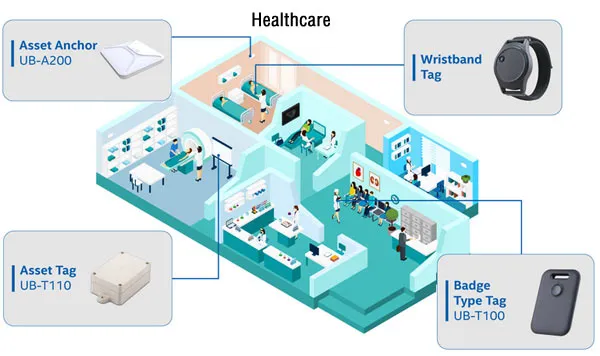
Digitizing and visualizing clinical staff and mobile assets, such as patient movement, equipment status, and staff interactions, provides operational visibility via real-time, reliable IoT technologies. This visibility is realized using hospital-deployed positioning technologies, badge tags, and NFC tags.
With smart technologies, healthcare systems can reduce costs and improve efficiency, assisting clinicians and improving patient experience while enabling the care team to work more intelligently. Healthcare providers can use advanced IoT positioning to obtain real-time locations of critical equipment, patients, and staff to optimize management, streamline workflows, and enable faster responses.
Artificial intelligence and machine learning are enhancing analytics applied to positioning data, which helps to better understand and optimize workflows, improving operational efficiency and patient care. Medical institutions worldwide are adopting these technologies to develop future smart hospitals and to sustain patient and staff confidence.
Clinical workflow applications
Deploying positioning systems in hospitals makes care activities visible and enables data-driven workflow optimization. For example, monitoring can identify the busiest times of day and guide staffing levels for each department. Automated workflow platforms can reduce time spent on handwritten documentation and lower the chance of recording errors.
Custom algorithms can prioritize tasks related to patient care, transport, treatment, and inpatient management. By allocating 100% of staff resources to critical operations during peak times and shifting administrative tasks to off-peak periods, efficiency improves. These measures can raise both patient satisfaction and staff engagement.
Using IoT-enabled badges or signage assigned at patient registration, workflow platforms can provide proactive status updates, estimated wait times, SMS alerts, and dashboards showing staff locations. For example, when a patient is moved out of an operating room to a recovery area, staff can see this in real time and begin preparing the operating room for the next patient. This ensures the team shares consistent, up-to-date information and resolves workflow bottlenecks.
IoT for asset management
About one third of nurses report spending at least one hour per shift searching for equipment, delaying patient care. Asset tracking addresses this by using IoT-enabled smart tags so platforms can provide real-time room-level and precise location data, list equipment locations and usage details, and issue maintenance and cleaning alerts. Once asset tags are attached to required equipment, staff can locate devices within seconds. Ensuring availability and quick retrieval of monitoring equipment is critical for both staff and patients. Automated inventory replenishment helps maintain adequate stock levels. By continuously monitoring inventory, managers can predict utilization, reduce manual counts, and maintain a stable supply of medical devices.
IoT for staff and patient safety
Accidents or violent incidents can occur in hospitals. Using IoT-enabled badges, tags, or RF cards with an emergency button allows staff to trigger discreet real-time alerts that share their precise location. This enables security to respond more quickly. Real-time location, instant alerts, and location updates contribute to a safer environment for staff and patients.
Conclusion
As IoT and positioning technologies are applied in hospital settings, they have shown substantive progress optimizing clinical and operational processes. A comprehensive intelligent positioning solution enhances scalability, making it easier to expand across an organization over time and further improve operations. For many healthcare managers, asset management is just the starting point for digital transformation using real-time location systems.